

Your inherited land is a financial burden until you strategically liquidate it. You’re likely facing complex probate requirements, rising property taxes on a lot you never wanted, and the stress of managing heirs from a distance. If you’re feeling overwhelmed, you aren’t alone. This selling inherited land guide provides the direct path you need to turn that vacant acreage into liquid cash without the traditional headaches. Stop acting like an accidental property manager. Secure a clean exit now and move on with your life.
You’ll learn how to leverage the 2026 step-up in basis rules to minimize your capital gains liability and navigate the specific tax brackets that apply to your income level. We’ll break down the simplified steps to clear your title and avoid the 5.70% average commission rates that eat into your equity. This roadmap covers everything from managing multiple heirs to utilizing a specialized marketplace designed specifically for vacant land parcels. Follow this guide to discover a clear, multi-step strategy to liquidate your property quickly and efficiently.
Key Takeaways
- Navigate the probate process efficiently to clear your title and authorize a legal sale.
- Reset your property’s cost basis to its current market value to minimize or eliminate capital gains taxes.
- Use this selling inherited land guide to identify parcel boundaries and evaluate physical access for accurate pricing.
- Gather drone photography and conduct a Competitive Market Analysis to attract high-intent land buyers.
- List your property on a specialized marketplace to reach land-specific investors without the high costs of traditional realtors.
Understanding the Legal Framework: Probate and Title Transfer
Probate is the mandatory court-supervised process used to authenticate a will and distribute assets. It ensures the property moves from the deceased owner to the rightful heirs. You cannot legally sell the land until the court initiates this process. The court appoints an Executor or Personal Representative to lead the estate. This person carries the fiduciary duty to manage the land sale and sign all necessary closing documents. They act as the primary decision-maker for the estate.
Title represents your legal right to ownership. Buyers and title companies require a “clear title” before any transaction can close. This means the property is free from liens, unpaid taxes, or competing claims from unknown heirs. If the land was held in a Living Trust, you can bypass the court system entirely. A Successor Trustee takes control immediately. This allows for a faster transaction and immediate liquidation without the delays of a judge’s oversight.
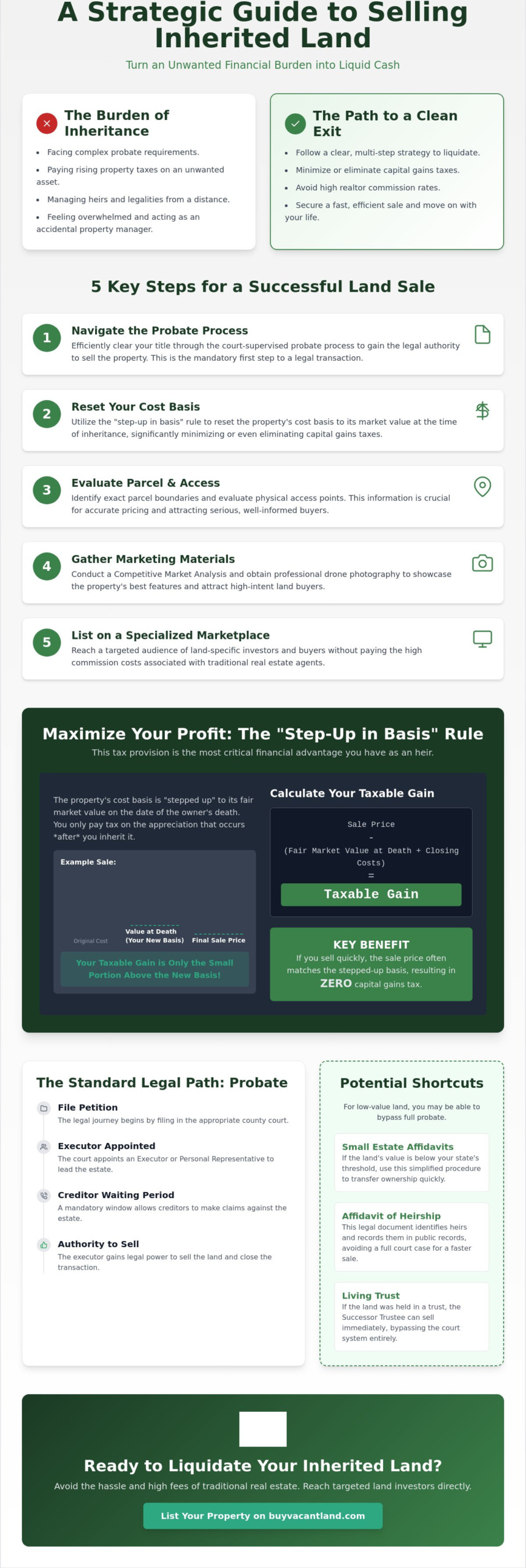
While you handle these legal hurdles, keep the financial benefits in mind. A step-up in basis significantly reduces your future tax liability. This tax rule resets the property’s cost basis to its fair market value at the time of the owner’s death. It ensures you only pay capital gains on the value gained after you inherited the asset. This selling inherited land guide helps you navigate these legal requirements to reach that financial relief sooner.
The Probate Process for Vacant Land
The legal journey begins by filing a petition in the county where the deceased resided or where the land is located. The court then issues Letters Testamentary. This document gives the executor the legal power to sell the acreage and negotiate with buyers. You must also account for a mandatory waiting period. Creditors have a specific window to make claims against the estate assets. Use this selling inherited land guide to stay organized during these procedural delays and avoid common filing errors.
Bypassing Full Probate: Small Estate Affidavits
Full probate is not always a requirement. Low-value vacant land often qualifies for simplified procedures that save time and money. Every state has specific thresholds for “Small Estates.” If the total value of the land falls below this limit, you can use a Small Estate Affidavit to transfer ownership. An Affidavit of Heirship is another efficient tool. It identifies legal heirs and records them in public land records. This strategy avoids a full court case and provides a clear path to a fast sale.
Financial Realities: Taxes and the Step-Up in Basis
Managing the financial side of an inheritance doesn’t have to be a burden. The most critical advantage you have is the Step-Up in Basis rule. This tax provision resets the property’s value to its fair market value at the exact time of the owner’s death. You aren’t taxed on the growth that happened while the previous owner held the land. Instead, you only pay capital gains tax on the appreciation that occurs after you inherit it. This can save you thousands of dollars compared to a standard real estate sale.
To secure this benefit, you need a professional appraisal. Documenting the fair market value at the time of death is essential for your tax records. Without this proof, the IRS may use a lower cost basis, which increases your liability. You should also prepare for property tax reassessments. In many jurisdictions, the transfer of ownership triggers a new valuation. This often leads to higher annual tax bills. This selling inherited land guide recommends acting quickly to avoid these recurring costs. If you want to see what similar parcels are worth today, you can browse current land listings to gauge the market.
The IRS provides specific guidance on taxable income from inherited property to help heirs understand their obligations. Generally, inherited assets are treated as long-term capital gains regardless of how long you personally hold the land. This usually results in a lower tax rate than short-term gains. Following a clear selling inherited land guide ensures you maximize your net proceeds by minimizing these avoidable expenses.
Calculating Capital Gains on Inherited Land
Determining your tax obligation is straightforward. Use this formula to estimate your liability:
- Sale Price – (Fair Market Value at Death + Closing Costs) = Taxable Gain
If you sell the land shortly after inheriting it, the sale price often matches the fair market value at death. This results in zero capital gains tax liability. Speed is your best tool for financial efficiency. The longer you hold the property, the more likely it is to appreciate, creating a tax bill you could have avoided.
Handling Liens and Back Taxes
You must identify hidden debts before listing the property. Conduct a thorough search for unpaid property taxes or utility liens. The executor must settle these estate debts using the proceeds from the land sale. Clear tax records are non-negotiable for a smooth closing. Title companies will not transfer ownership if there are outstanding liens. Verify these records early to prevent your sale from collapsing at the last minute. Efficient liquidation depends on addressing these financial hurdles before they become deal-breakers.
Evaluating Your Inherited Asset: What Are You Actually Selling?
You have the legal authority to sell, but you must now define the physical asset. Start by locating the Assessor’s Parcel Number (APN). This unique identifier is the key to all county records. It reveals the exact boundaries, tax history, and historical plat maps. Without the APN, you cannot provide the certainty buyers demand. This selling inherited land guide emphasizes that clarity on paper translates to speed in the market. Use the APN to pull the latest property report from the county assessor’s office immediately.
Assess physical access before you set a price. Is the land “landlocked,” or does it have paved road frontage? Landlocked parcels require a legal easement to be buildable. If no easement exists, your buyer pool is limited to neighboring owners. Buyers also want to know about infrastructure. Determine if there are “utilities at the lot line” or if the property is strictly “off-grid.” Off-grid status isn’t a deal-breaker, but it changes your target audience. Be direct about what is available to avoid wasted time during negotiations.
Consult a comprehensive guide to selling inherited property to understand how these physical traits impact your overall estate value. Evaluating the land is not just about the dirt; it’s about the rights attached to it. Clear information prevents deals from falling through during the due diligence period. Accurate data is your best tool for a swift transaction.
Zoning and Land Use Restrictions
Zoning determines who will buy your land. Residential zoning attracts individual homebuilders, while agricultural zoning is for farmers or homesteaders. Unrestricted land is currently a high-demand category. Many buyers seek parcels where they can build without strict county oversight. Check for easements that might restrict building. A pipeline or power line easement can render large portions of a lot unusable. Knowing these restrictions upfront allows you to market the land to the right person at the right price.
The Importance of a New Land Survey
Old surveys are often inaccurate or missing for inherited parcels. Boundary lines can shift over decades due to erosion or neighbor encroachment. A fresh survey provides a definitive map that increases buyer confidence. It removes the guesswork and speeds up the title insurance process. When calculating your expenses, factor in the lot survey price to ensure you aren’t surprised at closing. This small upfront cost often pays for itself by preventing boundary disputes that could derail your sale. This selling inherited land guide recommends a new survey for any parcel over five acres or any lot with unclear markers.
Strategic Marketing: How to Price and List Inherited Land
You’ve cleared the title and assessed the acreage. Now you need a buyer. Marketing raw land requires a different strategy than selling a residential home. Forget about interior staging or curb appeal. Land buyers care about utility, access, and price. This selling inherited land guide focuses on the data-driven steps to move your property fast. Using a proven selling inherited land guide allows you to skip the trial and error of traditional real estate.
Visuals are your best sales tool. Use drone photography to capture the entire parcel from above. Buyers need to see the terrain, tree coverage, and surrounding roads. A single photo from the street is not enough for a five-acre lot. Pair these photos with a direct, benefit-driven description. If the land is “Perfect for RVing” or “Ready for a Cabin,” say so immediately. Disclose that this is an inherited property. This transparency explains your motivation for a swift transaction and attracts serious cash buyers who are ready to close.
Pricing for a Fast Liquidation
Compare your lot to other cheap land for sale in your county. If your price is significantly higher than similar parcels, your listing will sit. Follow the “90-day rule.” If you haven’t received a serious offer within three months, your price is too high for the current market. Emotional attachment to a family asset often leads to overpricing. Stick to the numbers to ensure a clean exit and immediate liquidity.
Creating a High-Impact Listing
Follow this four-step sequence to build a listing that converts. First, provide the APN and legal description so buyers can verify records. Second, upload clear photos of the road access and terrain. Third, list on a specialized marketplace that targets land-specific investors rather than home shoppers. Fourth, stay responsive. Buyers will ask about utilities, setbacks, and restrictions. Fast answers build trust and close deals. Ready to start? You can list your vacant land for sale today to reach a national audience of ready buyers.
The Efficient Exit: Why Specialized Land Marketplaces Win
Traditional real estate agents are built for selling houses, not dirt. They prioritize residential listings because the commissions are higher and the sales cycles are more predictable. Raw land often sits at the bottom of their priority list. When you hire a general realtor, your vacant lot is just another listing on a cluttered MLS. This selling inherited land guide recommends skipping the local agent in favor of a platform built specifically for vacant parcels. Specialized marketplaces ensure your land is the main attraction, not an afterthought.
Specialized platforms connect you directly with people who actually want what you have. You aren’t competing with three-bedroom suburban homes for attention. You are reaching a targeted audience of land-specific investors and developers. This direct-to-buyer model cuts out the unnecessary middlemen. By listing on a specialized marketplace, you avoid the 5.70% average real estate commission that typically eats into your inheritance profit. You keep more of the equity while achieving a faster transaction. This is the pragmatic choice for anyone who values time and financial efficiency.
The aura of reliability provided by a specialized platform alleviates the stress of asset ownership. You aren’t just listing a property; you are entering an ecosystem designed for liquidation. This selling inherited land guide highlights that speed is a product of visibility. When your acreage is visible to the right buyers, the path to a clear title and a closed sale becomes significantly shorter. Stop waiting for a local buyer to stumble upon a yard sign. Go where the investors are.
Connecting with Cash Buyers
Inherited land transactions move faster when you avoid the delays of bank financing. Traditional mortgages for raw land are notoriously difficult to secure and often take months to process. Cash buyers eliminate this entire hurdle. Specialized platforms attract professional “land flippers” and “homesteaders” who have liquid funds ready for immediate use. If you want to sell land quickly, you must target these cash-ready participants. They value speed and simplicity over the long-winded appraisals and inspections required by big banks.
Streamlining the Closing Process
The final step of your liquidation should be the most straightforward part. You don’t need to travel to the county where the land is located. Modern title companies handle vacant land transactions through fully remote processes. You can use electronic signatures to execute all necessary documents from your own home. This digital approach is essential for out-of-state heirs managing a sale from thousands of miles away. The title company coordinates the transfer of funds and records the deed with the county. You receive your proceeds via wire transfer without ever setting foot in a corporate office. It is a clean, assured transaction that marks the end of your ownership burden.
Secure Your Financial Exit Now
You now have the tools to turn a complex asset into immediate liquidity. This selling inherited land guide has outlined the essential steps to navigate probate, leverage the step-up in basis for tax savings, and evaluate your parcel’s true market potential. Don’t let a vacant lot become a permanent drain on your finances. You can clear your title and finalize a sale without the high costs of traditional realtors or the typical delays of bank financing.
Efficiency is the key to your peace of mind. Our platform is focused exclusively on vacant land parcels. You get direct access to a national audience of high-intent land buyers through a simple, no-nonsense listing process. List your inherited land on our specialized marketplace today and start the clock on your liquidation. It’s the fastest path to receiving your proceeds and moving on with your life.
You’ve done the hard work of understanding the legal and financial landscape. Now it’s time to act. Secure your financial future and move forward with confidence. You’re ready to complete this transaction and find the relief you deserve.
Frequently Asked Questions
Can I sell an inherited property before probate is completed?
No. You cannot legally transfer the title until the probate court grants you the authority to do so. The executor must receive Letters Testamentary before signing any sale documents. Attempting to sell before this step will cause the title company to reject the transaction immediately.
What happens if there are multiple heirs who disagree on selling the land?
Heirs who cannot agree often face a partition lawsuit. A judge can order the land to be sold and the proceeds divided among all parties. It’s faster and cheaper to reach a private agreement and use a specialized marketplace to liquidate the asset together. Avoid the high costs of legal litigation by cooperating early.
How much tax will I pay when I sell inherited land?
You only pay capital gains tax on the appreciation that occurs after the date of the owner’s death. If you sell the land quickly at its fair market value, your tax liability is often zero. Use this selling inherited land guide to navigate the 2026 tax brackets and minimize your federal obligations.
Do I need a realtor to sell inherited vacant land?
No. You can list the property yourself on a specialized land marketplace. This approach allows you to reach targeted investors directly and avoid the 5.70% average real estate commission. Realtors often lack the specific expertise required for raw land and may prioritize higher-commission home sales over your vacant lot.
What is a “Step-Up in Basis” and how does it help me?
A step-up in basis resets the property’s cost basis to its fair market value at the time of the owner’s death. It effectively wipes out the tax debt on all the appreciation that happened during the previous owner’s lifetime. This is your most powerful tool for maximizing your inheritance profit during a sale.
How do I find out who actually owns the land I inherited?
Search the county recorder’s office records using the Assessor’s Parcel Number (APN). The last recorded deed will show the legal owner of record. If the land was in a trust, the trust documents will identify the current trustee with the power to sell. Clear ownership is the first requirement for any transaction.
What documents do I need to sell inherited land by owner?
You need the death certificate, the probate court order or Letters Testamentary, and a new deed. The title company will also require a valid form of identification for the executor. Having these documents ready prevents delays and ensures a smooth closing process for both parties.
Is selling land different from selling a house after someone dies?
Yes. Land sales focus on zoning, physical access, and utility availability rather than home inspections or interior staging. This selling inherited land guide treats the property as a raw financial asset. You are selling potential and utility to investors rather than a living space to a family.




Join The Discussion