

The average building permit cost in 2026 is $1,688, but the true price of an error is a project that never starts. Many buyers fear purchasing a parcel only to find it’s legally unbuildable. Applying for building permits on raw land involves a maze of local and state regulations that feel designed to slow you down. You’re likely stressed about hidden fees for perc tests or the uncertainty of soil stability. This confusion creates a barrier between you and your development goals.
You need a reliable system to bypass the traditional hurdles. This guide provides a pragmatic, step-by-step framework to master the permitting process in any US county. We’ve simplified the 2026 requirements into a clear document checklist and an actionable timeline for approval. You’ll learn how to identify parcels with existing surveys on BuyVacantLand.com to save time and money. Follow this path to gain the confidence you need to secure your land and start construction without delay.
Key Takeaways
- Confirm zoning feasibility before spending a dollar; if your intended use isn’t allowed, the permit is impossible.
- Secure a professional boundary survey and topographical map to provide the essential data required for every county application.
- Streamline the process of applying for building permits on raw land by obtaining separate grading and land use approvals before submitting final construction drawings.
- Assemble your team of engineers and surveyors early to ensure your site plan survives the rigorous five-step approval workflow.
- Accelerate your timeline by filtering for residential lots that already include utility connections at the property line.
Understanding Raw Land Permitting and Zoning Feasibility
A raw land permit is the legal authorization to alter undeveloped earth for construction. It’s the bridge between a wild lot and a cleared construction site. Without this document, you cannot legally move dirt, remove trees, or pour concrete. Applying for building permits on raw land is a distinct process because the land has no history of development. You are starting from zero.
Zoning is your first and most critical hurdle. If your project doesn’t align with local zoning, your permit is impossible. Most jurisdictions require planning permission to ensure your build fits the community’s long-term plan. You’ll encounter two main types of use: “By-Right” and “Conditional Use.” By-Right means your project follows existing rules; you submit plans and receive approval. Conditional Use requires an exception. This often involves public hearings and adds months of delay to your schedule.
The feasibility period is your best defense against a bad investment. This 30 to 60-day window allows you to research the land’s potential before you finalize the purchase. Use this time to verify that the county will actually issue a permit for your specific vision. Don’t rely on the seller’s word. Verify every claim with the local building department. If the lot cannot support a septic system or lacks legal access, the permit won’t happen.
Zoning Classifications and Your Build
County zoning maps dictate what you can build. Residential zones usually allow for single-family homes. Agricultural zones might require 10 or 20 acres per dwelling. Unrestricted land offers the most freedom, but it’s becoming rare. Locate your parcel on the county GIS map to check for setbacks and easements. Setbacks define how far you must build from property lines. Easements are strips of land reserved for utilities or road access. These factors directly reduce your total buildable area.
The Pre-Purchase Permitting Checklist
Don’t guess; get facts. Contact the local planning department for a “Preliminary Site Review.” A planner will walk through your concept and identify immediate red flags. You should also check for existing violations or liens on the vacant land. Old illegal clearing or grading fines can transfer to you. Finally, ask about impact fees. When applying for building permits on raw land, these one-time infrastructure costs can reach thousands of dollars. On BuyVacantLand.com, look for listings that already include survey info to save time during this research phase.
The Essential Site Studies Required for Permit Approval
Applying for building permits on raw land requires more than just a floor plan. You must prove the site is physically capable of supporting your project. This involves a series of technical studies that verify the land’s health, boundaries, and resource access. Skipping these steps leads to rejected applications and wasted fees. Your permit depends on the data these studies provide.
A boundary survey is your first requirement. It establishes the legal limits of your property and identifies any encroachments. If your land has significant slopes, you’ll also need a topographical map. This map shows elevation changes and helps engineers design a stable foundation. You must also secure utility availability letters. These documents from local water and power companies confirm that service can be extended to your lot. Without these, your permit application is incomplete.
Environmental factors are equally critical. You may need assessments for wetlands or endangered species habitats. If your project disturbs more than one acre, you must often comply with the Construction General Permit guidelines to manage stormwater runoff. These studies protect you from future legal liabilities and environmental fines. Addressing these issues early prevents construction stops later.
Surveying and Mapping Your Land
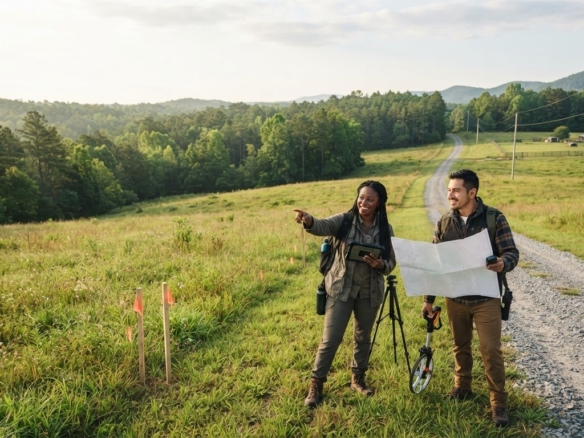
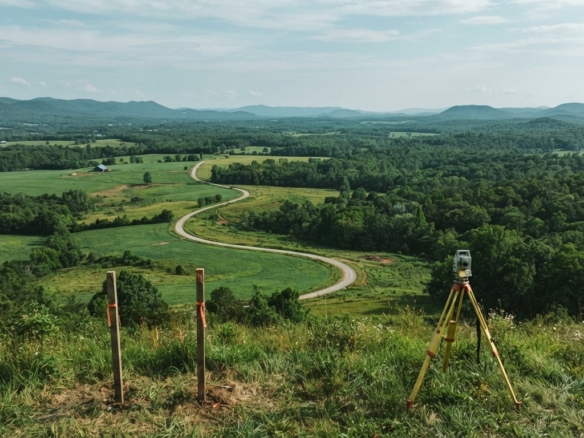
A simple fence-line check isn’t enough for a building permit. Old fences are often misplaced. A professional surveyor uses GPS and historical records to mark exact corners. This data allows you to identify “buildable envelopes,” which are the specific areas where construction is legally allowed after accounting for setbacks. A Site Plan is the bird’s-eye view of all proposed changes, showing exactly where your building, driveway, and utilities will sit on the surveyed land. You can find undeveloped vacant land listings that already include these surveys to speed up your timeline.
Soil and Environmental Testing
The Perc Test is the most important site study for raw land. It measures how quickly water drains through the soil. If the soil fails to drain, you cannot install a traditional septic system. This is the #1 deal-breaker for most rural builds. You must also manage protected areas like floodplains or protected vegetation. Building in a floodplain requires specialized engineering and higher insurance costs. For a deeper look at the research process, read our guide on how do you buy land to ensure your due diligence is airtight.
Common Permit Types for Developing Undeveloped Land
Applying for building permits on raw land is not a single event. It is a sequence of approvals. You cannot secure a master building permit until you have cleared the specific hurdles for site preparation. Each permit addresses a different risk, from environmental damage to public health. You must secure these individual authorizations to move your project from a concept to a construction site.
Your first requirement is often a Land Use Permit. This document confirms that your specific activity is legal for that parcel. You should consult your local Department of Planning and Permitting or the equivalent agency in your county to verify these requirements. Following this, you will need a Grading and Clearing Permit. This allows you to remove vegetation and level the earth. If your land is in a rural area, you must also obtain an Encroachment Permit. This grants you legal permission to connect your private driveway to a public road. Without it, your lot remains landlocked in the eyes of the law.
Every county has its own order of operations. Some allow you to apply for these simultaneously. Others require a strict linear path. Failing to follow the local sequence will result in rejected applications and lost filing fees. Focus on securing your site preparation permits first to avoid delays during the structural phase of your build.
The Septic and Well Permit Process
Rural development usually requires a Septic and Well Permit. The health department manages these, not the building department. They enforce strict minimum distance rules. Your well must typically sit at least 100 feet away from your septic drain field to prevent contamination. If your land fails a standard perc test, don’t panic. You can often apply for an alternative system permit, such as a mound system or an aerobic treatment unit. These systems cost more but make “unbuildable” land functional. Secure these permits before you finalize your architectural plans.
Grading and Erosion Control
Clearing land often requires a permit before the building begins. You cannot simply bulldoze trees. A Grading and Erosion Control Permit ensures you have a plan to manage stormwater runoff. If you strip the land of vegetation without a silt fence or a retention plan, you risk heavy fines. Local timbering restrictions may also apply if you plan to sell the cleared trees. Always verify if your county requires a separate permit for “grubbing,” which is the removal of roots and stumps. This keeps your project compliant and prevents soil from washing into neighboring parcels.
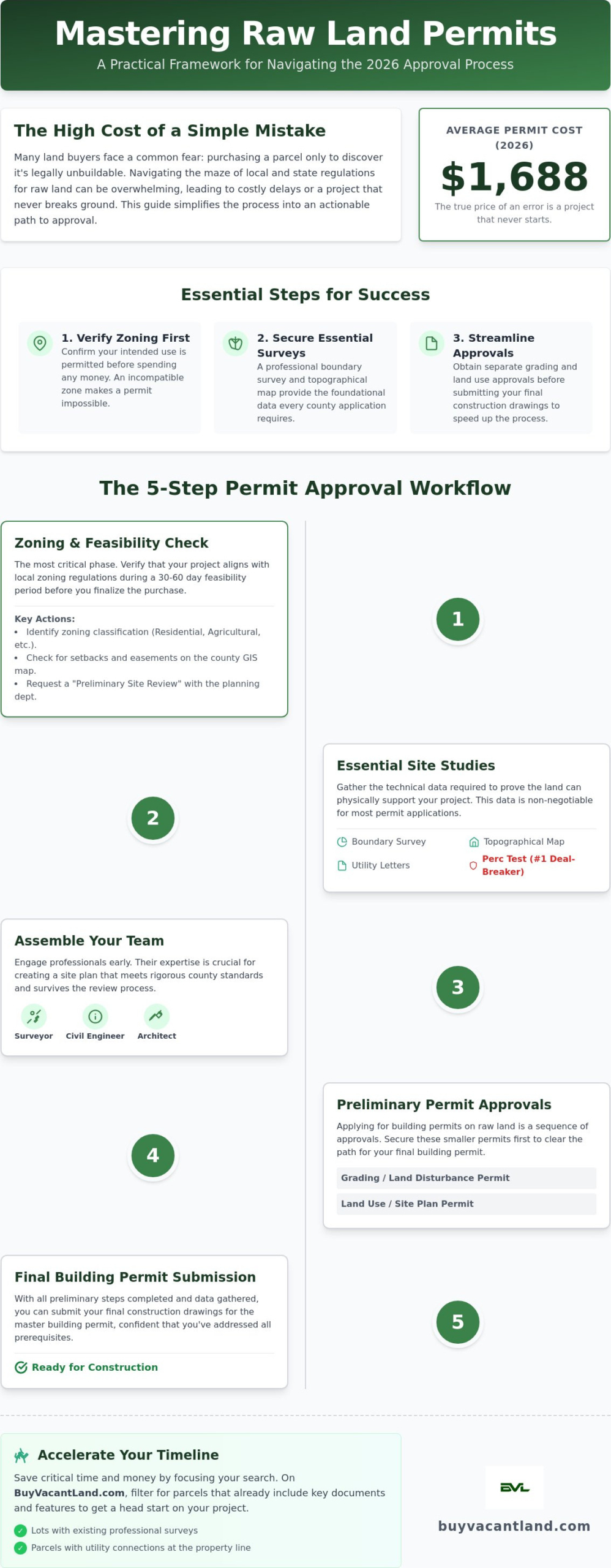
The 5-Step Building Permit Application Workflow
Applying for building permits on raw land requires a precise sequence of actions. The county doesn’t care about your architectural vision; they care about code compliance and safety. If you skip a step, the process stalls. Follow this five-step framework to push your project through the bureaucratic machine without unnecessary delays.
- Step 1: Assemble your professional team. You cannot draw these plans yourself. Hire a licensed surveyor, a structural engineer, and an architect. They provide the technical data and stamped drawings that officials demand.
- Step 2: Submit a complete Site Plan and Construction Drawings. This package is your project’s resume. It must show every structure, utility line, and grading change proposed for the lot.
- Step 3: Pay application fees and enter the Plan Review phase. In 2026, the average building permit cost is approximately $1,688, though new construction permits often reach up to $8,500 depending on the scope.
- Step 4: Address Redlines. These are requested corrections from the county. Don’t take them personally. Address every comment immediately and resubmit the corrected sheets.
- Step 5: Receive your permit and post it. Once approved, you must post the permit visibly on the job site. Construction cannot begin until this document is physically present.
Assembling Your Submittal Package
Incomplete applications are the #1 cause of permit delays. If one signature or one site map is missing, the clerk will reject the entire file. Many developers use a “Permit Runner” to handle this. This professional knows the local clerks and manages the administrative back-and-forth. In 2026, expect digital submittals to be the standard. Most US counties have moved to online portals. Use high-resolution PDFs and follow the county’s specific naming conventions to ensure your files are processed quickly.
Navigating the Plan Review and Inspections
Timelines for review vary by jurisdiction. You might wait 10 days in a rural county or 6 months in a dense urban area. When applying for building permits on raw land, stay proactive. Check the status of your application weekly. When you receive redlines, address them without starting the whole process over by highlighting only the specific changes requested. Once you have the permit, schedule your first foundation inspection. You cannot pour concrete until a county official verifies your footings are deep enough and properly placed. Find residential lots that already have preliminary approvals to skip these early administrative hurdles.
Simplify Your Build: Finding Permit-Ready Land
Finding a permit-ready parcel is the fastest way to break ground. Most developers lose months in the feasibility phase because they start with land that has no infrastructure. You can bypass this stress by selecting land that has already cleared the major bureaucratic hurdles. Look for residential lots that are already platted. This means the county has already reviewed the subdivision and confirmed each parcel is legally buildable. The heavy lifting is done before you ever sign a contract.
Prioritize land with utilities at the lot line. This status removes the need for utility availability letters and expensive extension plans. When applying for building permits on raw land, having power and water ready to tap saves thousands in engineering costs. You won’t have to wait for months while utility companies draft service extensions. Use BuyVacantLand.com to filter for these specific features. Our national marketplace allows you to target parcels that fit your exact development timeline.
Capital management is vital for a successful build. Consider owner financed land to keep your liquid cash available for construction. Permit fees, surveys, and impact fees require upfront capital. If you don’t have to pay the full land price today, you can fund your professional team immediately. This leverage keeps your project moving while others are stuck waiting for bank approvals. It is a pragmatic way to secure your asset without draining your build budget.
Keywords to Look for in Land Listings
Listings with terms like “build-ready” or “utilities at street” indicate a streamlined path. These parcels often have existing surveys on file with the county. Check our guide on cheap land for sale to find affordable lots that already have these technical studies completed. Always verify seller claims by asking for the parcel’s recorded plat map. This document proves the land is legally recognized as a buildable unit. It simplifies the process of applying for building permits on raw land because the lot’s boundaries and access are already verified.
Start Your Search for Buildable Land Today
Buying direct from a seller offers a unique advantage. You can ask about previous permit attempts or soil tests that did not make it into the public record. This transparency saves you from inheriting someone else’s problem. Browse our national inventory and use our lands of america guide to navigate the buying process. Your build starts with the right parcel. Efficiency is the key to profit in real estate development. Browse our latest vacant land listings now!
Take Control of Your Development Timeline
Applying for building permits on raw land doesn’t have to be a source of anxiety. You now have the pragmatic framework to verify zoning, coordinate essential site studies, and navigate the five-step application workflow. Success in real estate development depends on your ability to cut through bureaucratic noise and focus on actionable data. By prioritizing land with existing surveys or utility access, you eliminate the most common hurdles that stall new construction projects.
Stop guessing and start building. BuyVacantLand.com is an exclusively vacant land marketplace that provides direct access to land sellers nationwide. Our platform features a diverse inventory of residential lots, off-grid parcels, and commercial land designed for development. This direct-to-seller model allows you to verify permit potential and utility availability before you commit your capital. It’s the most efficient way to find a site that matches your vision and your timeline.
Find your next buildable lot on BuyVacantLand.com. Your project is within reach when you start with a verified foundation. Secure your land today and build with total confidence.
Common Questions About Permitting Raw Land
Can I apply for a building permit before I own the land?
Yes, you can submit a permit application if you have written authorization from the current property owner. This is a common strategy during the feasibility period to ensure the land is buildable before you finalize the purchase. It protects your capital by verifying that the county will approve your specific project plans before you commit to the land sale.
How much do building permits cost for raw land in 2026?
In 2026, the average cost for a building permit is approximately $1,688. Simple permits for minor work may start as low as $150, but permits for a new house typically range between $1,000 and $3,000. Complex construction projects or large-scale developments can reach fees up to $8,500 depending on the specific county and project valuation.
What is a perc test and why do I need one for a permit?
A percolation test measures how quickly soil absorbs water to determine if a site can support a septic system. Applying for building permits on raw land in rural areas requires this test to prevent environmental contamination. If the soil fails to drain properly, the county will deny a standard septic permit, forcing you to install a more expensive alternative system.
How long does it take to get a building permit for a new home on vacant land?
Approval timelines generally range from 10 days to 6 months. Rural jurisdictions with lower application volumes often process requests within two weeks. In contrast, urban centers with complex zoning codes and high backlogs can take several months. Your speed of approval depends entirely on the accuracy of your site plans and the responsiveness of your professional team.
Do I need a permit to clear trees from my own land?
You usually need a grading or clearing permit before removing significant vegetation for construction. Local ordinances often protect specific tree species and require erosion control plans to manage stormwater runoff. Clearing land without these authorizations can lead to heavy fines and immediate stop-work orders that stall your entire development timeline.
What happens if I build on raw land without a permit?
Building without a permit results in severe financial and legal consequences. The county will issue stop-work orders and levy daily fines until you comply. In extreme cases, officials can force you to demolish unauthorized structures at your own expense. Furthermore, unpermitted work makes the property uninsurable and nearly impossible to sell to future buyers.
Can a building permit application be denied?
Yes, applications are frequently denied for zoning non-compliance or incomplete engineering data. If your project violates setback rules or fails to meet the current building code, the clerk will reject the submittal. You must address all “redline” corrections from the plan reviewer and resubmit the drawings to move forward with your construction.
Do I need a separate permit for a septic system and a well?
Yes, septic and well permits are separate from your structural building permit and are typically managed by the local health department. Applying for building permits on raw land requires coordinating between multiple agencies to ensure all utilities meet safety standards. You must secure these health permits before the building department will issue a final permit for your home.


Join The Discussion