

Finding a perfect parcel of raw land is exciting. Realizing it has no street address is frustrating. Most people stop their search because they don’t know how to find out who owns vacant land without a physical mailbox. They assume the data is hidden or the county records are too old to navigate. This is a mistake. Every inch of land in the United States belongs to someone, and that information is public record. You just need a reliable system to access it. You want a name, not a mystery.
This 2026 guide provides the exact steps to identify any landowner using modern GIS tools and digital public records. It’s about moving past confusing legal descriptions and outdated databases to secure a verified mailing address. You want to stop guessing and start contacting the right person. We’ll walk through parcel maps, assessor data, and ownership verification. You’ll gain the certainty needed to move from discovery to making a firm offer on undeveloped property. Master these tools today and gain the peace of mind that comes with accurate data.
Key Takeaways
- Access public records in any of the 50 states to find legal owner information. It’s your right to know who owns the property.
- Use interactive GIS maps to identify parcel boundaries when a physical address isn’t available. These tools connect specific land plots to official county data.
- Master how to find out who owns vacant land by cross-referencing Tax Assessor files with the County Recorder’s office. This ensures you have the most current contact info.
- Verify ownership history through Warranty Deeds or Quitclaim Deeds at the County Clerk’s office. This step protects your interests before you initiate a deal.
- Transition from research to action by preparing a direct, professional offer once you’ve secured a verified mailing address.
The Foundation of Property Ownership: Navigating Public Records
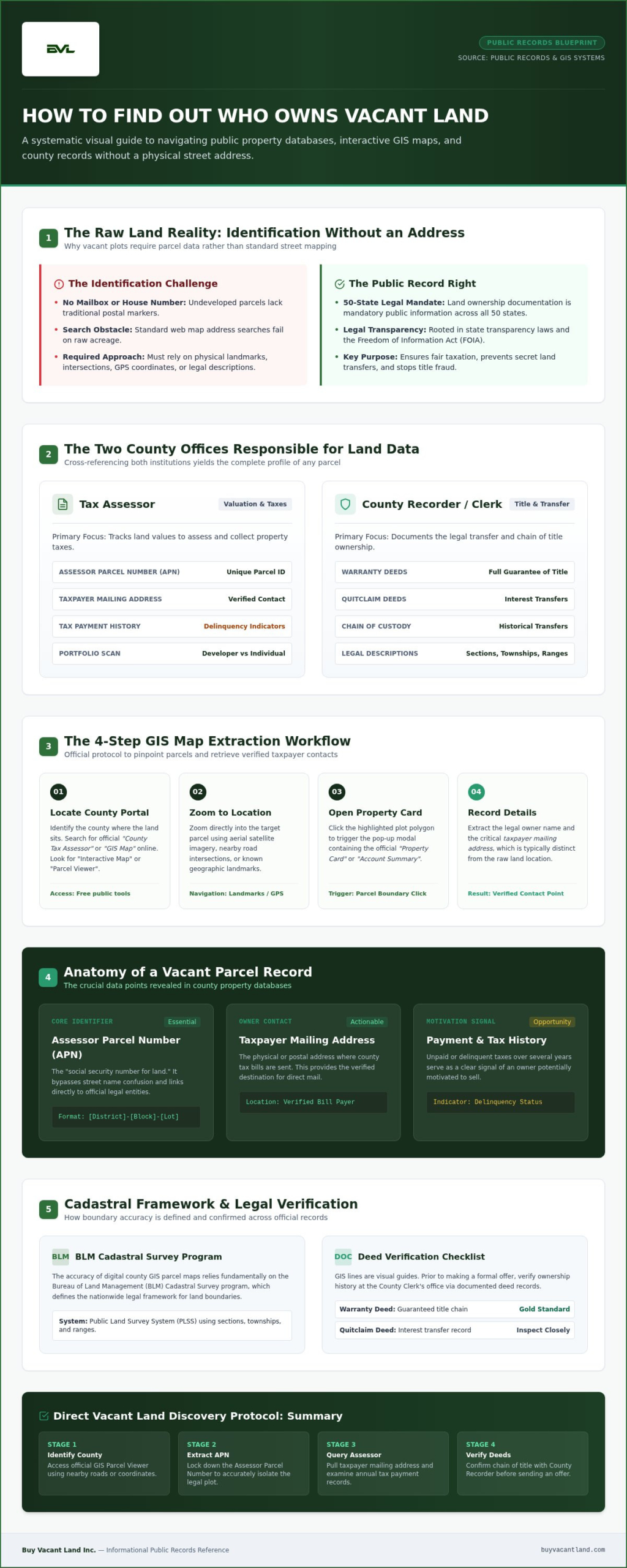
Every acre of land in the United States is documented. Laws in all 50 states mandate that property ownership is public information. This transparency isn’t a suggestion; it’s a legal requirement. It ensures fair taxation and stops land fraud before it starts. If you want to know how to find out who owns vacant land, you must understand the two primary offices involved. The Tax Assessor tracks the value of the land to collect taxes. The County Recorder or Clerk of Deeds documents the legal transfer of the title. These offices work together to create a verifiable chain of ownership. You have a legal right to this data under transparency laws and the Freedom of Information Act (FOIA). Use this right to bypass gatekeepers and get the facts directly from the source.
Why Land Ownership Data is Publicly Accessible
Public access to land data protects your interests. It allows you to perform a property title search to confirm a seller actually owns what they’re selling. This process establishes a clear chain of custody. Without this transparency, boundary disputes would be impossible to settle. You can view parcel data for due diligence at any time. This access prevents secret land transfers and ensures that every taxpayer contributes their fair share. It’s a system built on accountability and open records. You don’t need a special license to view these documents. They belong to the public and remain accessible to anyone willing to look.
The Unique Challenge of Identifying Vacant Parcels
Raw land rarely has a mailbox or a street number. You can’t just look up a house address on a standard map. This is the primary hurdle when learning how to find out who owns vacant land. You must rely on physical landmarks, nearby road intersections, or GPS coordinates to narrow your search area. Most county databases prioritize the Legal Description over a physical address. This description uses a system of sections, townships, and ranges to pinpoint the exact location. Once you find the unique Parcel ID or Assessor’s Parcel Number (APN), the owner’s name is easy to retrieve. Focus on the parcel number rather than the street name. It’s the most reliable way to identify undeveloped acreage accurately and quickly.
Locating Owners via County Tax Assessor and GIS Maps
Every county in the United States maintains a digital portal for property data. Your first step is to identify the specific county where the land sits. Search for the “County Tax Assessor” or “GIS Map” on any search engine. Most counties provide these interactive tools for free. They are the most direct way to solve the puzzle of how to find out who owns vacant land. Once you are on the official site, look for terms like “Interactive Map” or “Parcel Viewer”. These platforms display the geographical boundaries of every registered plot.
Follow these steps to extract data from a GIS map:
- Identify the county and open their official GIS viewer.
- Zoom into the parcel location using satellite imagery or nearby intersections.
- Click the parcel to open the “Property Card” or “Account Summary”.
- Record the owner name and the taxpayer mailing address.
The GIS tool is a visual database. Zoom into the specific area using local roads or coordinates as a guide. When you click on a specific plot, a window will pop up. It contains the legal owner’s name and, crucially, their taxpayer mailing address. This address is often different from the physical location of the land. It’s the verified contact point for the person who pays the bills. The accuracy of these maps relies on the Bureau of Land Management Cadastral Survey program, which defines the official framework for land boundaries across the country.
Searching by APN (Assessor Parcel Number)
The Assessor Parcel Number (APN) is the social security number for land. It is the most reliable identifier available. If you have the APN, you can skip the visual search and enter it directly into the search bar. You can find the APN by clicking the parcel on the GIS map. It usually appears at the top of the property profile. Use this number to ensure you are looking at the correct legal entity. Boundary lines on GIS maps are generally accurate, but you should always cross-reference them with the legal description to avoid errors.
Navigating Online Tax Databases for Owner Info
Tax databases reveal more than just a name. You can search by the owner’s name to see if they own other properties in the same county. This helps you determine if they are a professional developer or an individual owner. Check the payment history. Delinquent taxes are a strong signal of a motivated seller. If the owner hasn’t paid taxes in several years, they might be ready for a direct offer. Download the official tax statement. It provides the most current, verified mailing address on record. Once you have this data, you can look for similar undeveloped vacant land listings to compare values and market activity.
Alternative Discovery Methods: Deeds, Title Companies, and Neighbors
Digital GIS maps are fast, but they don’t always tell the full story. Sometimes, the online database is lagging or the parcel data is incomplete. You need to verify the owner through physical records or professional assistance. Go to the County Clerk or Registry of Deeds. These offices house the actual legal documents that prove ownership. If you want to know how to find out who owns vacant land with absolute certainty, the deed is the gold standard. It overrides the tax bill. You can request a copy of the most recent Warranty Deed or Quitclaim Deed for a small fee. These documents list the “Grantee,” who is the current legal owner. They also provide the owner’s legal name and often their primary residence address.
Searching the Chain of Title and Deeds
A deed search reveals the history of the land. You can trace ownership back through decades of historical transfers. This process confirms the current status and ensures the seller actually has the right to transfer the property. Look for corporate names versus individual names. If a corporation owns the land, you must search the Secretary of State records to find a registered agent. Be alert for liens or encumbrances listed in the records. These legal claims can stall a sale. Reviewing the Legal Information Institute’s title search overview helps you understand how these public records establish ownership integrity. It protects you from land fraud and title defects.
Working with Title Professionals for Verified Reports
Hire a title company when the ownership situation is complex. They offer “Property Profiles” or “Trio” packages. A Trio includes the current deed, a tax map, and a property profile. This package gives you everything needed to start a deal. Professional title reports are guaranteed. They identify every person or entity with a legal claim to the acreage. You can also ask a real estate agent to pull “tax rolls” for a specific area. This is a fast way to get a list of owners for multiple parcels at once. Use these professional tools to save time and avoid data errors.
Don’t overlook the power of local knowledge. Talk to adjacent landowners. Neighbors often know the history of the vacant lot next door. They might know if the owner recently passed away or if the land is tied up in an estate. This is a pragmatic way to find off-market leads before they hit the public databases. Ask specific questions about who maintains the property or who has visited the site recently. This boots on the ground approach provides context that a computer screen cannot offer. It turns a cold search into a warm lead for off grid land or residential lots.
Modern Digital Tools and Advanced Skip Tracing Strategies
Manually searching county records is slow. Professionals use paid land data platforms to aggregate information into a single dashboard. This is the most efficient way to learn how to find out who owns vacant land when you’re looking at multiple properties at once. These platforms pull data from thousands of counties instantly. You get the owner’s name, taxpayer address, and parcel history without visiting multiple government sites. It’s about speed and data accuracy. You want the facts without the procedural hurdles of 50 different county websites.
Utilizing National Land Data Aggregators
National aggregators simplify complex searches for active investors. These tools allow you to overlay zoning data directly onto ownership records. You can see if a parcel is designated for residential or industrial use while simultaneously identifying the owner. Use built-in filters to find “Absentee Owners.” These individuals own property but live in a different state. They’re often more likely to entertain a fair offer because they don’t use the land. This strategy is a proven method for finding cheap land for sale before it hits the open market. You get a direct line to motivated sellers without the competition.
Skip Tracing for Direct Contact Information
Skip tracing turns a name into a conversation. Use these tools to find phone numbers and email addresses for owners who don’t live on the property. If an LLC owns the land, find the registered agent through the Secretary of State website. Then, skip trace that individual. Always cross-reference your findings to ensure you’re contacting the right person. Professionalism is key. Avoid aggressive tactics that look like spam. Follow all Do Not Call (DNC) rules and local privacy regulations to maintain your credibility.
Direct mail remains a powerful tool for land acquisition. Send a formal Letter of Intent (LOI) to the taxpayer mailing address you found in the public records. Be clear and punchy. State your interest in the specific parcel and provide your contact information. This approach is less intrusive than a cold call and often yields higher-quality responses from serious sellers. It provides the owner with a physical document they can review on their own time. Once you have identified a parcel and verified the data, you can buy vacant land with total confidence. Start your search with the right tools and move from research to ownership faster.
From Identification to Acquisition: Making the Offer
Identification is the first step. Acquisition is the goal. You’ve mastered how to find out who owns vacant land, so now you must verify the seller’s legal standing. A name on a tax record doesn’t guarantee a clear title. Perform a final check to ensure no undisclosed liens or probate issues exist. This due diligence saves time and prevents legal headaches. Move forward only when you’re certain the seller has the sole authority to transfer the deed. Knowing how to find out who owns vacant land gives you a massive advantage, but you must use that data to secure a legal commitment.
Drafting a Professional Off-Market Offer
An off-market offer should be concise. Avoid complex legal jargon that scares off individual sellers. Focus on providing an equitable financial proposal that respects the owner’s time. Emphasize the total absence of common transactional costs or service fees to make your offer more attractive. Use this simple sequence to move toward a close:
- Present a direct purchase price based on current market data.
- Define a clear closing date, typically within 30 to 45 days.
- Include a feasibility period for final inspections and zoning checks.
The feasibility period is non-negotiable for raw land. It gives you time to verify legal access and soil quality. If the land doesn’t meet your needs, you can back out without penalty. This protects your capital while you perform necessary due diligence. For a step-by-step breakdown of the transaction process, see our guide on how do you buy land? to ensure you follow the correct legal path.
Leveraging Specialized Marketplaces for Comparable Value
General real estate sites fail when it comes to undeveloped acreage. They lack the specific data points needed for a fair assessment. Use a focused platform like BuyVacantLand.com to find comparable sales in the same region. This data allows you to gauge fair market value with precision. You’ll see what active buyers are actually paying for farms and ranches or residential lots. This knowledge gives you leverage during negotiations. You can present a data-backed offer that reflects the current 2026 market reality. Once you secure the deed, you can list your own undeveloped vacant land on the same platform to reach a national audience of cash buyers.
Take Control of Your Land Search Today
Mastering the use of GIS maps and verifying ownership through official deeds removes the mystery from undeveloped property. You’ve now gained the system to identify any owner and skip trace their contact information with precision. This data-driven approach replaces guesswork with verified facts. Understanding how to find out who owns vacant land is the difference between a missed opportunity and a closed deal. Every parcel has an owner, and now you know exactly how to reach them.
Instead of doing all the research yourself, visit a marketplace built for efficiency. Browse Verified Land Listings on BuyVacantLand.com to find your next property. We offer national coverage across the United States and a direct-to-seller platform focused exclusively on vacant land. You have the tools and the knowledge. Take the final step toward ownership now. Your next investment is waiting for a professional offer.
Frequently Asked Questions
Is it free to find out who owns a property in the US?
Viewing public records online through county GIS maps or tax assessor portals is typically free. Most jurisdictions allow you to search for the owner’s name and taxpayer address at no cost. You might encounter a small fee if you require official certified copies of deeds or historical title documents from the County Recorder. Accessing basic ownership data is a legal right designed to ensure transparency in real estate transactions.
How do I find the owner of a vacant lot without a street address?
Use the local county’s interactive GIS map to locate the parcel visually. Zoom into the satellite view using nearby road intersections or physical landmarks as your guide. Once you click on the specific plot, the system will display the unique parcel number and the legal owner’s name. This visual method is the most reliable way to solve how to find out who owns vacant land when a physical mailbox doesn’t exist.
What is an APN and why does it matter for land searches?
An APN is the Assessor’s Parcel Number. It is a unique identifier assigned to every piece of real estate by the local government. This number acts as a social security number for the land. It is essential because it links the physical ground to the legal records. Using an APN ensures you are researching the correct boundaries and ownership data rather than relying on vague descriptions or approximate map locations.
Can I find a property owner by their name alone?
Most county tax assessor websites allow you to search records by the owner’s name directly. This search reveals all land holdings that a specific person or entity owns within that county. It is a pragmatic tool for identifying if a seller owns multiple farms and ranches or industrial lots. Always verify the middle initial or company suffix to ensure you have identified the correct individual before sending an offer.
What should I do if the owner listed in tax records is deceased?
You must search the local probate court records to identify the executor or the legal heirs of the estate. The person currently listed on the tax bill may no longer have the legal authority to sign a deed. Contacting the executor is the only way to move forward with a valid purchase agreement. This step is critical to ensure your title remains clear and the transaction is legally binding for all parties.
Are property records private in some US states?
Property ownership is a matter of public record in all 50 states. While some states are “non-disclosure” jurisdictions regarding the final sale price, the owner’s name and the legal description remain accessible to the public. You can always find this information through the county recorder or tax assessor’s office. Transparency in land ownership is legally mandated across the country to prevent fraud and to ensure that property taxes are assessed fairly.
How do I contact a land owner if they live out of state?
Use the taxpayer mailing address found in the official county records. This address is where the owner receives their tax bills and is typically their primary residence. Send a professional letter of intent to this location to start a conversation. If you need a faster response, use a skip tracing service to find a verified phone number or email address associated with that specific name and mailing history to initiate direct contact.
Can a title company find a property owner for me?
A title company can perform a formal search to identify the legal owner and any existing liens on the property. Request a “Property Profile” or a “Trio” package. This professional report provides the current deed, tax status, and a parcel map. While this service might require a small fee, it offers the highest level of certainty before you commit to an off-market offer on undeveloped vacant land or residential lots.



Join The Discussion