
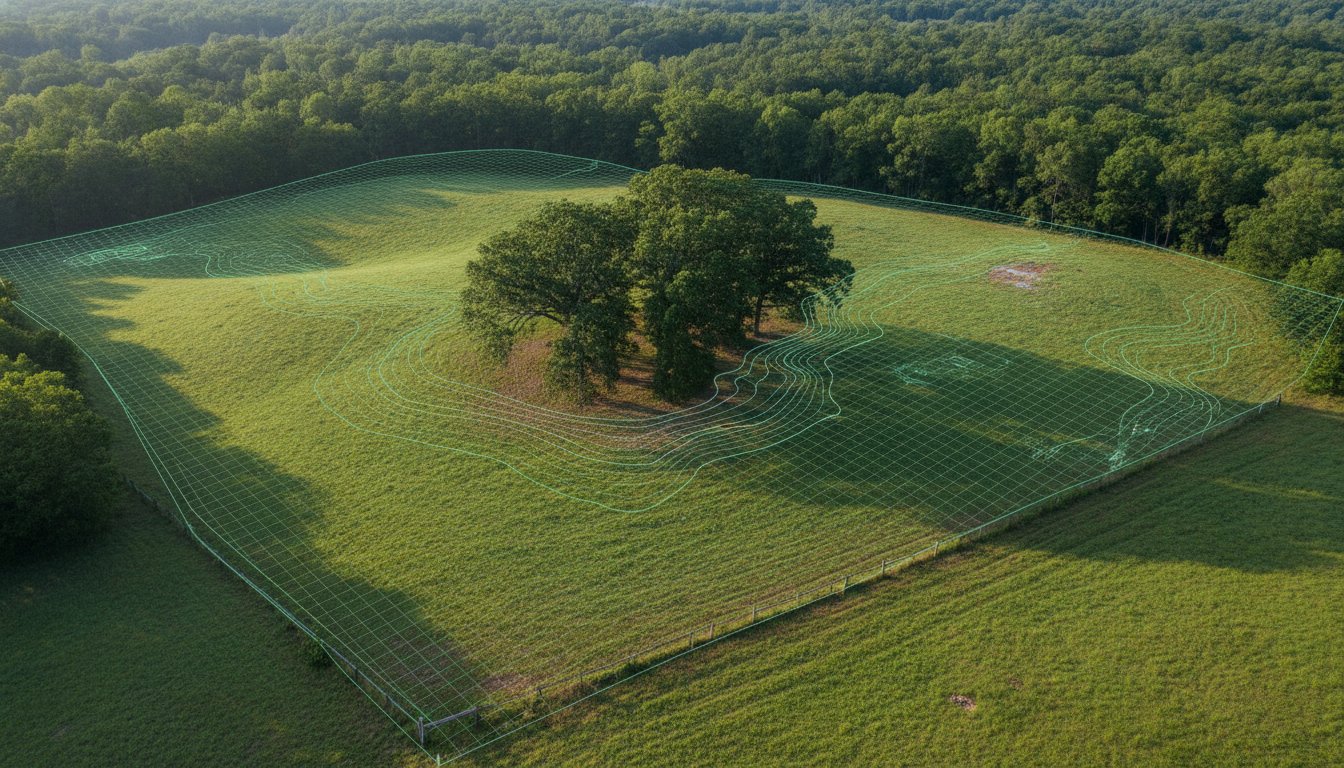
Raw land prices surged by 86.5% since 2019, yet many owners still rely on guesswork when setting a listing price. This lack of strategy leads to properties sitting on the market for years or selling for far less than their actual market value. You likely feel the pressure of getting it right. It’s difficult to find reliable comparable sales for a patch of dirt, and the fear of leaving money on the table is real. Zoning laws and utility access add layers of confusion that make a simple valuation feel impossible.
This guide changes that by showing you exactly how to value vacant land using the pragmatic methods professional investors use to secure fast, profitable deals. We’ll strip away the complexity and focus on the data that matters in the 2026 market. You will learn to calculate your property’s “Highest and Best Use,” account for current inventory shortages, and navigate new federal reporting requirements. We provide a clear path to a definitive dollar figure so you can list with total confidence and move on to your next project without delay.
Key Takeaways
- Identify the four core pillars of land value to establish a realistic baseline for your property.
- Master the sales comparison approach to learn how to value vacant land by analyzing actual sold data from the last year.
- Evaluate how zoning restrictions and utility access costs act as the ultimate ceiling or floor for your listing price.
- Use the land extraction method to calculate accurate values in developed areas where recent vacant sales are scarce.
- Apply a “Testing Price” strategy to validate your valuation against real market demand and ensure a fast sale.
What Determines Vacant Land Value? The Core Drivers
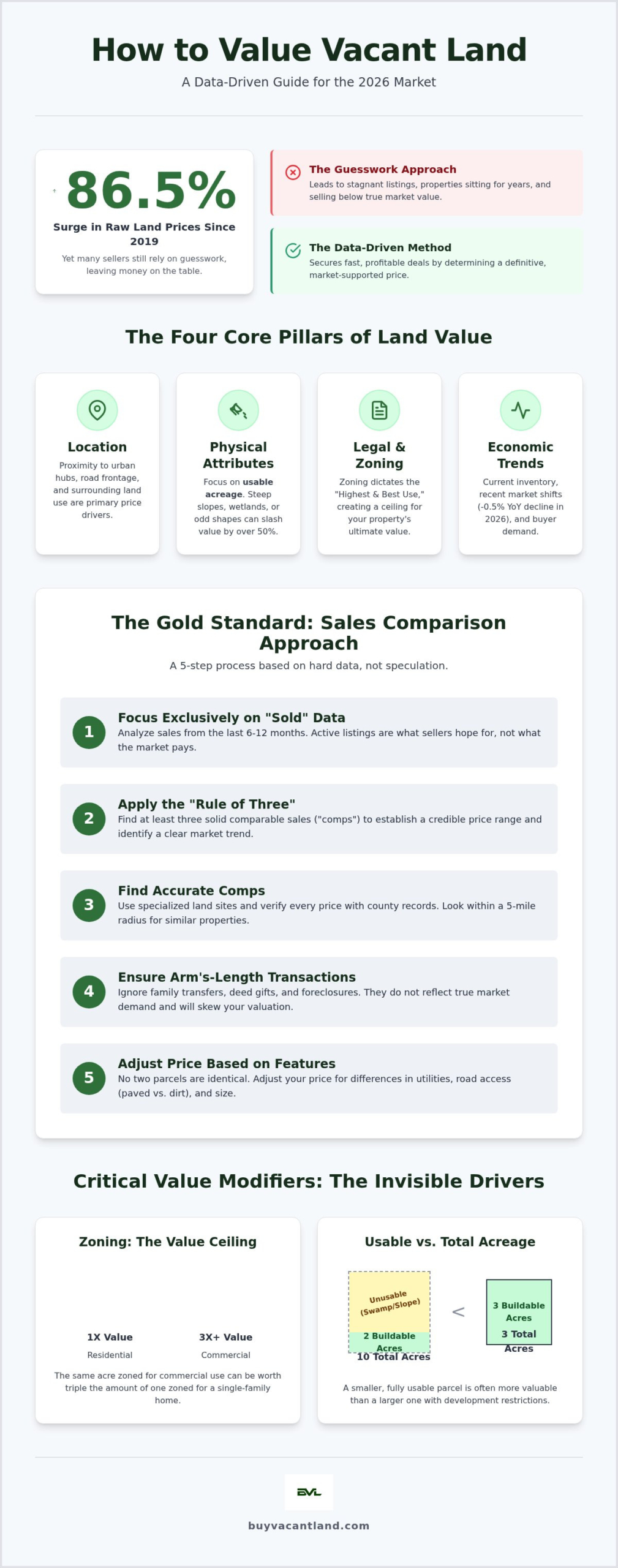
Land value isn’t a fixed number on a spreadsheet. It’s the final price a willing buyer pays in a competitive, open market. Understanding how to value vacant land starts with identifying the four pillars: location, physical attributes, legal constraints, and economic trends. Professional investors always determine the “Highest and Best Use” (HBU) before making an offer. This concept identifies the most profitable, legal, and physically possible use for the dirt. If your land is zoned for a skyscraper but sits in a swamp, its HBU changes, and so does its price.
Don’t confuse market value with assessed value. Tax assessors use mass appraisal techniques to estimate value for property taxes. This number rarely reflects what a buyer will pay today. A formal real estate appraisal provides a much tighter estimate by focusing on current market conditions rather than historical tax data. Relying on assessed value often leads to overpricing and stagnant listings. Smart sellers look at what people are actually spending, not what the government says they owe.
Location and Accessibility
Proximity drives price. Land near expanding urban hubs or popular natural amenities commands a premium. Accessibility is a non-negotiable factor. A parcel with extensive road frontage is worth significantly more than a landlocked one. If a buyer can’t get a truck or a bulldozer onto the site without a legal battle over easements, the value drops. Look at surrounding land use as well. A residential lot next to a noisy industrial park has a lower ceiling than one bordering a protected forest. The neighborhood’s trajectory determines your property’s future potential.
Size, Shape, and Topography
Total acreage tells only half the story. Buyers pay for usable acreage. Steep slopes, rocky outcrops, or protected wetlands can slash property value by 50% or more because they increase construction costs. Usable land is the area remaining after you subtract setbacks, easements, and environmental restrictions. A 10-acre parcel with only two buildable acres is often worth less than a flat, three-acre lot with full utility access. Shape matters too. Narrow, “bowling alley” lots are harder to develop and often sell at a discount compared to square or rectangular parcels. Efficiency in design equals higher value for the developer.
The Sales Comparison Approach: A 5-Step Valuation Process
The Sales Comparison Approach (SCA) is the most reliable way to determine market value for residential or recreational parcels. It’s the gold standard because it relies on cold, hard facts rather than speculation. When learning how to value vacant land, you must focus exclusively on “Sold” data from the last 6 to 12 months. Active listings represent what sellers hope to get, not what the market actually pays. In early 2026, land prices saw a slight year-over-year decline of 0.5% after years of rapid growth. This shift makes recent data more critical than ever.
Professional investors rely on the “Rule of Three.” You need at least three solid comparable sales (comps) to establish a credible price range. One high sale might be an outlier. Three similar sales define a trend. This method aligns with Traditional Methods and New Approaches to Land Valuation, which emphasizes the importance of market-derived data over theoretical estimates. Using fewer than three comps leaves you vulnerable to pricing errors that can stall your sale for months.
Finding Accurate Comparable Sales
Start your search on specialized land marketplaces rather than generic residential sites. Generic sites often lack the granular detail needed for raw land. Verify every transfer price through county records or local GIS maps. Ensure every sale was an “arms-length” transaction. This means the buyer and seller were unrelated and acting in their own self-interest. Ignore family transfers, deed gifts, or forced foreclosures. These transactions don’t reflect true market demand and will skew your final number. Look for properties sold within a five-mile radius that share similar zoning and terrain.
Adjusting Price Based on Features
No two parcels are identical. You must adjust your price based on specific features. Utilities are the biggest factor. A lot with power at the property line is worth significantly more than a remote site requiring miles of infrastructure. Size also plays a counterintuitive role. Because of the “plottage” effect, two 5-acre lots often sell for more than a single 10-acre parcel. Smaller lots attract a larger pool of buyers, which drives up the price per acre. Finally, look at the road access. Paved road frontage commands a premium over gravel or dirt roads. If you want to see how your property stacks up against current competition, you can list your land on a specialized marketplace to gauge real-time buyer interest and refine your strategy on how to value vacant land for a fast exit.
Zoning and Utilities: The Invisible Value Drivers
Zoning is the invisible ceiling of your property’s worth. It dictates exactly what a buyer can build. If you want to know how to value vacant land, you must start at the local planning office. A residential lot might be worth a specific baseline, while the same acre zoned for commercial use could fetch triple that amount. Density is the primary lever here. One single-family home per acre offers less profit potential than a parcel zoned for four townhomes. Buyers calculate their return on investment based on these legal limits.
Raw land value is essentially a math problem: finished value minus development costs. Most sellers ignore this “cost-to-develop” factor. If municipal water is half a mile away, a developer faces massive trenching fees. These costs come directly out of your asking price. A lot with a pre-approved septic permit or an existing well is a “plug-and-play” asset. It removes risk for the buyer and justifies a higher price point. If you haven’t verified these details, you are guessing at your value.
Decoding Zoning Classifications
Residential, commercial, and agricultural labels carry different price tags per acre. Agricultural land is often the baseline price. Residential lots command more due to infrastructure proximity. Commercial vacant lots sit at the top of the hierarchy. If your land is “unrestricted,” you have a powerful selling point for buyers seeking off-grid land or industrial land. These buyers value freedom from strict building codes and HOA oversight. Always check the density allowances to see how many units the land can support.
The High Cost of Utilities
Distance to power is a critical metric. Calculate the distance to the nearest transformer. Utility companies often charge by the foot to drop new lines. In 2026, broadband and fiber optic access have become essential value drivers. Remote workers won’t look at off-grid land if they can’t attend a video call. Piped water and sewer are ideal. In rural areas, a “perc test” for septic is the gold standard for proving buildability. Without it, your land is just dirt; with it, it’s a homesite.
Check your title for easements and encumbrances. A utility company’s right-of-way can prevent building on the best part of your lot. These legal restrictions devalue the property because they limit the usable footprint. Disclose these early to maintain trust and keep the transaction moving fast. Understanding how to value vacant land means looking past the grass and trees to the legal and physical infrastructure beneath.
The Land Extraction Method for Developed Areas
Finding recent sales for raw dirt is impossible in fully developed neighborhoods. When no vacant lots have sold nearby, you must use the Land Extraction Method. This technique treats the property as a whole and then subtracts the value of the improvements. The formula is simple: Total Property Value minus Depreciated Building Value equals Land Value. This method provides a logical way to determine how to value vacant land when traditional comps don’t exist. It’s a vital tool for identifying cheap land for sale in transitioning urban areas where the structure adds little value compared to the lot itself.
Developers use a similar logic called the “Residual Value” concept. They calculate the total revenue a finished project will generate. From that total, they subtract all construction costs and their necessary profit margin. The amount left over is the maximum they can pay for the land. If your asking price exceeds this residual value, the property will sit. Understanding how to value vacant land from a developer’s viewpoint ensures you price your property for a swift transaction rather than a long wait.
Calculating the Building Component
Start by estimating the cost to rebuild the existing structure at today’s 2026 labor and material rates. You aren’t looking for the original cost. You need the current replacement cost. Next, subtract depreciation based on the building’s age and physical condition. A house with a failing roof and outdated electrical systems has high depreciation. The remaining figure represents the building’s current contribution to the total property value. When you remove this from the total sales price, you are left with the “Site Value” as if the lot were vacant and ready for new construction.
The Developer’s Perspective
Professional buyers distinguish between “Raw Land” and a “Finished Lot.” A finished lot already has roads, utilities, and drainage in place. Raw land requires massive capital investment before a single brick is laid. The 25% Rule serves as a common benchmark in the industry. It suggests that land costs should not exceed 25% of the total value of the new construction. Professional buyers always subtract entitlement risk from the final price. This risk covers the uncertainty of obtaining permits or facing community opposition. If you want to bypass the math and get your property in front of serious buyers, list your parcel on our specialized land marketplace to see what developers are actually willing to pay today.
Pricing Your Land for a Competitive Marketplace
Exposure is the best tool to validate your valuation. Generic real estate sites focus on bedrooms and bathrooms. They aren’t built for raw land. Listing on a specialized platform ensures your property reaches serious investors looking for residential lots or commercial vacant lots. This targeted exposure, often from professional firms like Covenant Properties, proves your price point through actual offers rather than theoretical estimates.
Sentimental value is a liability. The market doesn’t care about your family history with the property. It cares about the “Highest and Best Use.” If your property sits on the market for months without an inquiry, your price is the problem. Watch the “Days on Market” metric closely. High numbers signal to buyers that a property is flawed or overpriced. It’s better to price correctly at the start than to chase the market down with repeated price cuts.
Consider a “Testing Price” strategy. List your property at 90% of its estimated market value. This approach creates a sense of immediate opportunity. It often sparks bidding wars that drive the final price above your original estimate. In a stabilized market where inventory remains 23.6% lower than 2019 levels, a competitive entry price is your most powerful weapon for a fast exit.
Listing for Maximum Exposure
High-quality listings justify your price. You must sell the “capability” of the land. Use drone photography to show the terrain, road frontage, and boundaries. Include a clear plat map to prove legal access. Buyers in 2026 place a high emphasis on transparency. Proving your land is build-ready or suitable for off-grid land use adds immediate credibility to your asking price and reduces buyer friction.
Don’t leave your sale to chance. If you are ready to sell, list your vacant land on our national marketplace to reach active buyers today. Our streamlined process connects you directly with people looking for everything from farms and ranches to industrial land. We specialize in raw land only. This focus ensures your property gets the professional attention it deserves without the distraction of residential home listings. Understanding how to value vacant land is only half the battle; real market exposure completes the transaction.
Take Control of Your Land Sale Today
You now have the tools to move from guesswork to a data-driven listing price. By analyzing the four pillars of value and applying the sales comparison approach, you’ve mastered the professional methods of how to value vacant land. You understand that zoning defines your price ceiling and utility access determines your development floor. These insights protect you from leaving money on the table or letting your property sit for years without an offer.
The final step is testing your valuation in the real world. A price on paper only becomes reality when a serious buyer signs the contract. List your land for sale on BuyVacantLand.com to reach a national audience of land-specific investors. Our marketplace focuses exclusively on raw land, so your parcel never competes with residential home listings. We connect you directly with buyers looking for off-grid lots, farms, and commercial parcels. There are zero hidden service fees for buyers, which makes your listing more competitive from day one.
Stop waiting for the right offer and start generating it. You have the data and the strategy. Now, get the exposure you need for a swift, successful transaction.
Frequently Asked Questions
How do I find out what my land is worth for free?
Start by researching recent sold data on specialized land marketplaces and county GIS records. You can establish a baseline by comparing your property to three similar parcels sold within the last year. Avoid using active listing prices, as these reflect seller hope rather than market reality. This self-directed research is the most efficient way to learn how to value vacant land without paying upfront fees for professional consultations.
Does land value increase over time?
Historical data shows a clear upward trend, with the median price per acre in the U.S. surging by 76.6% between 2019 and early 2026. Raw land has outperformed other development categories, seeing an 86.5% appreciation in that same period. While land is a finite asset, value growth depends heavily on local demand drivers like population growth and infrastructure expansion. Scarcity consistently supports high valuations in the long term.
How much does a land appraisal cost in 2026?
Professional land appraisals typically range from $500 to $1,500 for standard residential lots. Costs increase for large acreage, commercial parcels, or properties with complex legal issues. You are paying for a certified professional’s liability and detailed market analysis. If you don’t require a formal bank document for a loan, you can save money by conducting your own market research using the sales comparison approach detailed in this guide.
Does having a survey increase the value of my land?
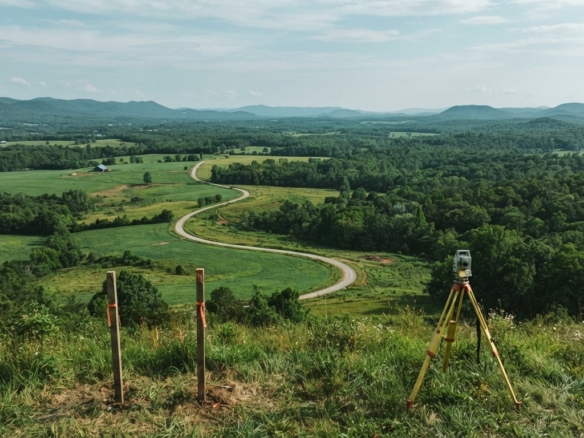
A survey increases value by removing buyer risk and clarifying exactly what is for sale. It confirms boundaries, identifies easements, and proves the total usable acreage. Buyers often pay a premium for build-ready parcels because it saves them time and legal headaches. Without a current survey, you invite price negotiations and delays. Providing this document upfront projects an aura of reliability and transparency that speeds up the transaction.
What is the most accurate website for land values?
Specialized marketplaces like BuyVacantLand.com are more accurate than generic residential sites because they focus exclusively on raw land data. Generic platforms often use algorithms designed for houses, which fail to account for zoning or utility costs. To get the most accurate figure, combine data from a land-specific marketplace with actual transfer prices found in county tax records. Real market exposure to land-specific investors is the ultimate validator of price.
How does timber or mineral rights affect land value?
Severed rights decrease the property’s overall value because they limit the owner’s control over the subsurface or surface resources. If you own the timber and mineral rights, your property is worth more as a complete asset. Timber value is calculated by a forester based on species and maturity. Mineral rights are more complex and depend on local extraction potential. Always verify if these rights are intact before setting your final asking price.
What is the difference between an acre of land and a buildable lot?
An acre is a measurement of area, while a buildable lot is a legal designation. A 10-acre parcel might not be buildable if it lacks road access or fails a septic perc test. A buildable lot has met all local zoning requirements and has access to necessary utilities. Buyers pay significantly more for a buildable lot because the entitlement risk has been removed. Raw acreage without these approvals often sells at a steep discount.
Can I value my land myself without an appraiser?
You can value your property by following a strict, data-driven process. Use the “Rule of Three” to find comparable sold data and adjust for features like road frontage and power access. This method is how professional investors determine how to value vacant land quickly. While a formal appraisal is required for bank financing, a well-researched seller can set a competitive market price that attracts cash buyers and facilitates a fast sale.



Join The Discussion