

What if the perfect five-acre lot you just found is legally impossible to build on? It happens more often than most buyers realize. You see a beautiful clearing. The local building department sees a protected wetland or a landlocked parcel with no legal road access. Knowing the specific questions to ask when buying land is the only way to protect your capital. You need a property that serves your vision, not a financial trap that drains your bank account with hidden liens or unexpected back taxes.
We know that navigating raw land feels overwhelming. You’re likely concerned about complex zoning laws or the high cost of bringing utilities to a remote site. This guide changes that. It provides a clear roadmap for property verification to give you total confidence in the land’s value. We’ve built the definitive 2026 due diligence checklist to help you uncover legal traps and physical limitations before you sign. You’ll get a simplified, step-by-step path to a successful, stress-free closing that cuts through traditional procedural hurdles.
Key Takeaways
- Verify soil suitability and zoning laws immediately to ensure the property can legally support your specific building plans.
- Confirm legal road access and investigate active easements to avoid being landlocked or sharing your property rights unintentionally.
- Master the essential questions to ask when buying land to uncover hidden utility costs before they drain your development budget.
- Identify delinquent taxes and outstanding assessments to protect your capital and ensure a clean, equitable title transfer.
- Utilize specialized land marketplaces to filter for vetted categories like owner-financed, off-grid, or residential parcels.
Analyzing the Physical Limits: Questions About the Dirt
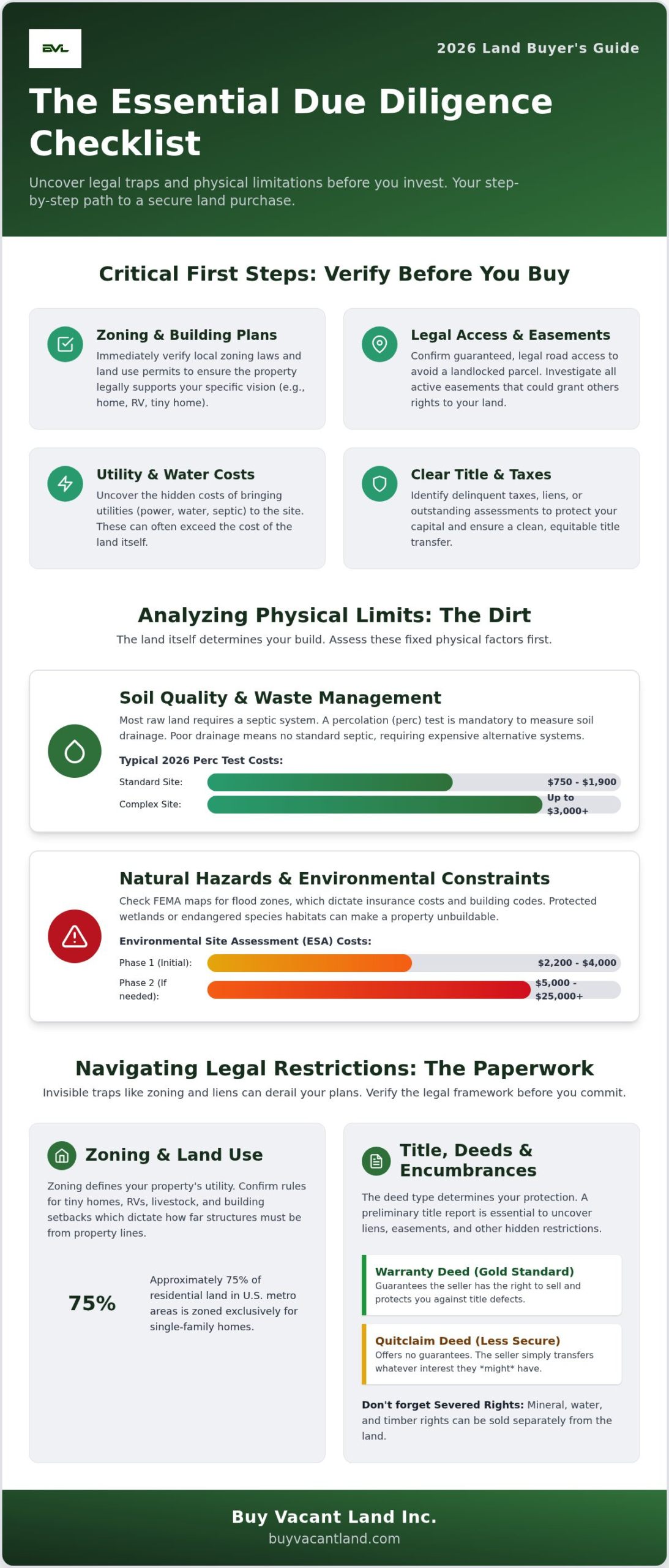
Buying land starts with a hard look at the earth itself. The view might be stunning, but the topography determines your construction budget. High elevation offers vistas but often comes with steep slopes that require expensive retaining walls and specialized foundations. Low-lying areas might look lush but often hide drainage nightmares that lead to standing water. You must prioritize these physical questions to ask when buying land before committing your capital. Physical limitations are fixed. You can’t easily change the slope of a mountain or the composition of the soil.
Soil Quality and Waste Management
Most raw land lacks access to municipal sewer lines. This makes a percolation (perc) test your most important diagnostic tool. A perc test measures how quickly water drains through the soil. If the soil doesn’t drain, you can’t install a standard septic system. In 2026, a standard perc test typically costs between $750 and $1,900. Complex sites might reach $3,000. Don’t skip the soil analysis. It’s one of the most critical questions to ask when buying land if you plan to build. High water tables or heavy clay often require specialized alternative waste systems. These systems are significantly more expensive than traditional septic setups. Verify the soil’s capacity to support your intended build before the closing date.
Natural Hazards and Environmental Constraints
FEMA maps are your primary resource. Check them immediately using the parcel’s exact coordinates. Even land that appears dry can fall within a designated flood zone. This status forces you into high-cost insurance and restrictive building codes. Inquire about the local history of wildfire, soil erosion, or drainage issues. Protected wetlands or endangered species habitats can shrink your buildable footprint to zero. A Phase 1 Environmental Site Assessment (ESA) provides the data you need. In mid-2026, a Phase 1 ESA for a standard parcel typically costs between $2,200 and $4,000. If the report indicates contamination or sensitive habitats, a Phase 2 ESA can cost between $5,000 and $25,000. Don’t sign a contract without these answers.
Use these checks to verify the land’s physical viability:
- Confirm the exact elevation and slope percentage via a topographic survey.
- Review official FEMA flood zone designations for the specific lot.
- Identify any visible signs of soil erosion or recent land instability.
- Check for federally protected habitats or wetlands that limit development.
Simplify your search by using a specialized marketplace. BuyVacantLand.com allows you to filter for residential lots or off-grid parcels across the United States. You can often find listings where the owner has already provided perc test results or topographic surveys. This saves you time and thousands of dollars in upfront due diligence costs.
Navigating Zoning, Deeds, and Legal Restrictions
Legal restrictions are invisible traps. You cannot see a zoning violation or a hidden lien just by walking the property lines. These represent the mandatory questions to ask when buying land to ensure you actually own the rights you think you are buying. Physical ownership of the dirt does not always grant you the right to use it as you wish. You must verify the legal framework of the parcel before you commit your capital.
Zoning and Land Use Permits
Zoning defines the utility of your investment. As of August 2026, the 21st Century ROAD to Housing Act encourages local governments to reform zoning, yet restrictions remain tight. Approximately 75% of residential land in U.S. metro areas is still zoned exclusively for single-family homes. If you plan to park an RV, live off-grid, or build a tiny home, verify the local ordinances first. Ask about minimum square footage requirements for new builds. Check the specific setback requirements. Setbacks dictate how far your structures must stay from roads and property lines. These rules can significantly shrink your buildable footprint on smaller parcels.
Confirm these specific zoning details:
- Verify if Accessory Dwelling Units (ADUs) or duplexes are permitted under recent 2026 local reforms.
- Check for “Right to Farm” laws if you plan to keep livestock or honeybees.
- Inquire about height restrictions that might block your intended views.
Title, Deeds, and Encumbrances
The deed type determines your level of protection. A Warranty Deed is the gold standard because it guarantees the seller has the right to sell the property. A Quitclaim Deed offers significantly less security. Always request a preliminary title report to check for outstanding liens or delinquent property taxes. You also need to investigate active easements. These legal agreements allow utility companies or neighbors to cross your land. If the property belongs to a Homeowners Association (HOA), review the Covenants, Conditions, and Restrictions (CC&Rs). These private rules often ban specific activities like parking a boat in the driveway or using certain building materials.
Don’t forget to ask about severed rights. In many states, mineral, water, and timber rights are sold separately from the surface land. You might own the ground but have no legal claim to the water underneath it or the valuable timber growing on it. This is one of the most overlooked questions to ask when buying land during the due diligence phase.
Save time by focusing on properties with transparent details. You can browse residential lots on our marketplace to find listings that often include pre-verified zoning and deed information from the sellers themselves.
Verifying Access and Essential Utility Infrastructure
Raw land is only as valuable as its accessibility. Without a legal way to reach your property, you own a liability, not an asset. Utility infrastructure often costs more than the land itself if you aren’t careful. These are the non-negotiable questions to ask when buying land to avoid total isolation and massive unforeseen expenses. You need to know exactly how you will get to the property and how you will power your life once you arrive.
Road Access and Maintenance
Legal access does not always mean physical access. A “paper road” exists on a map but might be a dense thicket of trees in reality. Ask the seller if the access road is publicly maintained by the county or if it is a private road. Public roads are plowed and graded by the local government. Private roads require shared maintenance agreements with your neighbors. This can lead to legal disputes if a neighbor refuses to pay their share. If you must cross someone else’s parcel to reach your lot, verify the recorded easement documents immediately; a resource like WithEasement can help you access these records and other critical property data in one place. Check if the road remains passable during heavy winter snow or spring mud seasons. A property you can only visit six months a year has limited utility.
Utility connection fees represent the largest hidden expense in land development. Inquire about the distance to the nearest electrical grid connection point. Local utility companies charge significant fees for every foot of line extension. If the grid is over a quarter-mile away, your costs will skyrocket. Evaluate the land’s suitability for solar power as a pragmatic alternative. Check for clear southern exposure and a lack of dense canopy cover that could block panels.
Water is your next priority. Ask if a municipal water hookup is available at the property line. If you need a well, research the average depth of successful wells in the immediate area. Drilling costs are calculated by the foot. A 500-foot well is a much larger financial burden than a 100-foot well. Finally, verify high-speed internet options. Modern land use often requires remote work capability. Check for fiber-optic lines or reliable satellite coverage. Steep ridges or heavy timber can sometimes block satellite signals, leaving you disconnected. These are critical questions to ask when buying land before you sign a binding contract.
Simplify your search by focusing on parcels with established infrastructure. You can browse off-grid land or residential lots on our marketplace to find listings that already specify utility availability. This direct connection to sellers helps you get the facts fast without the traditional procedural hurdles of land buying.
Financial Due Diligence and Closing Questions
Financial clarity is the final hurdle. You don’t want to inherit a previous owner’s debt. The debt stays with the dirt. These are the mandatory questions to ask when buying land to ensure a clean title and a predictable budget. Every dollar you fail to account for now will come out of your development fund later.
Always ask about delinquent property taxes. If the seller hasn’t paid, the county can seize the property even after you buy it. Check for outstanding assessments for road improvements or utility lines. These are separate from standard taxes and can cost thousands. Ask the local tax assessor for an estimated annual property tax amount based on the current sales price. Purchase prices often trigger a reassessment. Your taxes might be significantly higher than what the previous owner paid.
Determining who pays for a new land survey is a key negotiation point. In 2026, a standard land survey typically costs between $200 and $1,200. Boundary surveys for small lots up to 0.5 acre range from $300 to $900. If the seller has a recent survey on file, you can save this expense. Always verify the total ‘out-the-door’ price before signing. This includes recording fees, title insurance, and escrow fees. Title insurance protects you if a hidden lien appears later. Usually, the buyer and seller negotiate who pays these costs. Ask for a written breakdown of every fee to prevent last-minute surprises.
Owner Financing and Payment Terms
Many vacant land sales happen without traditional banks. You should ask about owner financed land options to simplify the transaction. Clarify the down payment requirement and interest rate. Current 2026 land loan rates from traditional lenders often range from 6.5% to 10%. Owner financing might offer more flexibility. Check for a ‘balloon payment’ clause. This requires the full balance to be paid by a specific date. Inquire about early payoff penalties. You need the freedom to pay off the debt early without extra fees. These are the final questions to ask when buying land to protect your investment.
Closing Costs and Professional Fees
Determine who pays for title insurance and escrow fees early in the process. Ask if the seller has a recent survey on file to save costs. Verify the total ‘out-the-door’ price including all recording fees. Professional fees can vary by state, so get a localized estimate. This transparency ensures an equitable financial proposal for both parties. It also creates a sense of momentum that pushes the transaction toward a successful closing.
Ready to start? You can find owner-financed land listings across the country on our marketplace today.
Taking Action: How to Find Vetted Land Listings
Knowledge is only valuable when you apply it. You now have the definitive checklist for due diligence. The next step is finding a property that passes the test without wasting months on irrelevant search results. Most traditional real estate sites prioritize houses and rentals. This forces you to sift through thousands of listings that don’t fit your needs. You need a streamlined path to raw land inventory.
Start by comparing multiple parcels in the same county. This gives you a baseline for market value. Look for patterns in pricing based on utility access or road frontage. Use your list of questions to ask when buying land to vet every listing before you schedule a site visit. High-quality listings often include details about zoning and topography upfront. If a listing is vague, move on or message the seller immediately for clarification. Speed is your primary advantage in a competitive market.
Why Use a Specialized Land Marketplace?
General marketplaces are cluttered and inefficient for land buyers. A specialized platform like BuyVacantLand.com focuses exclusively on empty parcels. You can find cheap land for sale that never hits the mainstream market. This direct connection between owners and buyers removes traditional procedural hurdles. You gain access to raw land listings that aren’t on typical real estate sites, including off-grid acreage and specialized commercial lots. This efficiency saves you time and reduces the stress of asset ownership.
Starting Your Search Today
Begin your journey by browsing national listings to find your ideal property type. If you’re new to the process, review our comprehensive guide on how do you buy land to understand the full sequence of a transaction. Use the marketplace filters to narrow your search by acreage, price, and financing availability. Reach out to sellers directly through the platform. Ask your questions to ask when buying land about perc tests, easements, and utility hookups immediately. This proactive approach ensures you only spend time on viable properties that meet your vision.
Follow this simplified sequence to close your deal:
- Identify 3-5 target parcels using specialized filters.
- Message sellers to verify the physical and legal status of the dirt.
- Review the preliminary title report for hidden liens or back taxes.
- Confirm the total “out-the-door” price with the seller.
- Execute the purchase through a secure, direct transaction.
Ready to find your property? You can browse vacant land listings across the United States today and connect directly with motivated sellers.
Secure Your Land Investment with Confidence
Success in real estate depends on the quality of your due diligence. You now have a definitive roadmap to verify the physical, legal, and financial status of any parcel. Prioritize soil suitability and zoning laws before you commit your capital. These questions to ask when buying land are your primary defense against hidden development costs and unusable property. Physical limitations are permanent, but legal traps are avoidable through diligent verification of titles and easements.
Efficiency is the hallmark of a successful transaction. You don’t need to waste time on cluttered residential sites that don’t understand your needs. Our specialized land-only marketplace offers national US coverage and direct seller-to-buyer connections. This transparency ensures an equitable financial proposal while removing traditional procedural hurdles. Browse vacant land listings and find your perfect parcel today!
Take charge of your future property. Your vision for a residential lot, off-grid escape, or commercial venture is within reach when you start with the right facts. Secure your investment with total peace of mind.
Frequently Asked Questions
What is the most important question to ask when buying vacant land?
The most important inquiry concerns the land’s legal and physical utility for your specific project. You must ask if the zoning, soil quality, and local ordinances permit your intended use. Many buyers fail to ask the right questions to ask when buying land and end up with property they can’t develop. Always verify that the parcel isn’t restricted by wetlands or steep slopes that could triple your construction budget before you sign.
Can I build whatever I want on my own land?
You cannot build whatever you want because local zoning laws and private deed restrictions dictate land use. In 2026, about 75% of residential land in U.S. metro areas remains zoned exclusively for single-family homes. You must also check for Covenants, Conditions, and Restrictions (CC&Rs) if the property is part of an association. These rules often ban mobile homes, tiny houses, or specific agricultural activities regardless of your ownership status.
How do I know if the land has legal access?
Legal access is confirmed by reviewing the property deed and a preliminary title report for recorded easements. Physical access is not enough; you need a legal right to cross adjacent parcels if the land doesn’t touch a public road. Without a recorded easement, the property is landlocked. This makes the land virtually impossible to finance or develop. Always verify this with a title company to ensure your path to the lot is legally protected.
What is a perc test and why do I need one?
A percolation test measures how quickly soil absorbs water to determine if a septic system is viable. You need one because most raw land lacks municipal sewer connections. In 2026, the average perc test costs between $750 and $1,900. If the soil fails, you might need an alternative system costing significantly more. This is one of the essential questions to ask when buying land to avoid a major financial setback early in development.
Is it better to buy land with a well already installed?
Buying land with an existing well is generally better because it eliminates the financial risk of a “dry hole.” Drilling a new well is expensive and costs are calculated by the foot. You won’t know the final price until the driller hits water. An existing well provides immediate proof of water availability and saves you from the uncertainty of 2026 drilling rates. Always test the flow rate and water quality before closing the deal.
What happens if I buy land with back taxes owed?
If you buy land with delinquent taxes, you inherit that debt immediately. Property taxes are a lien against the dirt itself, not just the previous owner. The local county can foreclose on the property to recover those funds even after you take ownership. Always request a title search to identify any outstanding assessments. This ensures you start your ownership with a clean slate and no surprise bills from the local tax assessor.
Do I need a real estate agent to buy vacant land?
You don’t need a traditional real estate agent if you use a specialized marketplace to connect directly with sellers. Platforms like BuyVacantLand.com provide a streamlined path to browse residential, off-grid, and owner-financed parcels without middleman fees. This direct connection allows you to ask due diligence questions quickly and negotiate terms yourself. Many land sellers prefer direct transactions because they are faster and more transparent than traditional home sales involving multiple agents.
How much does a typical land survey cost in 2026?
A typical land survey in 2026 costs between $200 and $1,200 depending on the parcel size and complexity. A boundary survey for a lot up to 0.5 acre usually ranges from $300 to $900. If you need a more detailed ALTA survey for commercial use, expect to pay between $1,200 and $4,000. These costs are a small price to pay to confirm your exact property lines and avoid future legal disputes with neighbors.



Join The Discussion