
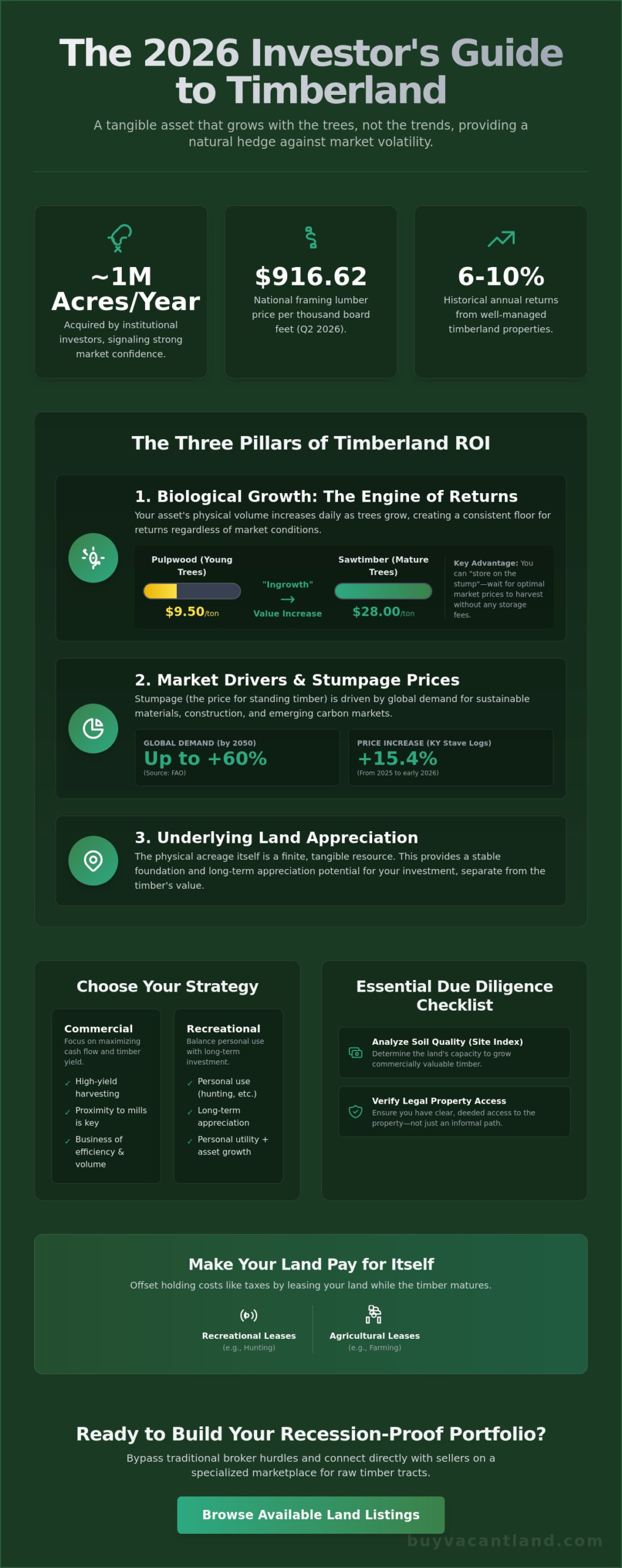
Institutional investors have been acquiring nearly one million acres of U.S. timberland per year since 2023. This aggressive pace continues into 2026 because wood is a tangible asset that grows regardless of what the stock market does. You already know that timberland investment properties offer a unique hedge against inflation, especially with national framing lumber prices hitting $916.62 per thousand board feet this quarter. However, finding these deals often feels impossible when you’re trapped outside the institutional inner circle.
Stop struggling with complex forestry jargon and the fear of overpaying for low-yield acreage. We agree that investing in land should be a pragmatic, transparent process. This guide provides the exact framework you need to identify, evaluate, and acquire profitable timberland. Understand the primary ROI drivers behind historic 6-10% annual yields and follow our clear due diligence checklist. We also provide a reliable source for finding vacant land listings so you can build a recession-proof portfolio without the typical procedural hurdles.
Key Takeaways
- Identify why timberland is a premier safe-haven asset in 2026 and how it provides a natural hedge against market volatility.
- Master the three pillars of ROI for timberland investment properties, focusing on the unique financial advantage of annual biological growth.
- Learn to perform professional due diligence by analyzing soil quality through the Site Index and verifying legal property access.
- Understand how timberland can pay for its own holding costs and taxes through strategic recreational or agricultural leases.
- Discover how to bypass traditional broker hurdles and find raw timber tracts by connecting directly with sellers on specialized marketplaces.
What Are Timberland Investment Properties?
Timberland is raw, undeveloped land primarily used for commercial tree harvesting. It is a dual-value asset where you own both the physical acreage and the standing inventory. In 2026, investors view these parcels as the ultimate safe haven. While paper assets fluctuate based on market sentiment, trees follow biological laws. They grow in volume every year regardless of economic cycles. The FAO projects global timber demand will increase by up to 60% by 2050. This trend positions timberland investment properties as a vital resource for the next several decades.
The 2026 market environment is particularly favorable for land buyers. Federal policy has shifted toward increased production. A March 2025 Executive Order targeted a 25% increase in timber volume on federal lands, signaling the strategic importance of wood. Additionally, the carbon credit market is no longer a niche experiment. This market reached a valuation of $479.41 billion in 2023 and continues to expand rapidly. Landowners now have multiple ways to monetize their holdings. You can harvest the wood for immediate cash flow or sell carbon offsets to corporations. This flexibility provides a safety net that traditional real estate lacks.
The Core Appeal of Forestry Assets
Ownership is tangible and direct. You possess a physical resource that ignores Wall Street’s daily noise. Biological growth is your primary engine. Trees add height and diameter every year. This increases the total board feet of your inventory automatically. Timber prices also serve as a powerful inflation hedge. As of April 2026, national framing lumber prices reached $916.62 per thousand board feet. This is a 5.11% increase from the previous quarter. Your asset gains value through both market pricing and physical expansion.
Commercial vs. Recreational Timberland
You must define your investment strategy early. Commercial tracts focus on high-yield harvesting and professional timber production. These properties require strict adherence to principles of sustainable forest management to maintain long-term soil health and yield. Investors in this category prioritize proximity to mills and high-quality site indices. It is a business of efficiency and volume. Success depends on reliable harvesting schedules and market timing.
Recreational timberland offers a different balance. These parcels allow for personal use, such as hunting or off-grid camping, while the trees mature. If you are researching how do you buy land for these purposes, the fundamentals remain the same. You need clear legal access and a solid understanding of the local market. Commercial tracts provide higher cash flow potential. Recreational land offers personal utility and long-term appreciation. Both assets provide the peace of mind that comes from owning a permanent, productive piece of the earth.
The Three Pillars of Timberland ROI
Investing in timberland investment properties isn’t a guessing game. It’s a calculated strategy based on three reliable wealth drivers. You don’t wait for a tenant to pay rent. You wait for the rain to fall and the sun to shine. Historically, well-managed timberland yields annual returns of 6-10%. This performance comes from a combination of biological growth, price appreciation, and the underlying value of the dirt itself. It’s a multi-layered approach to wealth building that most paper assets can’t match.
Biological Growth: The Engine of Returns
Biological growth is your primary advantage. This is the only asset class where the physical volume of your product increases daily. Research from the UGA Center for Forest Business highlights how this growth provides a consistent floor for your returns. You benefit significantly from “ingrowth.” This process occurs when trees transition from low-value product classes into high-value ones. For instance, young trees start as pulpwood. As they mature, they become chip-n-saw and eventually high-value sawtimber.
In South Georgia, pine sawtimber recently averaged $28 per ton. Meanwhile, pine pulpwood prices have faced challenges, falling to around $9.50 per ton. Your goal is to let the trees grow into those higher-paying categories. Trees are also a “liquid” asset in a unique way. You can store your inventory on the stump. If market prices are low, don’t harvest. Let the trees continue to grow in volume while you wait for a price rebound. You don’t have to worry about storage fees or inventory rot.
Market Drivers and Stumpage Prices
Stumpage is the price paid to a landowner for standing timber. It is your raw profit before harvesting and hauling costs. Several factors dictate this price. Proximity to local mills is critical. Short hauling distances keep your margins high. Logging conditions and the specific species mix on your land also play major roles. In early 2026, Kentucky reported delivered stave logs at $2.44 per board foot. This was a 15.4% increase from 2025.
Global demand for sustainable building materials keeps these prices strong. The FAO projects global timber demand will increase by up to 60% by 2050. You’re selling a renewable resource that the construction industry requires for modern, green building standards. If you want to capitalize on these trends, you can browse available land listings to find a tract that fits your budget.
The final pillar is alternative revenue. You don’t have to wait for a harvest to see cash flow. Hunting leases are a standard way to cover annual property taxes. Many owners also harvest pine straw or enter the carbon credit market. The global carbon credit market is growing at a CAGR of 39.4% through 2030. These secondary streams ensure your land is always working for you. You own a productive asset that appreciates in value while providing multiple paths to profit.
Timberland vs. Other Land Investments
Choosing between different types of acreage determines your level of stress and long-term profit. Residential lots and commercial vacant land often require constant attention. You face zoning battles, utility hookup fees, and property tax burdens that never stop. Timberland investment properties operate differently. They are the preferred choice for the patient investor who values simplicity over speculation. You don’t need to manage tenants or maintain buildings. You own a self-sustaining asset that pays for its own existence.
The “holding cost” myth often scares away new buyers. People assume undeveloped land is a drain on cash flow. This is false for well-managed timber. You can generate immediate income to cover taxes and insurance. Hunting leases are the most common method. In 2025, the U.S. South accounted for 56% of national transaction volume because these secondary revenue streams are so established. You get the tax benefits of land ownership without the typical monthly out-of-pocket expense. This makes timber a lower-intensity play than farms or ranches which require active labor and equipment.
Timberland vs. Residential Development
Residential development carries high risk. You are at the mercy of local planning boards and volatile housing demand. Timberland has lower regulatory hurdles. You aren’t fighting for sewer extensions or road permits. The entry price is also significantly lower. You can acquire large tracts of productive forest for a fraction of the cost-per-acre of a residential development site. While a residential flip is a one-time event, timber provides a multi-decade cycle of growth and harvesting. It is a long-term play for generational wealth.
Why Timberland Beats Traditional Savings
Traditional savings accounts and bond yields rarely beat inflation in 2026. Timberland has historically provided solid returns for investors that outperform many standard financial instruments. You are investing in “natural capital.” This asset gains value through biological growth and the global shift toward a green economy. If you are looking for entry-level opportunities, explore cheap land for sale to start your portfolio. You get the stability of a physical asset with the growth potential of a high-performing commodity. Trees don’t go bankrupt. They simply keep growing.
Evaluating a Timber Tract: A Buyer’s Checklist
Evaluating timberland investment properties requires a ruthless focus on data. You aren’t buying a view. You are buying a production facility. Start with the Site Index. This metric measures soil productivity and tree growth potential. Higher numbers mean faster biological growth and shorter harvest cycles. Verify legal access immediately. A landlocked property is worthless for commercial forestry. You cannot move logging equipment without deeded access. Check the distance to the nearest local mills. Long haul distances eat your profits through fuel and labor costs. Every extra mile reduces your stumpage value.
Review the standing inventory with a critical eye. You need a mix of age classes to ensure consistent cash flow. A tract with only young pulpwood means a long wait for high-value sawtimber returns. Conversely, a mature stand offers immediate harvest potential but requires a replanting plan. Assess environmental constraints such as wetlands or protected species habitats. These areas often become Streamside Management Zones (SMZs) where harvesting is restricted. You must know exactly how much “operable” acreage you are actually buying before you sign a contract.
The Importance of a Professional Cruise
Hire a registered forester for a timber cruise. This is a formal inventory of the standing wood. You need to know the exact volume, species, and density of the stand. A cruise report provides a breakdown of pulpwood, chip-n-saw, and sawtimber. It turns a forest into a clear balance sheet. Watch for red flags like high percentages of diseased trees or poor stocking levels. If the inventory data doesn’t match the seller’s claims, the deal is flawed. Accurate data is the only way to ensure an equitable financial proposal.
Logistics and Operability
Assess the physical operability of the tract. Road infrastructure must support heavy logging trucks year-round. Check for existing interior roads and their condition. Well-maintained roads increase the value of your timber because loggers can access the site in wet weather. Flat land is always cheaper to harvest. Steep mountain slopes require specialized equipment and higher labor costs. Review local zoning and any existing easements. Ensure there are no restrictions on clear-cutting or road construction. If you are ready to move forward, find timberland for sale on our specialized marketplace. We simplify the search so you can focus on the numbers.
How to Buy and Sell Timberland Fast
Speed is your greatest advantage in the 2026 land market. Institutional buyers move quickly to secure productive acreage, but you can outpace them by cutting out the middleman. Finding timberland investment properties doesn’t require an invitation to an exclusive institutional circle. You need a platform that removes the traditional barriers to entry. Skip the high-priced brokers and the endless paperwork. You can now connect directly with sellers who want to move assets quickly and efficiently.
Traditional real estate websites are cluttered with residential listings and rental properties. You waste valuable time filtering through noise that doesn’t fit your portfolio. Specialized marketplaces solve this problem by focusing entirely on the dirt. You can identify raw tracts, verify the timber potential, and close the deal without the typical procedural hurdles. This streamlined approach provides the peace of mind that comes from a swift, assured transaction.
Leveraging the BuyVacantLand.com Marketplace
Search exclusively for vacant land without the distraction of homes or commercial buildings. Use filters to find “Hunting Land” or “Undeveloped Land” that possesses significant timber potential. These categories often contain hidden gems where the standing timber value hasn’t been fully priced into the listing. Direct communication is the hallmark of this marketplace. You talk to the land owners yourself to get the raw facts on the property. This transparency allows you to make an equitable financial proposal based on real data rather than broker marketing fluff.
You can also scale your portfolio faster by seeking out owner financed land. This option allows you to acquire larger tracts with less capital upfront. It preserves your cash for essential management tasks like replanting or road maintenance. In a market where institutional investors are acquiring nearly one million acres of U.S. timberland annually, using creative acquisition strategies keeps you competitive. You get the benefits of a high-yield asset while maintaining your liquidity.
The Straightforward Path to Ownership
The path to a profitable harvest follows a simple, logical sequence. First, identify the property on a specialized marketplace. Second, verify the timber inventory and soil quality as discussed in previous sections. Third, close the deal directly with the seller. This process is significantly faster than traditional sealed-bid auctions or institutional sales. You avoid the “holding pattern” that often kills promising investments.
If you are looking to exit a position, listing your own timberland on a national marketplace is the most efficient way to find a buyer. You reach a targeted audience of investors specifically looking for forestry assets. This ensures your property gets the attention it deserves from people who understand its value. Don’t let traditional hurdles slow your progress. Start your search today on BuyVacantLand.com and build your recession-proof portfolio with confidence.
Secure Your Financial Future with Timberland
You now have the framework to acquire high-yield forestry assets without the stress of institutional gatekeepers. Biological growth remains your most reliable partner. It adds volume to your inventory every single day. By focusing on site index and proximity to mills, you ensure your land operates as a high-performance production facility. These timberland investment properties provide the permanent stability your portfolio needs in an unpredictable market. You’ve learned how to spot red flags in a cruise report and how to verify legal access before signing a contract.
Success depends on taking immediate action. You don’t need a middleman to find profitable acreage. Our national marketplace reach and exclusive focus on vacant land allow you to bypass traditional broker hurdles. You can connect directly with sellers to secure an equitable financial proposal without the typical procedural delays. The path to a recession-proof portfolio is straightforward and transparent. Browse Timberland and Vacant Land Listings Now and start building your legacy today. You’ve done the research. Now it’s time to own the dirt. Trees don’t wait for the market to recover. They just keep growing.
Frequently Asked Questions
Is timberland a good investment in 2026?
Timberland remains a premier safe-haven asset in 2026. Global demand for wood products is projected to rise by up to 60% by 2050. With framing lumber prices reaching $916.62 per thousand board feet this year, the market shows sustained strength. It provides a tangible hedge against inflation that paper assets simply cannot match.
How much money do I need to start investing in timberland?
Entry costs depend entirely on the acreage and location of the tract. You don’t need millions of dollars to enter this asset class. Small, undeveloped parcels are accessible to private individuals. You can often leverage owner financing on specialized marketplaces to acquire productive land with lower upfront capital requirements.
What is the average annual return on timberland investment?
Well-managed timberland investment properties historically yield annual returns of 6-10%. These gains come from a combination of biological growth, land appreciation, and rising stumpage prices. This asset class is known for low volatility. Trees continue to grow in volume regardless of daily fluctuations on Wall Street.
How do I calculate the value of timber on a property?
You must hire a professional forester to conduct a timber cruise. The forester measures the volume, species mix, and density of the standing trees. This inventory is then compared against current local stumpage prices. This process turns a physical forest into a clear financial balance sheet for the buyer.
What are the tax advantages of owning timberland?
Income from timber sales generally qualifies for favorable long-term capital gains treatment under Internal Revenue Code Section 631. This rate is typically much lower than ordinary income tax rates. Additionally, investors may be able to deduct management expenses and property taxes, which improves the overall net return on the investment.
How long does it take for a timber investment to pay off?
Timber is a long-term play, but the payoff timing depends on the stand’s age at purchase. You can see immediate returns if you acquire a mature stand ready for harvest. While biological cycles span decades, secondary revenue streams like hunting leases provide annual cash flow while your primary timber crop matures.
Can I hunt on my timberland investment property?
Personal recreation is a major benefit of owning timberland investment properties. You can use the land for your own hunting or lease the rights to a local club. Hunting land is a highly sought-after category on our marketplace. It allows you to combine a personal hobby with a profitable financial strategy.
What is a TIMO and do I need one?
A TIMO is a Timberland Investment Management Organization. These entities manage massive forest portfolios for institutional clients like pension funds. Private investors don’t need a TIMO to succeed. You can build and manage your own portfolio by using direct marketplaces to find listings and hiring local foresters for technical guidance.



Join The Discussion