

Buying raw land without a checklist is like signing a contract for a box you aren’t allowed to open until your check clears. You aren’t just buying dirt. You’re buying a bundle of legal rights and physical liabilities. Knowing the right questions to ask when buying land determines whether you build wealth or drain your bank account. Many buyers realize too late that “unimproved” often means “unbuildable” without a massive cash injection. You need certainty before you commit your capital.
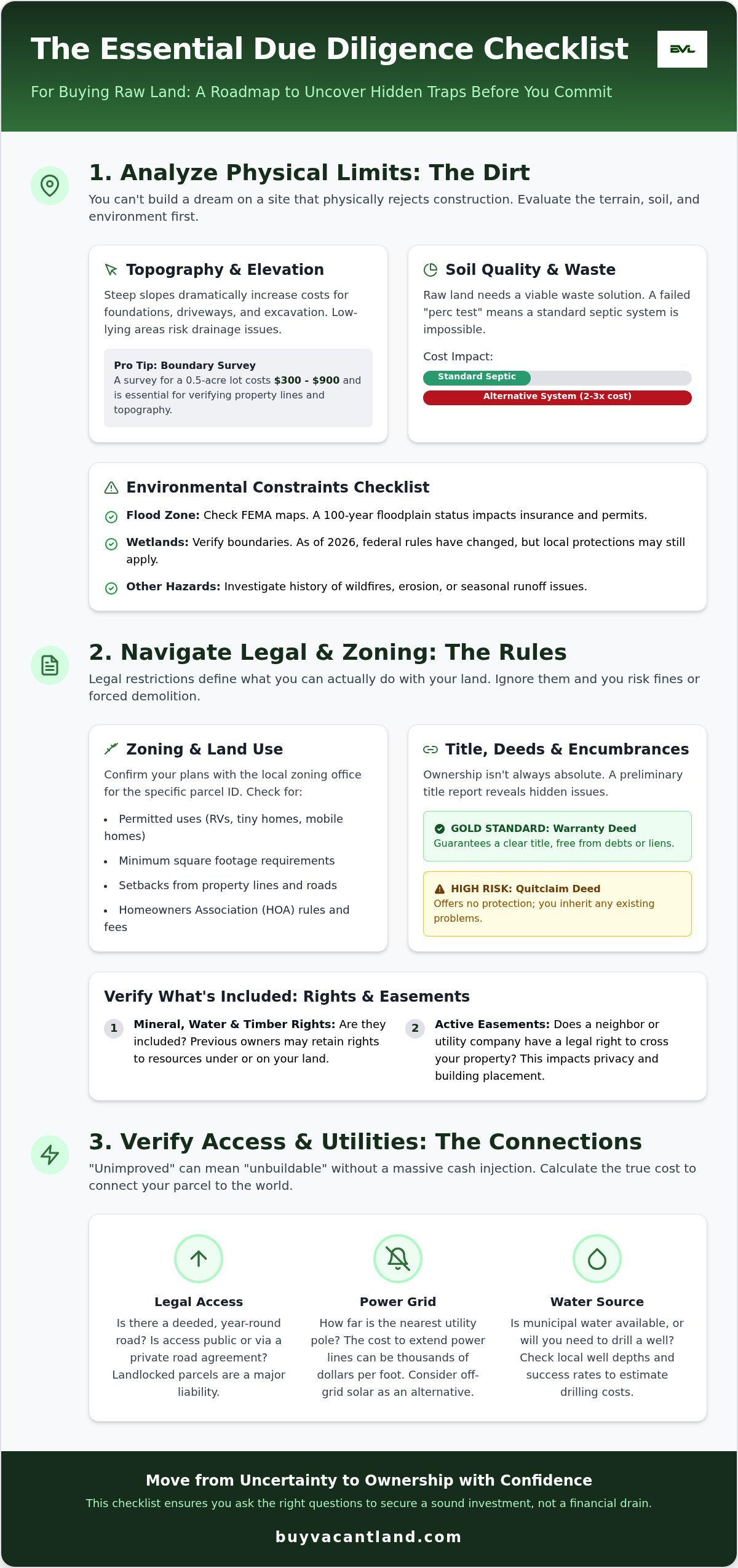
You want a secure asset, not a legal headache. It’s natural to worry about hidden liens, back taxes, or the cost of bringing utilities to a remote lot. This guide provides the definitive checklist to uncover hidden traps before you sign. You’ll get a clear roadmap for property verification. We’ll cover everything from the latest 2026 federal wetland regulations to confirming specific zoning codes and access rights. Follow this simplified sequence to ensure a successful, stress-free closing on your new property. We help you move from uncertainty to ownership with total confidence.
Key Takeaways
- Identify physical limitations like soil suitability and elevation early. Avoid sinking capital into land that cannot support your building plans.
- Navigate zoning laws and active easements with precision. Ensure your intended use aligns with local legal restrictions before you commit.
- Master the financial side by knowing the specific questions to ask when buying land regarding back taxes and liens. Secure your investment with a clean title.
- Confirm utility infrastructure and legal access points. Calculate the true cost of bringing power and water to your parcel before closing.
- Simplify your acquisition by connecting directly with sellers. Filter listings by category to find the exact type of raw land you need.
Analyzing the Physical Limits: Questions About the Dirt
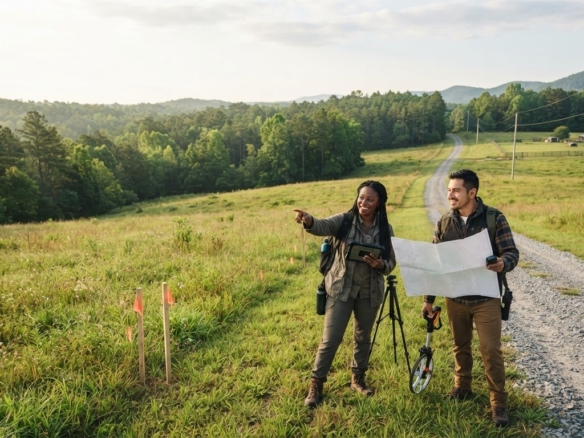
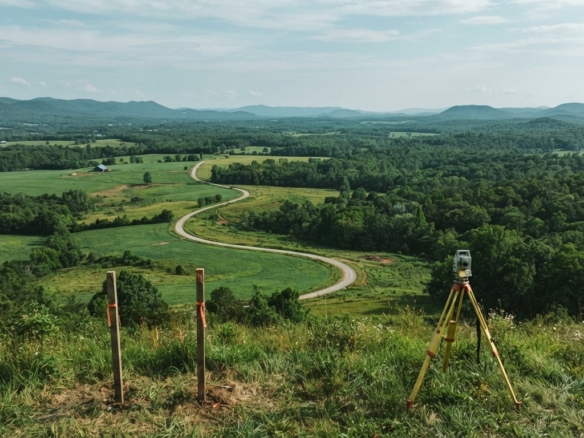
You cannot build a dream home on a site that physically rejects construction. The dirt is your foundation. Before you commit capital, you must evaluate the terrain. Is the parcel a flat meadow or a steep cliff? Topography dictates your building costs. High elevation offers views but often requires expensive excavation and road grading. Low-lying areas invite drainage nightmares. These are the essential questions to ask when buying land to avoid buying a beautiful but unusable view. When browsing listings on BuyVacantLand.com, prioritize sellers who provide topographic data or recent boundary surveys. A boundary survey for a property up to half an acre typically costs between $300 and $900, and it’s a non-negotiable step for verifying exactly what you’re buying.
Soil Quality and Waste Management
Raw land rarely comes with a sewer hookup. You must confirm the soil can handle waste. Ask the seller if a percolation or perc test has been performed recently. This test determines how quickly water drains through the soil. If the soil is too rocky or the clay content is too high, a standard septic system will fail. You should also inquire about the depth of the water table. A high water table often forces you into expensive, specialized alternative waste systems. These systems can cost double or triple the price of a standard setup. Get the data before you sign. If the land is advertised as off-grid, this waste management plan is your first priority.
Natural Hazards and Environmental Constraints
Nature often creates invisible boundaries. Check the FEMA flood maps for your specific parcel coordinates immediately. Being in a designated flood zone impacts your insurance rates and building permits. You should also verify the history of wildfire, erosion, or drainage issues on the property. Recent Supreme Court rulings, such as Sackett v. EPA, have changed federal wetland regulations. As of September 2026, federal protection typically applies only to wetlands with a continuous surface connection to navigable waters. Understanding Land-Use Planning is vital here because local governments use these environmental factors to restrict what you can build. Always ask for recent environmental studies or wildlife habitat reports. Even if the federal government has narrowed its definition, local zoning boards often maintain strict protections for endangered species habitats or seasonal runoff areas.
Use this checklist to verify the physical integrity of the parcel:
- Is the parcel in a flood zone? Check FEMA maps for the 100-year floodplain status.
- What is the slope? Steep grades increase foundation and driveway costs.
- Does the soil drain? Verify perc test results for septic suitability.
- Are there wetlands? Confirm boundaries under the latest 2026 federal standards.
Navigating Zoning, Deeds, and Legal Restrictions
Legal restrictions define what you can actually do with the dirt you just bought. You need to verify the zoning classification immediately. Don’t assume you can park an RV or build a tiny home just because the land is rural. These are critical questions to ask when buying land. Local planning departments set the rules for minimum square footage and setbacks from property lines. If you ignore these, you risk fines or forced demolition. You must also confirm if the property belongs to a Homeowners Association (HOA). HOAs often impose additional fees and restrictive rules that override local zoning. These private organizations can dictate everything from your mailbox color to the type of livestock you keep.
Zoning and Land Use Permits
Check if the county allows mobile homes or off-grid living specifically. Many areas have strict building codes that require a minimum square footage for any permanent structure. Setback requirements are equally important. You must know exactly how far back from the road or neighbor’s fence you have to build. These rules prevent you from building too close to hazardous areas or utility lines. Before browsing residential lots, call the local zoning office to confirm your plans are legal. Ask for a list of permitted uses for the specific parcel ID to ensure your project is viable.
Title, Deeds, and Encumbrances
Ownership isn’t always absolute. You need to know which deed type the seller is offering. A Warranty Deed is the gold standard because it guarantees a clear title. A Quitclaim Deed offers no such protection and carries higher risk. These are the legal questions to ask when buying land that protect your equity. The CFPB on Land Purchase Risks highlights how undisclosed encumbrances can derail your investment. Request a preliminary title report to check for hidden liens, back taxes, or active judgments. You also need to verify if mineral, water, and timber rights are included in the sale. In some states, a previous owner might still own the rights to the oil or water under your feet. This can lead to unwanted drilling or logging on your property. Finally, look for active easements. An easement might give a utility company or a neighbor the right to cross your property at any time. This reduces your privacy and could limit where you place your home.
Verifying Access and Essential Utility Infrastructure
Raw land is often priced low because it lacks basic infrastructure. You must look beyond the price tag to see the total cost of ownership. One of the most critical questions to ask when buying land is how you will legally and physically reach the property. Land without deeded access is landlocked. This makes it nearly impossible to get a loan or a building permit. Physical access is a separate issue. A road that looks fine in July might become a muddy trench in April. You need a path that supports heavy construction equipment and emergency vehicles year-round. Don’t guess. Drive the route yourself during the wet season to see the reality of the terrain.
Road Access and Maintenance
Confirm whether the access road is public or privately maintained. Public roads are the responsibility of the county or city. Private roads require a maintenance agreement among all neighbors. If no agreement exists, you could be stuck with the entire bill for grading or snow removal. Verify if you must cross a neighbor’s parcel to reach your gate. This requires a recorded, transferable easement. Ensure the road is wide enough for fire trucks. Many counties won’t issue building permits if the access road doesn’t meet specific safety widths. These details prevent you from being trapped on your own property.
Water and Power Solutions
Utilities are the primary source of budget overruns. Start with the electrical grid. Inquire about the exact distance to the nearest transformer. Extending power lines often costs a set fee per foot. If the grid is a mile away, your connection costs could exceed the price of the land itself. Ask for a written estimate from the local utility provider before you close. If the cost is too high, consider off-grid land solutions. You’ll need to evaluate the parcel’s solar potential. Check for tree cover or hills that might block the sun during winter months when you need power the most.
Water is your next priority. Ask if a municipal hookup is available at the property line. If it isn’t, you must drill a well. Inquire with local drillers about the average depth and flow rates in the area. A “dry hole” is a total loss of your investment. You also need to verify internet options. Rural fiber is expanding, but satellite or fixed wireless are more common. Check cellular signal strength at the exact building site. If you work from home, a lack of high-speed internet is a deal-breaker. Use these questions to ask when buying land to build a realistic budget for your infrastructure needs.
Financial Due Diligence and Closing Questions
Financial due diligence protects your capital from invisible drains. You must ask if there are delinquent property taxes or outstanding assessments before you make an offer. Unpaid taxes follow the land. If you buy a parcel with a $5,000 tax lien, that debt becomes your problem the moment the deed transfers. Verify the tax status with the county treasurer directly. Also, inquire about special assessments for future road improvements or utility expansions. These can appear months after closing and cost thousands. Knowing these questions to ask when buying land prevents expensive surprises during your first year of ownership.
Projecting your long-term carry costs is equally vital. Ask for the estimated annual property taxes after the purchase. Some states, like Colorado, assess vacant land at a higher rate than residential property. Effective rates vary wildly across the country, from Hawaii’s low 0.28% to New Jersey’s 2.23%. Don’t rely on the seller’s current tax bill as a permanent guide. A change in ownership often triggers a reassessment that could significantly increase your annual obligation. Get a clear estimate from the local county assessor to build an accurate budget for your investment.
Owner Financing and Payment Terms
Many buyers avoid the 6.5% to 10% interest rates of traditional land loans by seeking seller terms. Ask about the down payment requirement and the interest rate immediately. Most owner financed land deals require 20% to 50% down depending on the parcel type. Clarify if there is a balloon payment due at a specific date. You must also check for early payoff penalties. You want the flexibility to pay off the balance or refinance if bank rates drop without being penalized. This bank-free path is efficient but requires you to review the promissory note for any hidden fees or restrictive clauses that might limit your control over the asset.
Closing Costs and Professional Fees
Closing costs for cash land purchases typically range from 1% to 2% of the purchase price. Determine who pays for title insurance and escrow fees during the negotiation phase. Ask if the seller has a recent survey on file to save on professional fees. A boundary survey for half an acre costs between $300 and $900, while an ALTA survey for commercial use can exceed $4,000. If a survey isn’t available, you must decide who pays for it. Verify the total out-the-door price, including recording fees which average around $125. Browse owner-financed land listings now to find properties with transparent financial terms and clear closing structures.
Taking Action: How to Find Vetted Land Listings
You have the checklist. Now you need the inventory. Using a generic real estate site for raw land is a waste of time. You get buried in residential listings and rental properties. You need a specialized platform built for dirt. BuyVacantLand.com filters out the noise. It connects you directly with sellers who understand the specific questions to ask when buying land. This direct connection speeds up your due diligence and eliminates the middleman delays common in traditional real estate.
Why Use a Specialized Land Marketplace?
Traditional sites treat land as an afterthought. A specialized marketplace focuses on raw, undeveloped parcels. This allows you to find cheap land for sale without scrolling through thousands of suburban homes. You can specifically target categories like off-grid land, hunting land, or industrial lots. These platforms provide the data you need, such as acreage, zoning highlights, and financing availability. It’s a streamlined process designed for speed. You save hours of manual research by accessing a national database of vacant parcels that aren’t listed on traditional portals.
Starting Your Search Today
Execution is the final step in your due diligence. Begin by browsing national listings to find a property that fits your budget and goals. If you are a first-time buyer, review our guide on how do you buy land to understand the transaction flow. Once you find a parcel, use the platform to message the seller directly. Ask about the perc test, the deed type, and the utility connection points immediately. This immediate feedback loop keeps your acquisition on track.
Don’t look at a single parcel in isolation. Compare multiple listings in the same county to establish a baseline market value. Review the residential, off-grid, and commercial potential for each lot. A specialized marketplace makes this comparison easy. You can see how specific features impact the final price:
- Utility Proximity: Determine how much grid access adds to the property value.
- Road Condition: Calculate if paved access is worth a premium over gravel.
- Zoning Type: Evaluate if commercial potential justifies a higher price point.
Direct communication is your best tool. Reach out to sellers today to get the data you need. You’ve mastered the questions to ask when buying land; now it’s time to apply them. Filter by price, acreage, and financing to find your next asset. Start your search now and move from research to ownership with an efficient, reliable partner. Your successful closing starts with the right platform.
Secure Your Legacy with Confident Ownership
Purchasing raw land is a high-stakes transaction that requires precision. You now have the roadmap to navigate complex zoning laws, verify physical soil suitability, and uncover hidden financial liens. Mastering the specific questions to ask when buying land is the difference between a high-yield asset and a permanent financial burden. You’ve learned how to identify unbuildable terrain and how to calculate the true cost of bringing utilities to your site. This knowledge transforms you from a spectator into a decisive investor.
Stop guessing about property value and start verifying. Our specialized land-only marketplace offers national US coverage with direct seller-to-buyer connections. This transparency eliminates traditional procedural hurdles and ensures you get an equitable proposal. You can filter by acreage, price, and financing to find exactly what you need without the clutter of residential rentals. Take control of your future and start your search with a reliable partner today.
Browse vacant land listings and find your perfect parcel today!
Your ideal property is waiting. Use your new due diligence skills to close with total peace of mind.
Frequently Asked Questions
What is the most important question to ask when buying vacant land?
The most important question is whether the land’s zoning and physical state allow for your specific intended use. You must verify if the local planning department permits your project type. Many buyers assume a rural lot is a blank slate; however, legal restrictions often dictate structure size and utility requirements. Always ask for the parcel ID and call the county zoning office before making a financial commitment. This step prevents expensive mistakes.
Can I build whatever I want on my own land?
You cannot build whatever you want because every parcel is governed by local zoning laws and building codes. These regulations define setbacks, height limits, and permissible structures. Some areas prohibit off-grid living or tiny homes entirely. Additionally, Homeowners Associations may impose private restrictions that are even stricter than county rules. You must confirm these details during your due diligence phase to avoid legal penalties or the forced removal of your structures.
How do I know if the land has legal access?
Legal access is confirmed through a title search and a review of the property deed. You are looking for a recorded easement or frontage on a public road. Physical access, such as a dirt path, does not guarantee legal right of way. If you must cross another person’s property to reach your lot, ensure the easement is transferable and permanent. Without legal access, you cannot secure a land loan or a building permit.
What is a perc test and why do I need one?
A percolation or perc test measures how quickly soil absorbs water to determine septic system suitability. You need this test because most raw land lacks municipal sewer connections. If the soil fails to drain properly, you cannot install a standard septic tank. This often forces you to use expensive alternative waste systems or renders the land unbuildable. Always ask for recent perc test results before finalizing any purchase of undeveloped land parcels.
Is it better to buy land with a well already installed?
Buying land with an existing well is often better because it eliminates the high risk and cost of drilling a dry hole. A functional well provides immediate proof of water availability and saves you from coordinating with drillers. However, you must test the water quality and flow rate before closing. If the land lacks a well, research the average depth of nearby wells to estimate your future infrastructure expenses accurately before you buy.
What happens if I buy land with back taxes owed?
If you buy land with delinquent taxes, you become legally responsible for the debt once the deed transfers. Property tax liens stay with the land, not the previous owner. You could lose the property to a tax foreclosure if the balance remains unpaid. This is one of the critical questions to ask when buying land during your financial check. Always insist on a title search to verify the tax status is current.
Do I need a real estate agent to buy vacant land?
You don’t need a real estate agent to buy vacant land, especially when using a specialized marketplace like BuyVacantLand.com. Many buyers prefer working directly with sellers to streamline the process and avoid traditional commission fees. However, you should still conduct thorough due diligence or hire a title company to handle the closing. Buying direct allows for faster communication and more flexible terms, such as owner financing, which traditional agents often overlook.
How much does a typical land survey cost in 2026?
A typical land survey in 2026 costs between $200 and $1,200. A boundary survey for a standard half-acre lot usually falls between $300 and $900. If you require a topographic survey for construction planning, expect to pay between $400 and $1,500. Commercial or complex parcels needing an ALTA survey can cost $1,200 to $4,000. These professional fees are essential for verifying property lines and preventing future boundary disputes with neighboring land owners.


Join The Discussion