
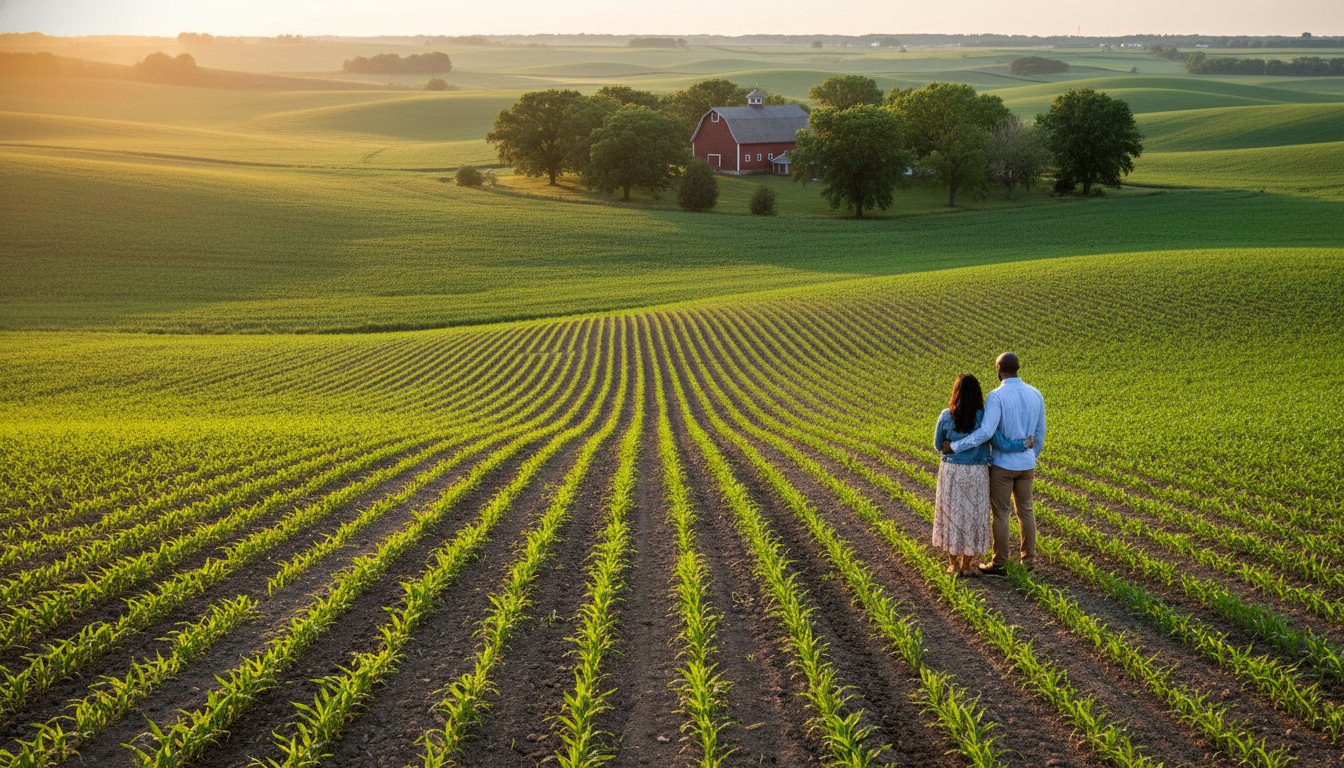
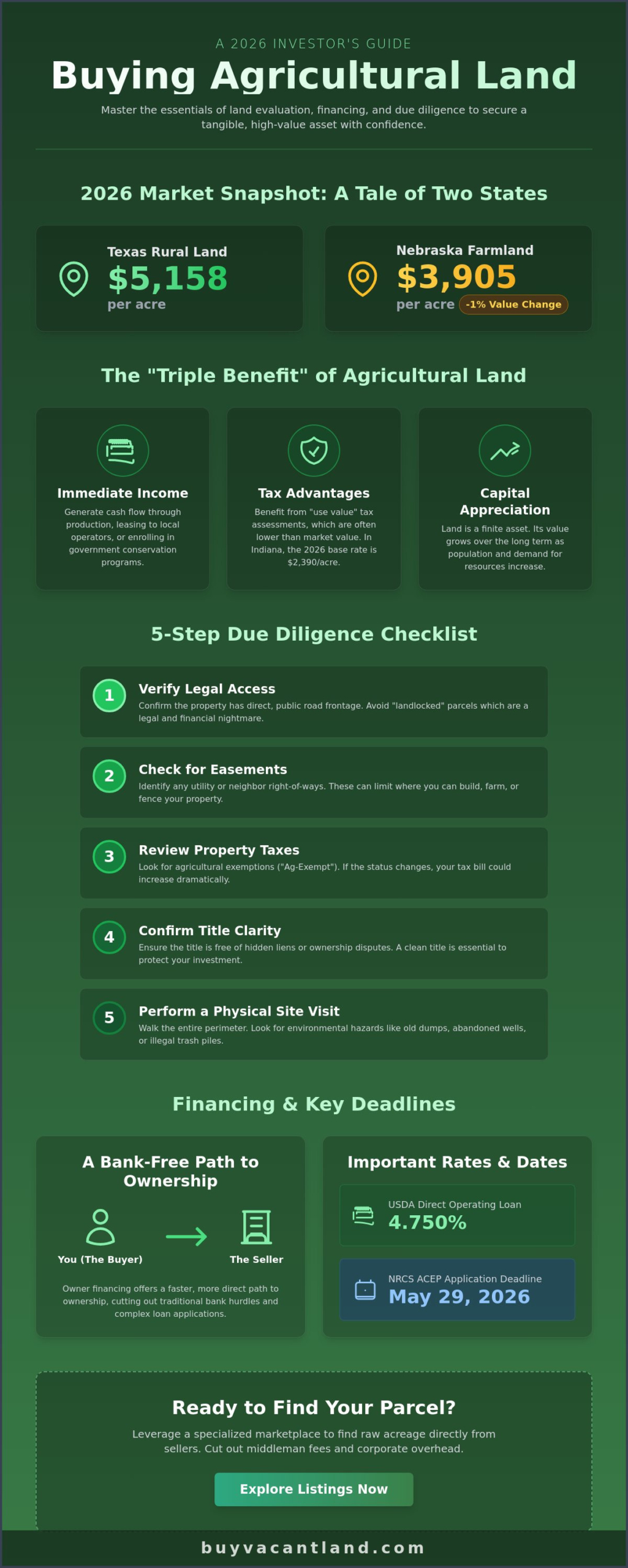
Texas rural land prices hit $5,158 per acre in late 2025, yet Nebraska saw a 1% value decrease. These shifting numbers prove that finding the right agricultural land for sale requires more than just a high bid. You likely feel the pressure of complex zoning laws and the frustration of banks that refuse to finance raw land. It’s stressful to hunt for a productive asset when hidden land defects or legal red tape wait around every corner. You want a clear path to ownership without the usual headache.
We’ve simplified the entire process into this direct, no-nonsense guide. You’ll master the essentials of land evaluation, from checking soil quality to understanding how the 2026 Farm Bill proposals might impact your investment. We provide the latest data, including the current 4.750% USDA direct operating loan rate and the May 29, 2026, ACEP application deadline. Stop guessing and start securing your future. This guide walks you through a logical sequence to identify, verify, and purchase your parcel with total confidence and zero wasted time.
Key Takeaways
- Learn why agricultural land is a finite asset and how 2026 market trends like food security drive long-term value.
- Execute a 5-step due diligence checklist to verify legal access and avoid landlocked traps when searching for agricultural land for sale.
- Utilize the USDA Web Soil Survey to confirm soil capability and water rights, ensuring the land meets your specific production needs.
- Discover why owner-financed land offers a faster, bank-free path to ownership for buyers facing traditional lending hurdles.
- Leverage a specialized marketplace to find raw acreage directly from sellers, cutting out middleman fees and corporate overhead.
The Strategic Value of Agricultural Land for Sale in 2026
Owning land is a play for permanence. Unlike digital assets or volatile stocks, Agricultural land is a finite resource. They aren’t making more of it. In 2026, the market reflects a sharp focus on food security and resource scarcity. This drives a steady demand for productive soil. Whether you look at Texas rural land reaching $5,158 per acre or the stabilizing $3,905 per acre in Nebraska, the underlying value remains clear. This is a tangible asset you can see, touch, and control.
Smart investors look for agricultural land for sale because it offers a “Triple Benefit.” First, it provides potential for immediate income through production or leasing. Second, it offers significant tax advantages. Many states assess property taxes based on “use value” rather than market value. In Indiana, for example, the 2026 base rate for farmland property taxes is set at $2,390 per acre. Third, you benefit from long-term capital appreciation. Your investment grows as the population increases and available acreage shrinks.
Inflation Protection and Tangible Wealth
Cash loses value over time. Land does not. It acts as a hard hedge against currency devaluation. When inflation rises, the price of food and fiber follows. This increases the value of the land that produces them. Agricultural land shows remarkably low volatility compared to traditional equities. It doesn’t crash overnight. A “buy and hold” strategy for raw acreage protects your wealth while providing a stable foundation for your estate.
Passive vs. Active Agricultural Income
You don’t need to be a farmer to profit from a farm. Many owners choose passive income by leasing their agricultural land for sale to local operators. This provides immediate cash flow without the need for expensive equipment. You can also participate in government-backed conservation programs. The NRCS, for instance, has a May 29, 2026, deadline for ACEP funding. These programs pay you to protect the land’s environmental value. Finally, keep an eye on the horizon. Land on the edge of growing towns offers a lucrative exit strategy through future residential development.
Direct Due Diligence: Verifying Your Land Parcel
Don’t let a low price blind you to a bad deal. Identifying agricultural land for sale is only the start. You must verify every claim the seller makes. This due diligence primer outlines the complexity of agribusiness transactions, but you can simplify your approach with a strict five-step process.
- Step 1: Verify legal access. Confirm the property has direct road frontage. A “landlocked” parcel is a legal nightmare that requires expensive court intervention to resolve.
- Step 2: Check for easements. Utility companies or neighbors may have rights to cross your land. These right-of-ways can limit where you build or plant.
- Step 3: Review property taxes. Look for outstanding agricultural exemptions. If a property loses its “Ag-Exempt” status, your tax bill could skyrocket overnight.
- Step 4: Confirm title clarity. Ensure there are no hidden liens or ownership disputes. A clean title is the only way to protect your equity.
- Step 5: Perform a physical site visit. Walk the entire perimeter. Look for environmental hazards like old chemical dumps, abandoned wells, or illegal trash piles.
Efficiency matters during this phase. If a seller can’t provide basic documentation, move on. You’ll find plenty of transparent listings for farms and ranches that meet these standards without the runaround.
Zoning and Unrestricted Land Realities
Labels can be deceiving. An “Ag-Exempt” property is a tax designation, not a zoning permission. “Unrestricted” land offers more freedom, but local ordinances might still block specific livestock or commercial structures. Contact the county appraiser’s office directly. Ask for the specific use codes and any pending regulatory changes. This prevents you from buying land you can’t actually use for your intended purpose. It’s a simple call that saves years of legal stress.
The Importance of a Professional Land Survey
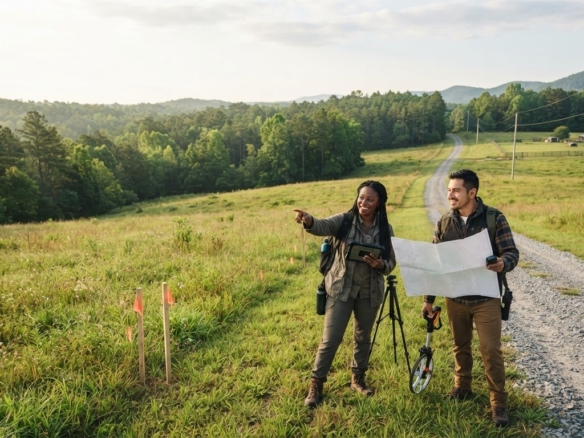
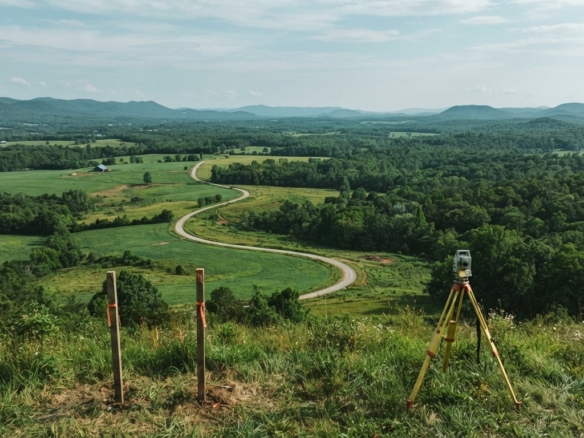
Never trust an old fence line. Over decades, fences drift and neighbors encroach. A professional survey is a non-negotiable expense. You should factor the lot survey price into your closing budget. A surveyor provides a legal map that settles boundary disputes before they start. If you find an encroachment, address it before the closing date. Force the seller to resolve the issue or adjust the price to reflect the actual acreage you’re receiving. This ensures you get exactly what you pay for.
Evaluating Soil Capability and Water Rights
Soil is the engine of your investment. When you browse agricultural land for sale, you aren’t just buying acreage. You are buying the capacity of that dirt to produce yield. High-quality soil determines the land’s utility and your eventual ROI. The USDA Web Soil Survey is your first line of defense. It is a free, essential tool that provides detailed maps of soil composition across the country. Use it to verify if a parcel is truly tillable acreage or just non-productive scrubland before you sign a contract.
The market reflects this reality clearly. In 2026, Nebraska’s irrigated cropland has held its value better than dryland options because water and soil quality provide a safety net. Don’t pay premium prices for land that can’t support your goals. Verify the “utility” of the dirt before you commit your capital.
Soil Types and Productivity Ratings
Look for the “Prime Farmland” designation. This is a specific USDA classification for land with the best physical and chemical characteristics for producing food, feed, and fiber. Drainage and slope are critical factors here. Steep slopes lead to erosion and runoff. Poor drainage can drown your crops or limit your grazing season. Beyond digital maps, you must perform a physical soil test. Evaluating Soil Health through physical and chemical testing reveals pH levels and nutrient deficiencies that a computer screen cannot see. These results tell you exactly how much you’ll need to spend on soil amendments to reach peak productivity.
Securing Water Access and Mineral Rights
Water is often more valuable than the land itself. In the Eastern U.S., “Riparian” laws generally allow landowners to use water from adjacent sources. In the West, “Prior Appropriation” rules mean the first person to use the water has the senior right. Never assume water comes with the deed. You must also check if the mineral rights have been “severed” from the surface. If they have, a third party could potentially access your property to extract resources. Use this checklist for any well on the property:
- Verify the current well depth and casing condition.
- Review the flow rate (gallons per minute) to ensure it meets production needs.
- Confirm the legality of the well permit and any existing water usage limits.
- Check for recorded water rights transfers in the county records.
A property without secure water is a liability. Confirm your access rights during the due diligence period to avoid buying a dry, unproductive lot.
Financing and Closing Your Agricultural Land Deal
Traditional banks are slow. They often avoid raw land because it doesn’t generate immediate rental income like a house. This makes finding agricultural land for sale frustrating if you rely on a standard mortgage. You’ll face high down payment requirements, rigid credit standards, and endless paperwork. Stop wasting time with lenders who don’t understand the value of the dirt. You need a financing strategy that matches the speed of the market.
The most efficient alternative is owner financed land. This is the fastest path to ownership. You deal directly with the seller. This “Bank-Free” approach often bypasses credit checks and requires much lower down payments than institutional loans. It removes the middleman and the associated service fees. You gain control of the asset immediately without the stress of a typical loan application.
If you have the capital, use the “Cash is King” strategy. Sellers of vacant land often value certainty over the highest possible price. Offering a quick cash close allows you to negotiate deep discounts. You trade liquidity for equity. This is a pragmatic move for any serious investor looking to secure a productive asset quickly. It eliminates the risk of a deal falling through due to financing hurdles.
How Owner Financing Works for Land
Most of these deals use a “Contract for Deed” or “Land Contract” structure. You make payments directly to the seller while you use the land. The process is incredibly fast because you avoid bank appraisals that can take weeks. This simplicity is a hallmark of the land market. Just ensure your contract allows for an early payoff without penalties. This gives you the flexibility to pay off the balance when your cash flow improves or when you’re ready to start major development. It puts you in the driver’s seat.
The Simplified Closing Process
Buying land isn’t like buying a house. It’s much faster. You don’t have to wait for inspections of HVAC systems or roofs. You can often close in days, not months. Follow this 3-step path to completion:
- Reach an agreement on price and terms with the seller.
- Perform a title check to ensure no liens or clouds exist.
- Record the deed with the county to finalize your ownership.
For a full breakdown of the logistics, check our how do you buy land guide. This streamlined sequence ensures you don’t get bogged down in procedural red tape. Ready to start your search? Browse our current listings of owner financed land to find your next investment today.
Find Your Next Parcel on BuyVacantLand.com
Your search for agricultural land for sale ends here. BuyVacantLand.com is a focused marketplace built specifically for raw acreage. We don’t waste your time with residential homes or rental properties. Our platform connects you directly with land owners and sellers who understand the value of the dirt. This direct model eliminates middleman fees and corporate overhead that typically inflate land prices. You get a straight path to the asset you want without unnecessary transactional costs.
Transparency is our primary standard. Every listing on our site aims to provide the facts you need to move fast. You can easily filter for cheap land for sale across the country to find deals that fit your specific budget. Whether you’re looking for a small plot for a hobby farm or a massive ranch, our platform streamlines the discovery phase. You see the land, you review the owner-financing terms, and you contact the seller directly. It is that simple.
Why Use a Specialized Land Marketplace?
General real estate websites fail land buyers. They bury vacant parcels under thousands of house listings and complex search filters that don’t apply to raw dirt. Our platform is different. We prioritize “Owner-Financed” and “Off-Grid” listings because those are the primary solutions for modern land buyers. For example, our regional guides like land for sale in florida provide specific local data to help you make an informed decision in high-demand markets. We provide the tools to evaluate the potential of the land, not just the zip code.
Start Your Search Today
Don’t wait for prices to climb further. Secure current 2026 pricing by taking action now. The market for productive acreage moves fast, and the best parcels disappear quickly. Our “Direct to Seller” communication model means you get answers in hours, not weeks. You cut through the noise, avoid the traditional procedural hurdles, and secure your asset with total efficiency. There is no better time to diversify your portfolio with a tangible, appreciating asset. Browse our current agricultural land listings now and take the first step toward ownership today.
Secure Your Productive Asset Today
Finding the right agricultural land for sale doesn’t have to be a multi-year struggle. You now have the blueprint to verify legal access, evaluate soil capability, and navigate bank-free financing. This guide provides a clear path to avoid common landlocked traps and hidden defects. You understand that land is a finite resource. It protects your wealth while providing immediate utility. Don’t let the complexity of traditional real estate slow you down.
BuyVacantLand.com is your direct-to-seller marketplace with national coverage across the US. We focus exclusively on vacant land to save you time. You’ll find owner-financed deals and raw acreage without the corporate overhead or middleman fees. It’s the most efficient way to browse, evaluate, and close on your next parcel. Take the first step toward securing your legacy and building tangible wealth.
Find Your Agricultural Land on BuyVacantLand.com
The dirt is waiting. Start your search now and secure your future with total confidence.
Frequently Asked Questions
Is agricultural land a good investment in 2026?
Agricultural land is a strong investment in 2026 because it is a finite, tangible asset that hedges against inflation. While some regions like Nebraska have seen a 1% value decrease, others like Texas reached $5,158 per acre in late 2025. This asset class offers lower volatility than traditional stocks and benefits from the global focus on food security.
How much is an acre of agricultural land on average?
Prices for agricultural land for sale depend entirely on location and soil productivity. As of early 2026, the average value in Nebraska was $3,905 per acre, while Texas rural land reached a statewide nominal price of $5,158 per acre. You should check specific county records, as values in states like South Dakota and Wyoming increased by 7.9% and 8.7% respectively through 2025.
Can I build a house on land zoned for agriculture?
You can usually build a residence on agricultural land, but you must follow local zoning ordinances. Many counties require a minimum acreage, often 10 to 40 acres, to qualify for a residential building permit in an ag-zoned area. Contact the county planning and zoning department to verify the specific density requirements and setback rules before you buy.
What is the difference between tillable and non-tillable land?
Tillable land is soil that is cleared, leveled, and suitable for row crop production. Non-tillable land includes areas like rocky pastures, timberland, or wetlands that are better suited for grazing or conservation. Tillable acreage generally carries a higher market value because it produces higher annual yields and immediate cash flow from farming leases.
How do I find out if a property has water rights?
You find water rights by conducting a title search and reviewing the property’s deed history at the county recorder’s office. In many states, water rights are severed from the land and sold separately. You must also verify if your state follows Riparian or Prior Appropriation laws to understand your legal priority for water usage during a drought.
What are the tax benefits of owning agricultural land?
The biggest benefit is the “use-value” assessment, which taxes your land based on agricultural productivity instead of its market value. Indiana, for example, set the 2026 base rate for farmland property taxes at $2,390 per acre. This assessment method keeps your carrying costs low compared to residential or commercial properties that are taxed at their highest and best use.
Can I buy agricultural land with no money down?
Buying with zero down is rare, but low-down-payment options are available for qualified buyers. The USDA Farm Service Agency offers a Farm Ownership Down Payment loan with a 1.750% interest rate as of May 1, 2026. You can also negotiate terms for agricultural land for sale through owner financing to minimize your initial cash outlay.
What should I look for in a land contract?
You must look for a clear legal description, a fixed interest rate, and a clause that allows for early payoff without penalties. Ensure the contract specifies that the seller will deliver a clean warranty deed once you make the final payment. Verify who is responsible for property taxes and insurance during the contract period to avoid unexpected costs.


Join The Discussion