
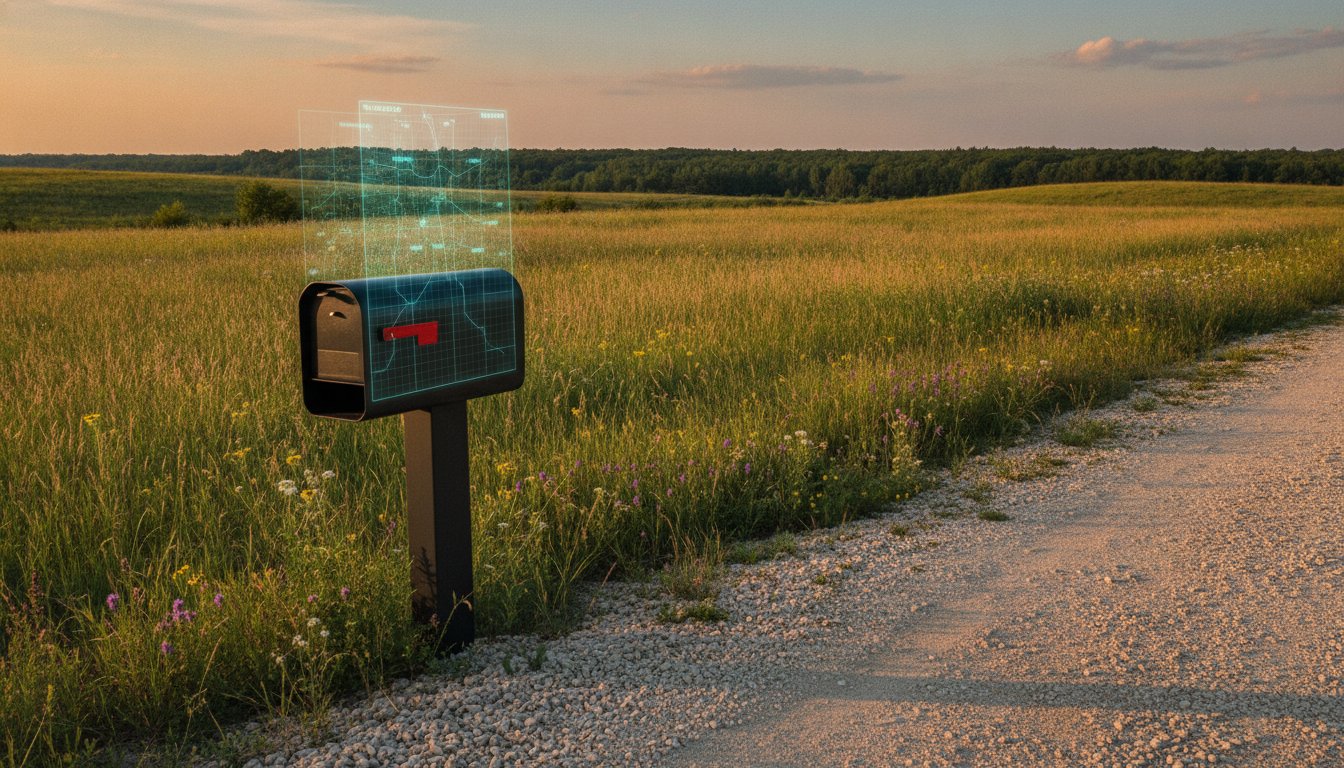
Your vacant land is just a coordinate on a map until you secure a formal street address. Without those few digits, your property is essentially invisible to the local power company, the water department, and even emergency responders. It is an asset stuck in a state of limbo. You likely already know the frustration of being bounced between county offices while trying to figure out how to get a physical address for land just to set up a basic utility connection or ensure a fire truck can find your gate.
We understand that bureaucratic confusion shouldn’t stall your plans. This guide cuts through the noise to provide the exact steps you need to take in 2026 to secure your address. You’ll learn how to navigate local planning departments, manage the typical application fees that range from $50 to $500, and coordinate with the USPS for mail delivery. We’ll simplify the process into a clear sequence so you can stop worrying about emergency response times and start building your future with confidence.
Key Takeaways
- Identify the correct local authority for your parcel. Rural land usually requires an application through the County Planning and Zoning Department.
- Learn exactly how to get a physical address for land by preparing your property deed and Assessor’s Parcel Number (APN).
- Unlock critical utility connections and emergency response services by transforming your vacant lot into a formally recognized location.
- Bridge the gap between county records and the USPS. You must manually activate mail delivery using an official address verification letter.
- Boost the marketability of your residential or off-grid land. A physical address makes your property more attractive and ready for immediate development.
Why Your Vacant Land Needs a Physical Address
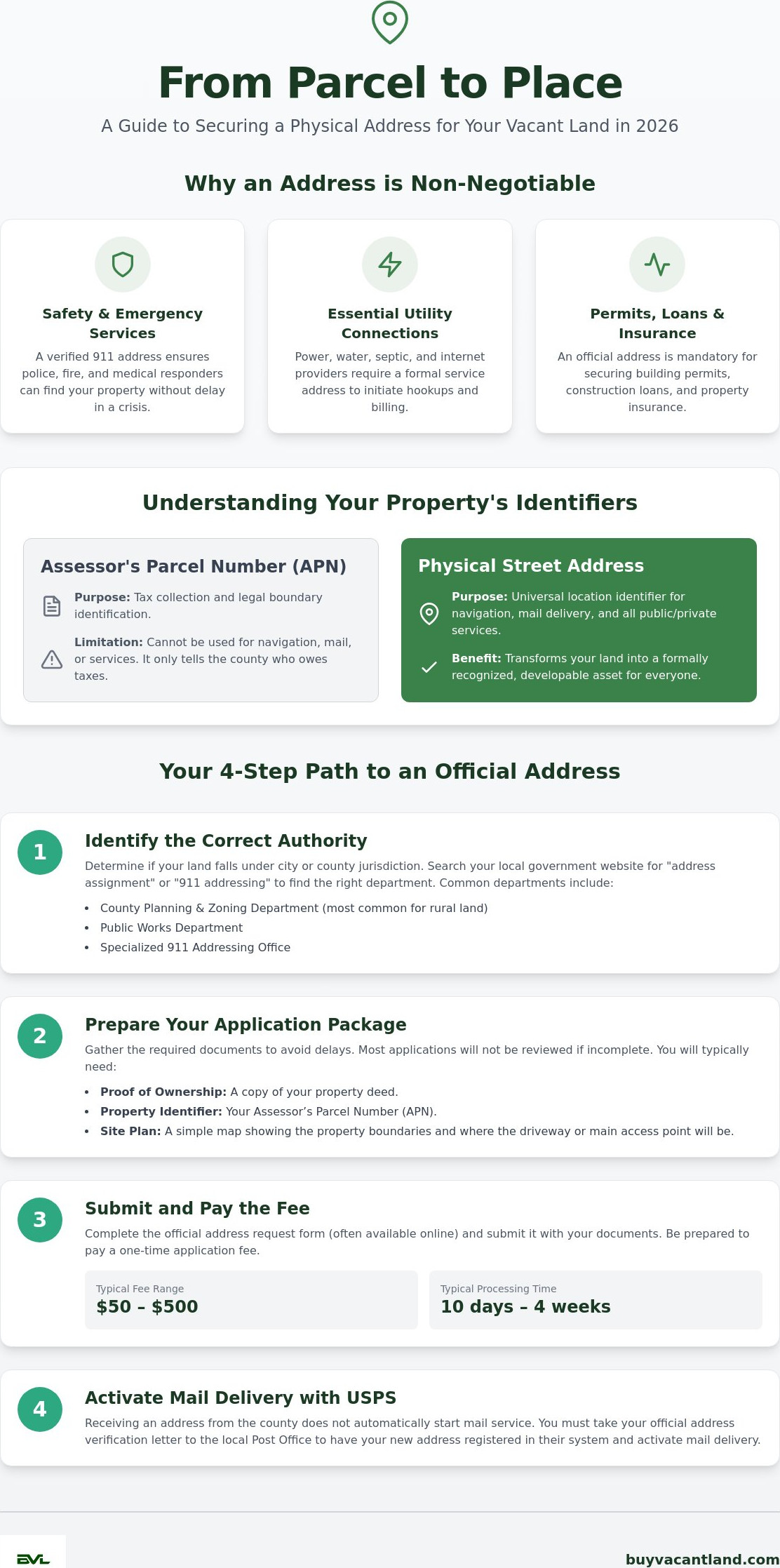
A physical address is more than just a line on an envelope. It is a formal geographic identifier assigned by your local government. Without it, your vacant land remains a ghost in the system. If you want to transform a raw parcel into a functional asset, you must understand how to get a physical address for land. This number serves as the primary handshake between your property and the infrastructure of the modern world.
Safety is the first priority. Emergency services rely entirely on the 911 dispatch database to locate properties during a crisis. If a fire breaks out or a medical emergency occurs on your land, first responders cannot navigate to a vague description of a dirt road. They need a verified street number to reach you in time. Minutes matter during an emergency; an address ensures those minutes aren’t wasted searching for a gate.
Financial institutions and insurance providers also demand this level of specificity. Lenders won’t finalize a construction loan on a property that doesn’t officially exist on a map. Insurance companies cannot underwrite a policy without a confirmed location to assess risk. Securing an address immediately elevates your land from a speculative lot to a legitimate real estate asset. It provides the certainty that banks and insurers require before they commit capital to your project.
The Difference Between a Parcel Number and a Physical Address
Don’t confuse your Assessor’s Parcel Number (APN) with a physical address. An APN is a tool for tax collection and boundary identification. It tells the county who owes property taxes and where the property lines sit. It does not help a delivery driver or a utility technician find your location. A physical address follows a specific house numbering system designed for navigation and logistics. You can’t use an APN to order a package or provide directions to a contractor. One is for the tax collector; the other is for the rest of the world.
Unlocking Utility Connections and Permits
Utility companies operate on a service address model. They cannot drop a power meter or run a water line to a property identified only by GPS coordinates. Most counties also freeze the building permit process until an address is assigned. You must learn how to get a physical address for land before you can even think about pouring a foundation. An official street address is the mandatory prerequisite that unlocks all future land development and construction permits.
Identifying the Correct Authority for Address Assignment
Your first step is to determine which government body holds jurisdiction over your property. Don’t waste time calling the wrong office. If your parcel sits within the boundaries of an incorporated city, the city government manages the process. If your land is in a rural area outside city limits, the county government is your primary contact. The specific department varies by location, but you will generally deal with Planning and Zoning, Public Works, or a specialized 911 Addressing office. Understanding how to get a physical address for land starts with identifying this gatekeeper.
The rules are not standardized across the country. For example, in Salt Lake County, Utah, the Addressing Office handles these requests. In Santa Cruz County, California, you will likely work through the Planning Department. Most jurisdictions provide an official address request process online. Search your local government’s website for “address assignment” or “911 addressing” to find the correct forms. If you are still in the process of scouting for the perfect property, you can browse available land listings to see parcels that may already have these foundational details in place.
The Role of the 911 Addressing Coordinator
In rural regions, the 911 Addressing Coordinator is often your most important contact. Emergency response logic drives the entire numbering system. Rural addresses are frequently distance-based rather than block-based. This means your house number might be determined by how many feet your driveway sits from the nearest intersection. This precision allows ambulances and fire trucks to find your exact location on a long country road. This office ensures your new address integrates perfectly into the regional emergency dispatch system.
Planning, Zoning, and Public Works Departments
In urban or suburban areas, the Planning or Public Works departments usually take the lead. These offices coordinate address assignments with new road names and subdivision plats. They ensure that your address doesn’t duplicate existing ones and follows the established grid. Once they assign a number, they notify the local tax assessor to update the property records. Be prepared for varying timelines. Some jurisdictions, like those in Salt Lake County, may process an application in about 10 business days. Others may take two to four weeks depending on their current workload and the complexity of your site plan.
Once you locate the correct department, you must transition from research to action. Securing an address is a formal administrative process that requires specific proof of ownership and intent. Knowing how to get a physical address for land means being prepared with a complete application package to avoid delays. Most offices won’t even look at your request if a single document is missing. The process is simple if you follow the sequence.
Administrative fees are standard across the country. These costs cover the staff time required to verify your location and update the regional 911 database. In Santa Cruz County, California, the processing fee is $132.00. Salt Lake County, Utah, utilizes a $100.00 flat fee plus a $40.00 per-address charge. Expect to pay anywhere from $50 to $500 depending on your local government’s structure. Submit your payment with the application to start the clock on the approval period, which typically lasts between 10 business days and four weeks.
Required Documentation Checklist
- Proof of Ownership: Provide a copy of your recorded deed or purchase contract.
- Legal Description: Use the exact language from your deed defining the property boundaries.
- Assessor’s Parcel Number (APN): This identifies your lot in the tax system.
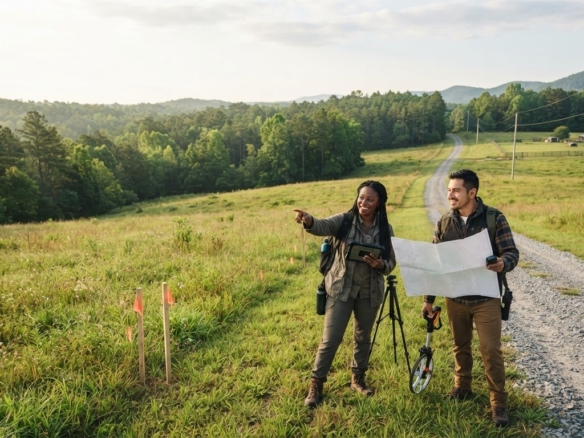
- Site Plan: Submit a simple map showing the property lines and the exact location of your proposed entrance.
- Coordinates: Include precise latitude and longitude for the center of your driveway.
The Importance of the Driveway or Entrance
If your land is raw and undeveloped, you face a common hurdle. County officials rarely assign an address to the center of a vacant lot. They assign it to the point where your driveway meets the public road. This ensures emergency vehicles know exactly where to turn. Understanding how to get a physical address for land requires you to think like a navigator, not just a landowner. If you haven’t cut a path yet, you may need to apply for a “culvert permit” or an “encroachment permit” before the addressing office will proceed. This permit allows you to build a safe entrance from the main road. An address is tied to the access point, not just the lot center.
Don’t skip the site visit. Many jurisdictions send an inspector to verify that the entrance location on your map matches the reality on the ground. They check for line-of-sight safety and proper drainage. Once the inspector signs off, the office generates an official “Address Assignment” letter. This document is your golden ticket for utilities and mail. Keep the original in a safe place. You’ll need it for every subsequent permit application.
Activating Mail Delivery with the USPS
Securing a number from the county is only half the battle. Most landowners mistakenly believe that a county-assigned address automatically enters the federal mail system. It doesn’t. Local government databases and the United States Postal Service (USPS) operate on entirely separate networks. If you want to receive mail at your gate, you must manually bridge this gap. Learning how to get a physical address for land requires a final, critical trip to your local Post Office.
Take your official “Address Verification” letter from the county directly to the local Postmaster. They are the only authority who can “activate” your address for delivery. Without this step, any mail sent to your new location will be returned to the sender as “undeliverable.” The Postmaster will verify your location and add it to the carrier’s route. If you are still looking for the perfect site to build your legacy, you can browse residential lots and off-grid land to find a parcel ready for this process.
Syncing Your Address with the National Database
The USPS maintains a master list called the Address Management System (AMS). This database is the backbone of modern logistics. Online retailers, banks, and utility providers pull data from the AMS to verify your identity. If your land isn’t in this system, you won’t be able to order supplies or even set up a digital account for property insurance. You can check your delivery status on the USPS website. If you attempt to submit a change of address request online, the USPS charges a $1.25 fee for identity verification. If your address shows up as “not found” in digital maps, it is usually because the AMS hasn’t yet synced with third-party providers like Google Maps or UPS.
Mailbox Placement and Rural Delivery Rules
Activation requires a physical receptable. You must establish a mailbox that meets strict USPS standards. In rural areas, this usually means placing the box on the shoulder of the public road at your property entrance. The bottom of the mailbox must sit 41 to 45 inches from the road surface. It must also be set back 6 to 8 inches from the curb or edge of the road. If your land is raw and you aren’t ready for a physical box, a P.O. Box is a reliable temporary solution. Be aware that the USPS announced a 3 percent price increase for Post Office Box rentals in 2026. Establishing a verified mailing point is a fundamental step in how do you buy land and preparing it for long-term use.
Maximizing the Value of Your Addressed Vacant Land
An official address is a value multiplier. It validates your land as a developable asset in the eyes of the market. You’ve done the work to navigate the county offices and sync with the USPS. Now, leverage that effort to increase your equity. Once you understand how to get a physical address for land, you can pull precise property reports that were previously unavailable. These reports provide the granular market data needed to price your land accurately against local competitors.
Insurance rates also shift in your favor. Providers view addressed land as a lower risk because it is officially mapped for emergency responders. When you call for a quote, a verified street number allows the agent to find your parcel instantly on their risk maps. This transparency builds professional credibility and often results in more competitive premiums for raw land coverage. It moves your property out of the “unknown” category and into a verified, insurable status.
Why Buyers Prioritize Addressed Lots
A street address has a profound psychological effect on potential investors. When browsing a cheap land for sale listing, buyers look for signs of readiness. An address signals that the property is “real” and ready for immediate use. It reduces the perceived risk that the land might be unbuildable or trapped in a bureaucratic maze. Buyers feel more confident when they can see a clear path to development.
Site visits become effortless for everyone involved. Buyers don’t want to hunt for GPS coordinates in rural areas with poor cell service. They want to type a number into their dashboard and arrive at the gate. This convenience directly translates to more tours and faster offers. By securing an address, you remove the first major friction point in the sales process.
Next Steps: From Address to Development
Your new address is the foundation for your entire project timeline. It serves as the anchor for all future logistics. Use it as the primary reference point for these essential tasks:
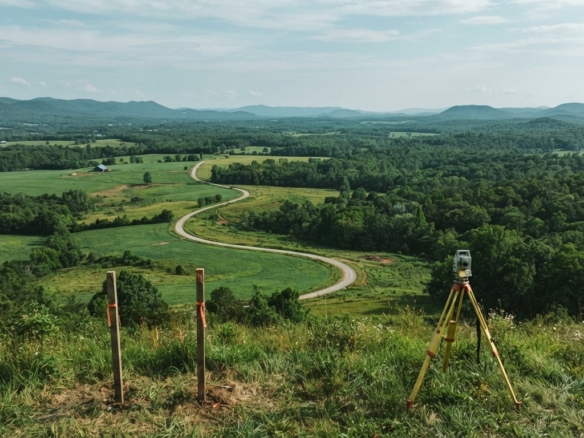
- Order a Professional Survey: Provide your new address to the surveyor to establish a permanent, recognized reference point for your boundaries.
- Secure Temporary Power: Utility companies will finally accept your application for a temporary service pole now that a service address exists.
- Apply for Well and Septic Permits: Most health departments require a physical address before they will schedule a perk test or issue drilling permits.
If your goal is a swift sale, update your listing immediately. Highlight the fact that the property is already addressed and “mail-ready.” This small detail separates your lot from the thousands of raw parcels that lack a basic identity. Consider listing your newly addressed property on BuyVacantLand.com to reach a specialized audience of buyers who specifically look for development-ready residential and off-grid lots. You’ve turned a coordinate into a home site; now make sure the market knows it.
Secure Your Property’s Identity Today
A physical address is the bridge between raw land and a functional home site. You now have a clear roadmap for how to get a physical address for land by navigating county departments and syncing with the USPS. Remember that your driveway location dictates your number. Coordinate with local inspectors early to avoid planning delays. Activating your address with the Postmaster ensures you are visible to utility providers and emergency services alike.
Your property is an investment that deserves a recognized place on the map. Securing an address eliminates buyer uncertainty and unlocks development potential. If you want to skip the bureaucratic hurdles, we have the solution. Browse thousands of vacant land parcels with established addresses on our marketplace. Our national platform focuses exclusively on raw land. We offer residential, off-grid, and commercial lots through a simplified listing process. Take the final step to turn your land into a verified asset today.
Frequently Asked Questions
Can I get an address for raw land without a house on it?
Yes, but the requirements depend on your local jurisdiction. Many counties only issue a physical address if you have an active building permit or a defined driveway entrance. Some rural areas allow addressing for vacant parcels to facilitate utility connections or emergency response. Check with your local Planning and Zoning Department to see if a structure is a prerequisite in your specific area.
How long does it take to get a physical address assigned?
Processing times generally range from 10 business days to four weeks. The workload of your local issuing authority and the complexity of your site plan determine the speed. Some jurisdictions, like Salt Lake County, aim for a 10-day turnaround. Others require a physical on-site inspection of the driveway entrance, which can extend the timeline depending on staff availability and seasonal weather conditions.
Does it cost money to get an address for my land?
Expect to pay an administrative fee between $50 and $500. This covers the cost of staff review and database updates. For instance, Santa Cruz County, California, charges $132.00 for processing. Salt Lake County uses a $100.00 flat fee plus $40.00 per address. Always confirm the current fee schedule with your local 911 Addressing Coordinator before you submit your formal application.
Why can’t I just make up my own address for my property?
A self-assigned address is invisible to emergency services and utility companies. Official addresses must follow a logical grid or distance-based system to ensure first responders can locate you during a crisis. If your address isn’t in the official county and USPS databases, you won’t receive mail, and utility providers cannot create a service account. Unauthorized numbers lead to dangerous confusion for delivery drivers and paramedics.
What is the difference between a 911 address and a mailing address?
A 911 address is a geographic identifier used by emergency dispatchers to find your property. A mailing address is a verified record in the USPS system that allows for mail delivery. While they are usually the same number, the USPS must manually activate your county-assigned address before it becomes a valid mailing point. Learning how to get a physical address for land involves securing both of these designations.
Will Google Maps automatically show my new land address?
Google Maps does not update instantly. Once the county assigns your address and the USPS adds it to the Address Management System, third-party mapping services eventually crawl that data. This sync can take several months. You can manually suggest an edit on Google Maps by dropping a pin and providing your official address verification letter to speed up the digital visibility of your property.
Do I need an address to get property insurance for vacant land?
Most insurance providers require a physical address to accurately assess risk and underwrite a policy. While some companies may use a legal description for basic liability on raw land, a street address is almost always required for builders’ risk or fire insurance. Having a verified location provides the certainty insurers need to offer competitive rates. It moves your land from a speculative lot to a recognized asset.
Can I use a GPS coordinate instead of a physical address for utilities?
Utility companies cannot use GPS coordinates to create a billing account or drop a service meter. They operate on a service address model that integrates with their internal logistics and taxing software. You must understand how to get a physical address for land to satisfy the requirements of power, water, and gas providers. Without a formal street number, your land development plans will likely remain stalled at the permit stage.


Join The Discussion