
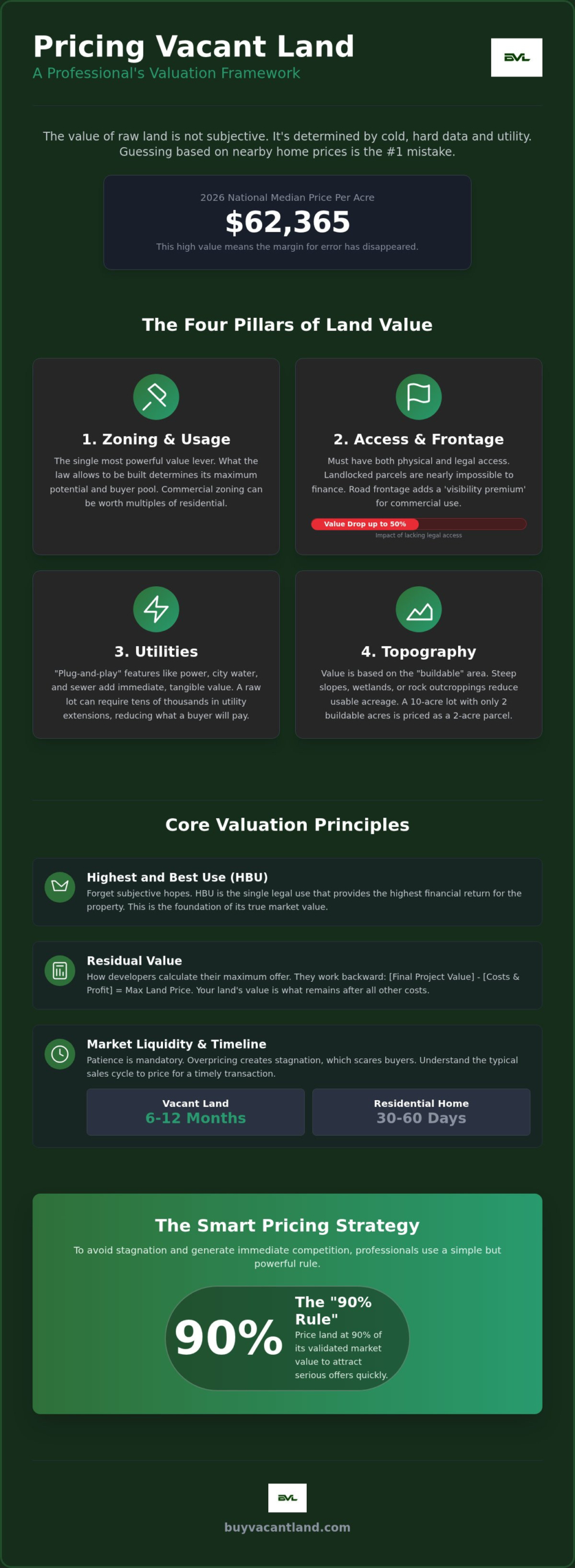
Your vacant land isn’t worth a penny more than what its specific utility dictates. Guessing at a number based on nearby home prices is the fastest way to ensure your property sits on the market for years. Mastering how to price land for sale requires a total shift from subjective hope to cold, hard data. With the national median price per acre hitting $62,365 in early 2026, the margin for error has disappeared. You need a strategy that accounts for raw utility and scarcity rather than just a neighborhood feel.
It’s stressful to own an asset that costs you taxes every year without providing a return. You likely worry about listing too high and scaring off buyers or listing too low and leaving thousands on the table. We understand that valuing raw land feels like a mystery when there are no structures to compare. This article promises to hand you the exact methodology professional investors use to determine maximum market value. You will gain the confidence to set a specific dollar amount that attracts serious offers immediately. We will cover the 2026 valuation framework, including how the 21st Century ROAD to Housing Act impacts your zoning and which specific factors add or subtract value from your dirt.
Key Takeaways
- Identify the “Highest and Best Use” of your parcel to move beyond subjective guessing and find its true market utility.
- Master the professional methodology for how to price land for sale by adjusting recent comparable sales based on size, zoning, and legal access.
- Evaluate the “Four Pillars of Land Value” to understand how road frontage and utility availability drastically shift your property’s worth.
- Apply the “90% Rule” to generate immediate buyer competition and ensure your asset doesn’t sit stagnant for years.
- Validate your final list price using specialized land marketplaces to capture real-time demand from targeted buyers.
Understanding Why Vacant Land Valuation Differs from Residential Real Estate
Land isn’t a house. Houses have finished kitchens, HVAC systems, and roof warranties. Land is raw potential. Most sellers fail because they look at neighboring home prices to decide how to price land for sale. This is a massive mistake. Home prices reflect labor and material costs that don’t exist on your vacant lot. Instead, land value depends entirely on its “Highest and Best Use” (HBU). This concept determines which legal use provides the highest financial return for that specific dirt.
Standard Real estate appraisal methods for houses don’t work for acreage. You must look at land-specific data. A 5-acre plot zoned for a multi-family complex is worth significantly more than 5 acres restricted to a single cabin. Volatility is high because value shifts based on development potential. You also face holding costs. Property taxes and brush clearing expenses drain your bank account every month the property remains unsold. If your price doesn’t reflect the cost of carrying the asset, you’re losing money daily.
The Concept of Residual Value in Land
Developers don’t guess; they work backward. They use a calculation called residual value. They estimate the final sale price of the finished project, then subtract construction costs, permits, and their required profit. What remains is the most they can pay you. Your land is worth more to a professional builder who can maximize density than to a passive investor who just wants to hold it. Residual Value is the maximum price a developer can pay for land while maintaining a viable profit margin after all construction and marketing costs.
Market Liquidity: Why Land Takes Longer to Sell
Patience is required in this industry. Residential homes often sell in 30 to 60 days. Vacant land typically sits for 6 to 12 months. This longer timeline is normal. However, pricing your property too high creates stagnation. A “stale” listing makes buyers wonder if the soil is contaminated or the title is clouded. If you need a faster exit, you must adjust your price to reflect current demand. You can learn more about accelerating the process in our guide on how to Sell Vacant Land Fast in Florida: A Guide.
Effective pricing requires understanding these three factors:
- Zoning: What the law allows you to build under the 2026 ROAD to Housing Act.
- Utility: The presence of water, sewer, and power.
- Access: Whether a buyer can actually reach the property via a paved road.
Focus on these metrics to avoid the trap of overpricing. Your land is a financial asset, not a decoration. Treat it like one.
Evaluating the Four Pillars of Land Value: Utility and Scarcity
Valuing land requires looking at what the dirt can actually do. You can’t rely on sentiment. You must analyze the physical and legal constraints of the property. Knowing how to price land for sale means evaluating four specific pillars: zoning, access, utilities, and topography. These factors create the utility that buyers pay for. Scarcity in any of these categories drives the price up. If your land lacks one, the value drops immediately.
The ‘Zoning Multiplier’: How Usage Dictates Price
Zoning is the most powerful lever in land valuation. A parcel zoned for “Light Commercial” use often commands a massive premium over land restricted to a single residential dwelling. You must check county records for density limits and set-back requirements. These rules determine how many units a developer can fit on the site. If the land is “Unrestricted,” it appeals to a specific off-grid buyer but may lack the pricing floor of a suburban lot with guaranteed development rights. Always verify the current classification before setting your price. Usage dictates the buyer pool, and the buyer pool dictates the price.
Access and Frontage: The ‘Visibility’ Premium
Never confuse physical access with legal access. Physical access means you can drive a truck onto the lot today. Legal access means you have a deeded, recorded right to be there. Banks rarely lend on landlocked property. If a parcel lacks a recorded easement or road frontage, its value can plummet by 50% or more. In commercial contexts, value is often calculated per linear foot of road frontage. High visibility equals high traffic, which justifies a higher asking price. If you want to see how similar parcels are positioned in the current market, you can browse vacant land for sale on specialized marketplaces to compare frontage data.
Utilities and infrastructure add immediate equity. Power, city water, and a pre-installed septic system are “plug-and-play” features. A buyer will pay more for a lot that is ready for a permit than one requiring $30,000 in utility extensions. Finally, look at the dirt itself. Steep slopes, rock outcroppings, or federally protected wetlands reduce the “buildable” area. If only two acres of a ten-acre lot are buildable, you must price the property based on those two usable acres. Precision here prevents your listing from sitting idle while buyers pass it over for easier projects. Focus on buildability to ensure a swift transaction.
The Comparable Sales Method: How to Find and Adjust ‘Comps’ for Raw Land
To master how to price land for sale, you must ignore asking prices. They are just wishes. You need “Sold” data to find the truth. The Sales Comparison Approach is the professional standard for valuation. It relies on concrete historical data rather than optimistic listing prices. Follow this four-step process to build your valuation framework:
- Step 1: Gather ‘Sold’ data. Find transactions from the last 6 to 12 months. Stay within a 5 to 10 mile radius to ensure market conditions are identical.
- Step 2: Filter for similar size. Comparing a 1-acre lot to a 40-acre tract is useless. Large parcels sell for less per acre because the buyer pool is smaller.
- Step 3: Apply the ‘Rule of Threes.’ Never base your price on a single sale. Find at least three similar properties to establish a reliable value range.
- Step 4: Use an adjustment grid. If your comp has power but your lot doesn’t, subtract the estimated cost of installation from the comp’s price to find your lot’s value.
Finding Reliable Land Data
Don’t trust general real estate site estimates for raw land. They’re often wildly inaccurate. You need actual sold prices from county records or specialized land marketplaces. Active listings represent the market ceiling. They show you what hasn’t sold yet. If you want to understand the broader landscape, read our Lands of America: Your Comprehensive Guide to Buying Vacant Land. Relying on “sold” data ensures you don’t list a property that sits stagnant for years.
Making the Adjustments: The DIY Appraisal
A DIY appraisal requires adjusting for specific features. Utilities are a major factor. Power at the lot line adds thousands in value compared to power 1,000 feet away. You must also adjust for the “Bulk Discount” effect. A 10-acre lot will almost always have a lower price-per-acre than a 1-acre lot in the same area. This happens because smaller lots are more affordable for a wider range of buyers. If a 1-acre lot sold for $20,000, don’t assume your 10-acre lot is worth $200,000. It’s likely closer to $120,000 or $150,000 depending on the local demand. Adjusting for these variables is the only way to determine how to price land for sale with surgical precision. Stop guessing and start calculating.
Strategic Pricing: Aligning Your Asking Price with Market Demand
You have calculated your base value. Now you must choose an execution strategy. Your “Exit Velocity” determines the final number. If you need cash in 30 days, you cannot price at the top of the market. Professional investors use the “90% Rule” to move property fast. Pricing 10% below the calculated market value triggers bidding wars. This often results in a higher final sale price than a stagnant high listing. Knowing how to price land for sale involves more than just math; it requires understanding buyer psychology.
Digital marketplaces use strict price filters. Pricing at $19,900 keeps you visible to everyone searching under $20,000. A price of $20,500 hides your listing from that massive buyer pool. Use psychological pricing to stay in front of your audience. Additionally, consider offering owner financing. Banks rarely lend on raw land. By providing terms, you can often command a 15% to 25% price premium. Buyers pay for the convenience of low down payments and accessible credit. Mastering how to price land for sale requires aligning your ask with actual buyer behavior.
Pricing for Different Buyer Personas
Different buyers have different priorities. A recreational buyer looking for cheap land for sale focuses on the total dollar amount. They want an affordable getaway. A custom home builder, however, evaluates residential lots based on site prep costs and proximity to utilities. You must align your price with the specific persona most likely to buy your dirt. Targeting the wrong audience with the wrong price point leads to a dead listing.
The Danger of ‘Testing the Market’ Too High
Many sellers list high to “see what happens.” This is a mistake. High “Days on Market” (DOM) stigmatizes your property. Buyers assume there is a hidden defect if it hasn’t sold in six months. This is known as the “Anchor Effect.” Your initial price sets the tone for all future negotiations. If you don’t see engagement within 30 days, trigger a price drop immediately. You should list your vacant land for sale today to gauge real-world buyer interest and adjust your strategy based on real-time data.
Testing Your Valuation: Leveraging National Land Marketplaces
You have calculated a specific dollar amount. Now you must validate it in the real world. Listing on a specialized land marketplace is the ultimate test for how to price land for sale. General real estate websites are built for houses. They are cluttered with kitchen photos and school district ratings that don’t apply to your dirt. A specialized platform connects you directly with land investors and builders. These buyers understand the value of raw utility and move faster than the general public.
Use inquiry volume as your primary indicator of price accuracy. This is real-time market feedback. If your listing receives zero calls or messages in the first 14 days, your price is likely too high. If you are overwhelmed with inquiries immediately, you have found the “sweet spot” that triggers buyer competition. High-quality drone photography and clear boundary descriptions justify your price. Buyers pay a premium when they can visualize the property’s potential. Be prepared to handle offers quickly. Distinguish between low-ball “bottom feeders” and fair market proposals based on the data you gathered during your research.
Why Specialized Marketplaces Win
Specialized platforms deliver targeted traffic. You aren’t competing with thousands of suburban homes for attention. You are reaching a national audience of buyers who specifically want raw acreage, off-grid tracts, or residential lots. This exposure is vital for rural properties that lack a large local buyer pool. If you choose to offer terms to justify a higher price point, ensure your listing highlights this benefit. You can learn the details of this strategy in our Owner Financed Land: The Complete 2026 Guide. Reaching the right audience reduces the need for desperate price slashing.
Ready to List Your Land?
The valuation workflow is simple: Research, Adjust, Strategize, and List. You have moved from confusion to a data-driven listing price. Mastering how to price land for sale removes the stress of asset ownership. It turns a stagnant piece of dirt into a liquid financial resource. Stop paying taxes on a property you no longer want. Take the final step toward a swift and assured transaction. List your property on BuyVacantLand.com to reach thousands of active buyers today and secure an equitable financial proposal for your land.
Secure Your Equitable Financial Proposal Today
You now have the framework to stop guessing and start selling. Successful land owners prioritize data over sentiment. Analyzing the four pillars of value and adjusting for specific site features ensures your property attracts serious offers immediately. Mastering how to price land for sale transforms a static asset into liquid capital. You don’t need to worry about listing too high and letting your property sit stagnant for years.
The final step is exposure. You must put your property in front of buyers who specifically want raw land and residential lots. Specialized platforms provide the targeted traffic that general residential sites lack. This focus ensures you receive fair market proposals without the constant pressure to slash your price. It’s time to stop paying taxes on a property you no longer use.
Ready to move forward? List your vacant land for sale on BuyVacantLand.com today. Our specialized platform connects you with a national audience of dedicated buyers. There are no hidden service fees for listing your property. Take control of your asset and secure the relief that comes from a swift, assured transaction. You are ready to close the deal.
Frequently Asked Questions
How do I find out what land sold for in my area?
You find actual sold prices by checking county deed records or property tax assessments. These are public records accessible at the local recorder’s office. Specialized land marketplaces often aggregate this data for users to simplify the process. Don’t rely on active listing prices found on general real estate sites. Those numbers represent the seller’s hope; not the market’s reality. Understanding how to price land for sale requires looking at recorded transaction amounts.
Is an acre of land worth more if it is cleared or wooded?
Cleared land usually commands a higher price because it is build-ready. Buyers save on the heavy costs of stump removal and brush clearing. However, if you are selling hunting land or high-end secluded estates, mature timber adds aesthetic value. For most residential lots, clearing the building envelope makes the property more attractive to custom home builders. They want to start construction immediately without the burden of site preparation costs.
Does having a survey increase the value of my land?
A recent survey significantly increases land value by removing boundary disputes. It provides a legal guarantee of what the buyer is actually purchasing. Banks often require a survey before approving a land loan. Having your corners marked and a recorded plat map available makes your property shovel-ready. This certainty allows you to maintain a firm asking price. It also speeds up the closing process by eliminating due diligence hurdles.
How much value do utilities like water and power add to vacant land?
Utilities like water and power move your property into a higher valuation tier. The presence of these services can add 20% to 30% to the base value of raw land. Buyers avoid the high cost and long wait times associated with extending main lines from the street. If your land has a pre-installed septic system or city sewer connection, it becomes even more desirable. These features make the development process much simpler.
Can I price my land higher if I offer owner financing?
You can absolutely price your land higher if you offer owner financing. Many buyers cannot secure traditional land loans due to strict bank requirements. By acting as the lender, you increase the pool of eligible buyers significantly. This convenience allows you to charge a 15% to 25% premium on the sale price. It also provides you with steady monthly income through interest payments while you retain the deed as collateral.
What is the difference between an appraisal and a broker price opinion (BPO)?
An appraisal is a formal, legally binding valuation performed by a state-licensed appraiser. It follows strict federal guidelines and is required for bank financing. A Broker Price Opinion is a less formal estimate provided by a real estate professional. BPOs are faster and cheaper but lack the legal weight of an appraisal. Use a BPO for your initial strategy on how to price land for sale and an appraisal for formal financing.
How long does it typically take to sell vacant land at a fair price?
Selling vacant land typically takes six to twelve months. This is much longer than the 30-day window common in residential housing. Land is a niche asset with a smaller buyer pool than homes. If your property is priced correctly, you should see consistent inquiry volume from the start. Properties that are priced at 90% of market value often sell faster. This strategy triggers immediate interest from professional land investors.
What should I do if my land hasn’t received any offers in 90 days?
If you haven’t received offers in 90 days, your price is likely the obstacle. Review your inquiry volume first. If people are viewing the listing but not calling, the price doesn’t match the utility. Check your listing photos and descriptions for clarity. If the marketing is solid, trigger a price drop of 5% to 10% immediately. This refreshes your listing in search results and signals to buyers that you are motivated to sell.


Join The Discussion