

Stop letting high bank interest rates and strict credit requirements kill your land deals. In 2026, savvy sellers are bypassing traditional lenders to close sales on their own terms. Recent market reports indicate that owner financing now accounts for nearly 25% of rural land transactions. You shouldn’t have to deal with endless red tape or expensive legal fees just to move a piece of raw land. Using a professional seller financing land contract template allows you to act as the bank and secure your investment without the headache. It’s about speed, simplicity, and getting the deal done.
You want a clean transaction without the fear of a bad contract coming back to haunt you. We agree that property ownership should be a benefit, not a burden. This guide provides a clear, no-nonsense breakdown of every essential clause your vacant land agreement must include to protect your equity. You’ll learn how to structure payment terms and handle defaults effectively. We’re showing you exactly how to navigate the transfer process to ensure a successful, bank-free closing.
Key Takeaways
- Master the “Contract for Deed” structure to retain legal title while your buyer builds equity.
- Use a professional seller financing land contract template to secure your deal with precise property descriptions and APN details.
- Protect your investment with land-specific clauses for access and zoning that generic templates often ignore.
- Learn the critical steps for recording your contract to prevent double-sales and ensure a clean legal path.
- Discover how to simplify the selling process and connect with ready buyers for a fast, guaranteed transaction.
What is a Seller Financing Land Contract?
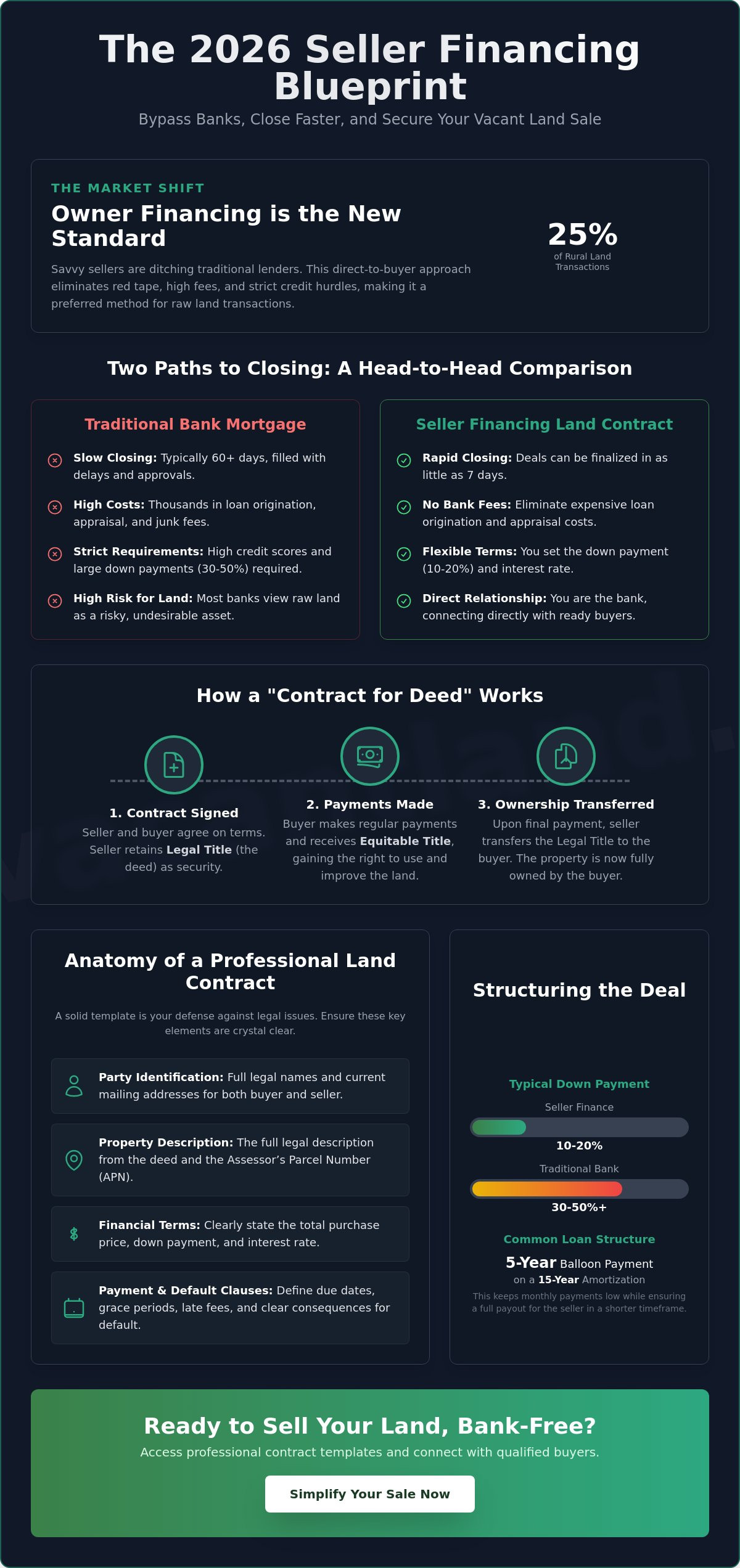
A seller financing land contract is a direct legal agreement between a buyer and a seller. In this arrangement, the seller acts as the lender. You skip the bank entirely. This is a pragmatic solution for raw land transactions in 2026. Most traditional lenders view vacant land as high risk. They often demand 30% or 50% down payments. A Land contract bypasses these hurdles. You use a seller financing land contract template to set your own terms. This document outlines the price, interest rate, and payment schedule. It’s fast. It’s efficient. It works.
This arrangement is often called a “Contract for Deed.” The buyer gains equitable title immediately. This means you have the right to use, clear, or improve the land. The seller keeps the legal title until you pay the final dollar. Once the balance hits zero, the seller transfers the deed to you. This structure provides a simple, three-step path to ownership. 1. Agree on terms. 2. Sign the contract. 3. Start your payments. It’s that simple. Banks avoid raw land because it doesn’t produce immediate income. A land contract solves this by removing the corporate gatekeeper.
The core benefit of this method is the total elimination of red tape. You save money because there are zero loan origination fees. There are zero appraisal requirements from a bank. You get a guaranteed path to ownership without the stress of a corporate loan officer. Closings happen quickly. You can move from an offer to a signed agreement in days, not months. This speed is essential in a competitive 2026 market where prime raw land sells fast.
Land Contract vs. Traditional Mortgage
Banks are middlemen. They add months of delays and charge thousands in junk fees. A land contract eliminates these costs. You can close a deal in 7 days instead of 60. This is the primary benefit of owner financed land for buyers with low credit scores. You deal directly with the owner. There are no predatory bank fees. There is no waiting for a committee’s approval. The seller cares about your down payment and your ability to pay, not a number from a credit bureau.
Common Terminology You Must Know
You must understand three specific terms before signing. First, Equitable Title gives you the rights of a homeowner while you make payments. Second, Legal Title is the actual deed held by the seller as security. Third, a Balloon Payment is a large final payment due at a specific date, usually 36 to 60 months into the term. Sellers don’t want to wait 30 years for their money. Finally, Amortization determines how much of your monthly land payment goes to interest versus the principal. Using a professional seller financing land contract template ensures these terms are clear and legally binding for both parties.
Essential Elements of a Professional Land Contract Template
A professional seller financing land contract template is your primary defense against legal headaches. It transforms a handshake deal into a binding financial instrument that protects your equity. You cannot afford to be vague when dealing with raw land. Every contract must start with precise party identification. Include the full legal names and current mailing addresses of both the buyer and the seller. This ensures there is no confusion about who is responsible for the debt.
Accuracy in the property description is non-negotiable. You must include the full legal description found on the most recent deed. Simply using a street address is not enough for vacant land. Include the Assessor’s Parcel Number (APN) to provide a secondary layer of identification. Understanding the legal requirements for a land contract helps you avoid common drafting errors that could void the agreement. State the total purchase price clearly alongside the initial cash required at signing. This transparency prevents disputes during the payment term.
Calculating Interest Rates and Payments
Setting the right interest rate is a balancing act. In the 2026 market, land financing rates often sit 3% to 6% higher than traditional residential mortgages. This premium accounts for the higher risk of raw land. Aim for a “fair” rate that provides you with a solid return while remaining affordable for the buyer. Most successful sellers use a fixed rate to keep the math simple and predictable.
Structure your payment schedule with a specific due date, such as the first of every month. Include a grace period and a defined late fee to encourage timely behavior. Amortization schedule is the roadmap for ownership. It shows the buyer exactly how much of each payment goes toward interest and how much reduces the principal. Many sellers use a 15-year amortization period but include a 5-year balloon payment. This keeps monthly payments low but ensures you get your full payout sooner.
The Down Payment: Protecting the Seller
The down payment is your safety net. In land transactions, a 10% to 20% down payment is the standard requirement. This initial cash serves two purposes. First, it covers your immediate costs like marketing and title searches. Second, it establishes buyer “skin in the game.” When a buyer invests 20% upfront, they are significantly less likely to default on the contract.
A substantial down payment provides immediate relief and liquidity to the seller. It proves the buyer has the financial stability to see the deal through to the end. If you are a buyer looking to enter the market, check out this guide on how do you buy land to ensure your finances are ready for the commitment. If you find the process of managing a contract too slow, you can always get a fair cash offer and close the deal in days instead of years.
Critical Land-Specific Clauses Generic Templates Miss
Generic legal forms often treat raw land like a suburban house. This is a dangerous mistake. Raw land lacks a physical structure to act as collateral. The value sits entirely in the dirt and the resources. If your seller financing land contract template doesn’t account for specific land risks, you’re exposed. You must define legal access and easements immediately. A property without a recorded easement is a liability. Your contract should also address timber and mineral rights. A buyer could clear-cut $10,000 worth of hardwood and walk away before the deed transfers. State clearly that resource rights remain with the seller until the final payment hits your account.
Zoning and land use clauses are equally vital. You need to control what happens on the property during the contract term. Understanding How Owner Financing Works helps you see why these protections are necessary for a secure transaction. Ensure the buyer agrees to comply with all local 2026 zoning ordinances. This prevents you from inheriting code violations or illegal dump sites if the buyer defaults.
Handling Property Taxes and HOA Fees
Follow the Pragmatic Seller rule: always pay the property taxes yourself. Don’t rely on the buyer to send checks to the county. If they miss a payment, a tax lien accumulates on your property. This can lead to a tax foreclosure in as little as 2 years in many jurisdictions. Pay the bill directly and invoice the buyer for the amount. This keeps you in total control of the title’s cleanliness. For your seller financing land contract template, include a Tax Impound clause. This clause requires the buyer to pay 1/12th of the estimated annual taxes and HOA fees along with their monthly principal and interest payment. It’s a simple, zero-stress way to ensure the government stays out of your business.
Restrictions on Improvements and Waste
Prevent the buyer from devaluing your asset. Many people searching for cheap land for sale overlook the risks of unrestricted usage. Your contract must prohibit “waste.” This includes unauthorized excavation, dumping, or the removal of valuable topsoil. Require written consent and proof of permits for any temporary structures or off-grid setups. This protects you from 2026 environmental regulations and potential cleanup costs. Use these specific rules to maintain your property value:
- No permanent structures without a 25% equity stake.
- No commercial timber harvesting until the balance is zero.
- Mandatory liability insurance for any high-risk activities.
- Strict “no-dumping” clauses with immediate default penalties.
These steps ensure your land remains an asset, not a burden. Keep your process fast and your equity protected.
Legal Procedures: Recording and Default
A reliable seller financing land contract template isn’t just a piece of paper. It’s a legal framework that requires specific actions to stay valid. You must secure a Title Commitment before signing. This document reveals the land’s history and any existing liens. It proves the seller actually owns what they’re selling. Private deals often skip this step to save money, but that’s a massive risk. You can keep closing costs at zero by negotiating directly with the seller to handle paperwork in-house. This strategy eliminates the $500 to $1,500 fees typically charged by traditional title companies.
The Importance of Recording Your Land Contract
Go to the County Recorder’s office immediately after signing. Recording the document puts the world on notice. It creates a public record of your interest in the property. This process prevents the seller from selling the same plot to another buyer next week. Your primary shield is Constructive Notice. This legal concept means anyone searching the public record is legally aware of your claim. It stops double-sales and protects your equity from the seller’s future creditors. If you don’t record the contract, you’re essentially invisible to the law.
Managing Default and Forfeiture
Land contracts usually include a forfeiture clause. This is faster and simpler than a standard mortgage foreclosure. If a buyer stops paying, the process begins with a grace period. Standard templates often allow 15 to 30 days for the buyer to catch up. After this window closes, the seller sends a Notice of Intent to Forfeit. This is the first formal legal step. It warns the buyer that the contract will end and they’ll lose all previous payments.
Laws vary significantly by state. You should check the specific land for sale in florida regulations for regional nuances regarding notice periods. Forfeiture returns the property to the seller without a lengthy court battle. It’s efficient and keeps the process moving. For the seller, it means getting the land back to sell again. For the buyer, it means losing their investment. Clear communication during this phase is vital to avoid litigation.
- Grace Period: Usually 15 to 30 days to remedy a missed payment.
- Notice of Intent: The formal warning before legal forfeiture begins.
- Title Insurance: A non-negotiable step to verify ownership.
- Zero Closing Costs: Achieve this by managing the filing and paperwork yourself.
Stop worrying about complex legal red tape and expensive attorney fees. Get your fair cash offer today and sell your land without the headache of managing a contract.
Buy or Sell Owner-Financed Land Today
You have the knowledge. You have the seller financing land contract template ready for use. Now you need a marketplace that moves as fast as you do. BuyVacantLand.com simplifies the connection between motivated sellers and ready buyers. We strip away the complexity of traditional real estate. You get a direct, bank-free environment where deals close without the 6% commission hit. Our platform is built for speed. It’s built for people who value their time and want results without the typical industry fluff.
Sellers benefit from a national audience without spending a dime on listing fees. You reach thousands of investors searching for specific opportunities. Buyers get access to “Bank-Free” land deals across the United States. This means no credit score hurdles and no predatory bank interest rates. It’s a win for both sides. The process is transparent. The results are guaranteed. Take your template and apply it to a real listing today to see how efficient land ownership can be.
Listing Your Property with Owner Financing
Flagging your listing as “Owner Financed” is the fastest way to attract serious inquiries. In many rural markets, listings with seller terms see 40% more engagement than cash-only properties. Buyers search specifically for these terms to avoid the rigid requirements of traditional lenders. Our platform allows you to highlight these terms prominently. You control the down payment. You control the interest rate. You keep the equity until the final payment is made.
Zero commission listings are the standard here. You don’t need a broker to facilitate a fair deal. By removing the middleman, you secure a better price and a faster closing. We provide the platform; you provide the land. It’s a pragmatic solution for the modern landowner. List your vacant land now and put your property in front of a national network of buyers today.
Finding the Right Plot of Land
Finding land shouldn’t feel like a second job. Our marketplace uses precise filters to help you locate off-grid escapes, residential lots, or commercial acreage in seconds. We focus on “Bank-Free” land deals across all 50 states. This removes the stress of dealing with loan officers who don’t understand raw land value. You deal directly with the owner. You use your seller financing land contract template to lock in the terms that work for your budget.
Our discovery process is built for efficiency. It mirrors the ease of major listing sites but focuses strictly on direct owner transactions. This eliminates the confusion of third-party agents. You see the land, you talk to the owner, and you start your path to ownership. The relief of finding the perfect plot is just a few clicks away. Browse our current land listings to find your next investment or homestead right now.
Secure Your Land Deal with Confidence
Success in 2026 land transactions depends on precision and speed. You need a professional seller financing land contract template that includes specific clauses for legal access and mineral rights. Generic forms often fail to protect sellers from default or buyers from title issues. Always record your executed contract with the local county recorder within 30 days to ensure your legal interests are publicly documented. This simple step eliminates future ownership disputes and secures your investment.
Stop struggling with the slow, expensive traditional real estate market. Our specialized marketplace focuses only on raw land, connecting you directly with cash buyers and sellers nationwide. You’ll deal with zero commissions and zero hidden fees. We cut through the red tape to provide a direct path to a closed deal. It’s time to move forward without the typical stress of property ownership.
Don’t let your land become a financial burden. Take action now to simplify your life. List Your Land for Free and Get a Fair Cash Offer today. You deserve a fast, guaranteed solution that puts your needs first. Your next successful transaction starts right here.
Frequently Asked Questions
Is a seller financing land contract the same as a mortgage?
No. A land contract keeps the legal title in the seller’s name until the buyer makes the final payment. A mortgage transfers the title to the buyer at closing while the lender records a lien against the property. Land contracts are often faster because they bypass 30-day bank underwriting cycles. You get a direct agreement without the traditional red tape of a commercial bank.
Can I use a generic template for any state in the US?
No. Every state has unique statutes governing real estate transfers and foreclosure rights. For example, Ohio Revised Code Chapter 5313 sets strict rules for land contracts that don’t apply in Texas. Using a generic seller financing land contract template without state-specific clauses puts your investment at risk. Always verify your document meets local 2026 legal requirements to ensure it’s enforceable in court.
What is the typical interest rate for a land contract in 2026?
Expect interest rates between 8% and 12% in 2026. This range reflects the increased risk sellers take by bypassing traditional credit checks. According to 2025 market trends, seller-financed rates typically sit 3% to 5% above the current 30-year fixed mortgage rate. Negotiate these terms directly with the buyer to ensure the deal remains profitable for both parties and covers your carrying costs.
Who is responsible for property taxes in a land contract?
The buyer typically pays property taxes and insurance premiums. Most contracts require the buyer to provide proof of payment to the seller annually by January 31. This protects the seller’s interest in the property. If the buyer fails to pay, the seller can pay the taxes and add that cost to the principal balance to prevent a 2026 tax lien from attaching to the land.
What happens if the buyer defaults on a land contract?
The seller can initiate a forfeiture or foreclosure process depending on state law. In states like Michigan, a seller can regain possession in 90 days if the buyer has paid less than 20% of the purchase price. If the buyer has significant equity, a full judicial foreclosure is often required. This process typically takes 6 to 12 months to complete in most jurisdictions across the country.
Do I need a title company for a seller-financed land deal?
Yes. Use a title company to perform a title search and issue insurance. This ensures the land is free of undisclosed liens or 20th-century easements that could ruin the deal. A title company also acts as a neutral third party to handle the closing and record the deed. Spending $500 to $1,500 on professional closing services prevents $10,000 legal headaches later in the process.
Can the buyer build a house on the land before it is paid off?
Yes, provided the contract explicitly permits construction. Most sellers require the buyer to obtain all necessary permits and maintain builder’s risk insurance before breaking ground. Ensure your seller financing land contract template includes a clause regarding “improvements.” This prevents the buyer from starting a project and leaving an unfinished, unsellable structure on your land if they default on their monthly payments.
How do I record a land contract at the county level?
Take the original signed and notarized document to the County Register of Deeds. Pay the recording fee, which usually ranges from $15 to $50 depending on the page count. Recording the contract creates a public record of the buyer’s interest. This step is vital because it prevents the seller from selling the same parcel to another person while the 2026 contract is active and in good standing.




Join The Discussion