
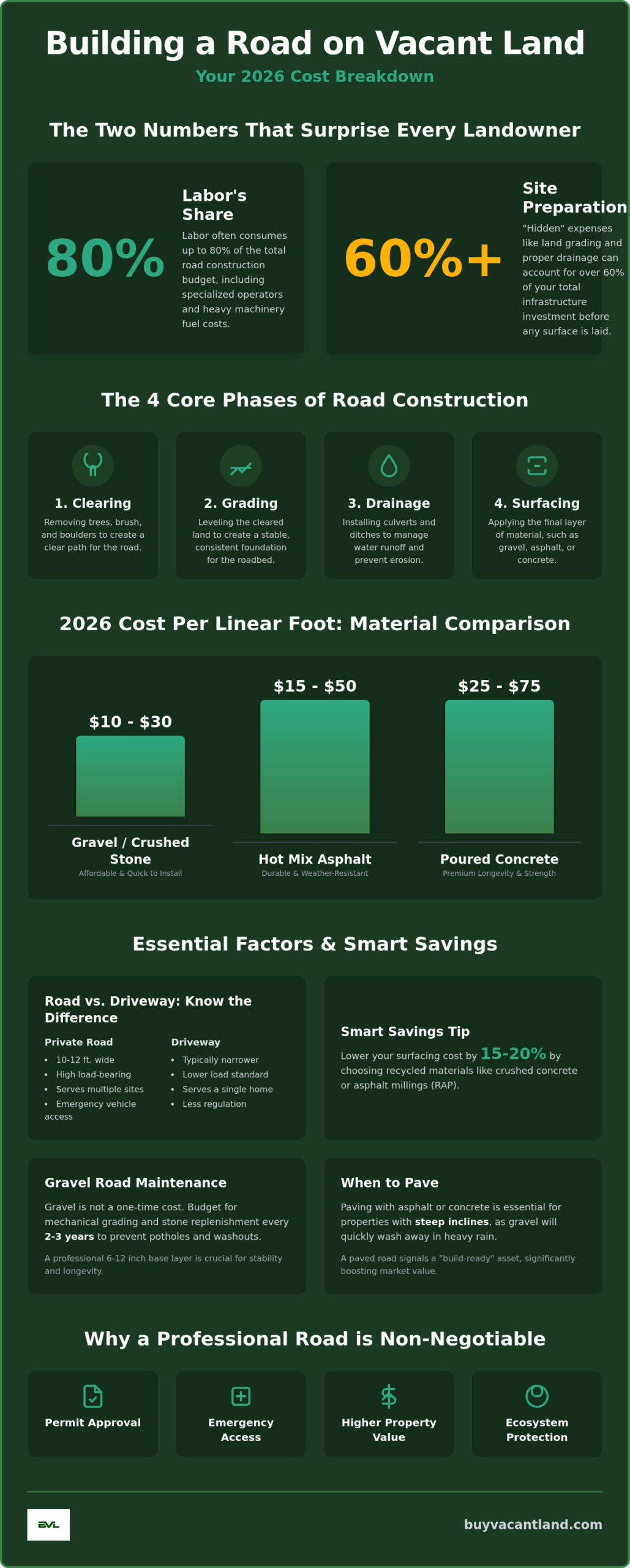
Did you know that labor often devours 80% of your total road construction budget? It’s a staggering figure that catches many vacant land owners off guard. If you’re looking at a raw parcel and wondering about the building a road on your property cost, you likely feel the pressure of unpredictable excavation fees and confusing material choices. You need a clear path to your build site; you don’t want to get buried in hidden expenses or permit traps before you even break ground.
We agree that budgeting for raw land development should be simple and transparent. This guide provides a direct, no-nonsense breakdown of road construction costs to help you budget for your vacant land project with total confidence. You’ll gain a clear budget range per linear foot and learn which materials fit your specific terrain. We’ll preview everything from $10 gravel options to $100 paved solutions, while identifying the hidden fees that often derail a project. Stop guessing and start planning with these verified 2026 cost benchmarks to ensure your land reaches its full financial potential.
Key Takeaways
- Pinpoint the exact building a road on your property cost by comparing 2026 material prices from basic gravel to premium asphalt.
- Identify hidden site preparation expenses like grading and drainage that often account for over 60% of your total infrastructure budget.
- Match road materials to your specific terrain to balance immediate construction speed with long-term maintenance requirements.
- Streamline the permitting and survey process to avoid environmental fines and ensure your road stays within legal property lines.
- Discover how adding professional road access transforms raw acreage into a high-value, build-ready asset that attracts more buyers.
Understanding Road Construction Costs: The 2026 Overview
Building a road is the first move in turning raw land into a functional asset. Without access, your property remains a locked box. A well-constructed road transforms undeveloped acreage into a usable, buildable site. Professionals usually calculate the building a road on your property cost by the linear foot. For larger projects, like ranch development or industrial parcels, contractors provide estimates by the mile. This unit-based pricing allows for quick budgeting, but the final bill depends on the specific obstacles your land presents.
Four primary drivers dictate your final invoice: clearing, grading, drainage, and surfacing. Clearing involves removing trees, brush, and boulders. Grading creates a level, stable foundation. Drainage includes culverts or ditches to prevent water from destroying your investment. Surfacing is the final layer of gravel, asphalt, or concrete. In 2026, labor and fuel remain the most volatile variables in your estimate. Heavy machinery consumes significant diesel, and specialized operators command high hourly rates. Expect these costs to fluctuate based on local market demand and seasonal conditions.
The Difference Between a Driveway and a Road
Don’t confuse a simple driveway with a full-scale private road. A driveway usually serves one single structure. Roads often require higher load-bearing standards to support heavy delivery trucks or construction equipment. Width is a major factor. Standard private roads are typically 10 to 12 feet wide to allow for safe passage. Understanding these basics of road construction helps you avoid under-engineering your project. This distinction is vital when you plan your how do you buy land strategy. A parcel that already has a road is a much more efficient purchase than one requiring 500 feet of new construction.
Why Raw Land Needs Professional Access
Professional access is often a legal requirement, not just a convenience. Most counties will not issue building permits without a road that meets emergency vehicle standards. Fire trucks and ambulances need a stable, wide surface to reach your future home. Beyond legalities, a proper road protects the local ecosystem. It prevents soil compaction and manages water runoff to stop erosion. Permanent access is also a massive selling point. If you are looking for cheap land for sale, always factor in the building a road on your property cost. A low purchase price can quickly be erased by the high price of clearing a path through difficult terrain.
Cost Per Linear Foot by Road Material
Material choice is the primary lever in your development budget. It dictates your upfront cash outlay and your future maintenance schedule. For most rural or off-grid projects, gravel remains the industry standard. It’s affordable, easy to repair, and fast to install. If you require a permanent, dust-free surface, asphalt or concrete offer superior longevity but demand significantly higher initial capital. You can effectively lower the building a road on your property cost by 15% to 20% by opting for recycled materials. Crushed concrete and recycled asphalt millings (RAP) provide a durable, compacted surface for a fraction of the cost of virgin hot-mix asphalt.
Gravel and Crushed Stone Roads
Gravel and crushed stone roads generally cost between $10 and $30 per linear foot in 2026. This range depends on the width of the path and the local availability of stone. A 12-foot wide road will naturally sit at the higher end of that scale. Don’t skip the base layer to save money. A professional installation requires a 6 to 12-inch base of larger stones to provide structural integrity. This prevents the road from sinking into the mud during the spring thaw or heavy rains. A proper gravel base typically costs between $3 and $8 per square foot. Remember that gravel isn’t a “set it and forget it” solution. You must plan for mechanical grading and stone replenishment every 2 to 3 years to prevent potholes and washouts.
Asphalt and Paved Surfaces
Moving to paved surfaces creates a substantial price jump but offers a weather-resistant finish. Hot mix asphalt averages $15 to $50 per linear foot. Concrete is the premium choice, often ranging from $25 to $75 per linear foot. These materials are essential for properties with steep inclines. On a sharp grade, gravel will wash away during the first major storm. This leads to constant repair costs and lost access. Paving eliminates this issue entirely. High-quality road infrastructure also significantly boosts the market appeal of land for sale in florida and other high-demand regions. A paved road signals to buyers that a lot is truly build-ready, which justifies a higher asking price.
Balancing your initial investment against long-term utility is the key to a successful land project. If you haven’t secured your parcel yet, you can view available land listings to find properties where the road work is already partially or fully completed. This strategy can save you thousands in mobilization fees and engineering costs. Getting the road right the first time prevents expensive rework and ensures your land remains accessible in all seasons.
Site Factors That Inflate Your Road Budget
The “sticker price” of gravel is just the tip of the iceberg. Most landowners focus on the surface material, but the actual building a road on your property cost is largely determined by what lies beneath. Your terrain dictates the engineering complexity and the type of heavy machinery required to move earth. Clearing a dense forest costs significantly more than grading a flat meadow. In 2026, site preparation including clearing and grading can add $1 to $5 per square foot to your total bill. If your property is remote, mobilization fees for equipment delivery can add another $2,000 to $5,000 before the first bucket of dirt is moved.
Clearing and Grading Requirements
Clearing involves more than just pushing brush aside. You must remove trees, stumps, and large rocks to create a stable sub-grade. Tree removal is a massive budget driver, costing between $400 and $1,200 per tree depending on size and location. Once the path is clear, grading begins. A professional must create a proper “crown” where the center of the road is slightly higher than the edges. This ensures water runs off the sides rather than pooling in the middle. You also face costs for hauling away debris. Burning on-site might save money, but local regulations often require professional hauling. Land clearing for a road can cost between $250 and $1,000 per acre.
Culverts and Drainage Systems
Drainage is the most critical factor for road longevity. Water is the primary enemy of any dirt or gravel path. Skipping a $2,000 to $5,500 drainage system leads to total road failure within a single season. You need culvert pipes to cross low spots or existing streams safely. These pipes prevent water from washing out your foundation during heavy rainfall. To further protect your investment, use geotextile fabric. This industrial-strength cloth acts as a barrier. It prevents your expensive gravel from sinking into the soft mud below. While a 6 to 12-inch gravel base with fabric costs $3 to $8 per square foot, it’s a necessary expense. It ensures your building a road on your property cost stays a one-time investment rather than a recurring repair bill.
Permits, Surveys, and Regulatory Costs
Hard construction costs are easy to visualize. Regulatory “soft costs” are less obvious but equally critical to your budget. Building a road often triggers a wave of county or state environmental regulations. Ignoring these requirements is a fast track to heavy fines or a forced removal of your infrastructure. In 2026, the national average for a residential building permit is around $1,650. However, specific road permits like a grading/drainage permit or a private driveway approach permit add several hundred dollars more. These administrative expenses are a non-negotiable part of the building a road on your property cost.
The Importance of a Professional Survey
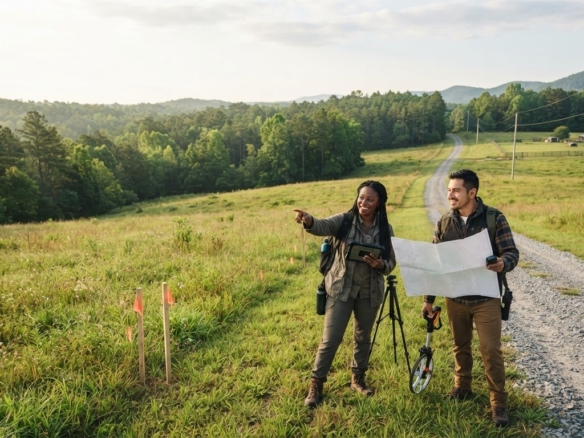
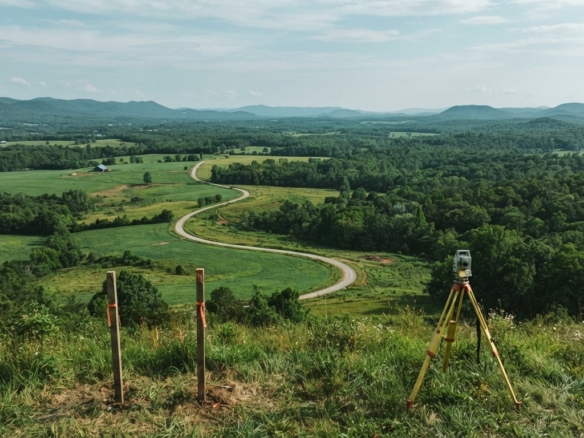
A professional survey is your first line of defense against legal disaster. You must stake the centerline of the road before any heavy machinery arrives. This ensures your construction aligns perfectly with your site plan. Encroaching on a neighboring parcel or a utility easement can result in a total loss of your investment. Understanding your boundaries is essential, especially when calculating how much is an acre of usable area you have left for your build site. A land survey for larger parcels can cost between $800 and $5,500 per acre. It’s a small price to pay to avoid a permanent boundary dispute.
Environmental and Building Permits
Environmental compliance is the most scrutinized part of road building in 2026. Erosion and sediment control (ESC) permits are usually required for any large-scale land disturbance. These permits ensure that runoff from your construction doesn’t pollute local waterways. If your road crosses sensitive areas, you’ll need a wetland delineation. This specialized survey identifies protected zones that cannot be disturbed. For steep or complex roads, counties often demand professional engineering stamps. A civil engineer must verify that your design is safe and sustainable. Always verify local zoning laws before breaking ground. Some jurisdictions have strict width or material requirements that can double your initial estimate.
Don’t let regulatory hurdles catch you by surprise. If you’re looking to acquire a property that already has these clearances in place, you can browse residential lots for sale that are ready for immediate development. Securing a lot with existing permits can save you months of administrative delays and thousands in engineering fees. Efficiency is the key to a successful land project.
Maximizing ROI: How Road Access Drives Land Value
Stop viewing the building a road on your property cost as a sunk expense. It is a strategic investment that transforms a dormant asset into a high-demand product. A property with a finished road is “build-ready,” which immediately attracts a wider pool of buyers. Raw, landlocked parcels often sit on the market for months because buyers fear the hidden costs of infrastructure. When you install a professional road, you remove that fear. You shift the burden of development from the buyer to the seller, allowing you to command a significant price premium. In the 2026 market, accessible land moves faster and sells for more than undeveloped acreage.
Road access also simplifies the financial side of a transaction. Appraisers and lenders prioritize accessible land. They see a road as a sign of lower risk. Most traditional banks won’t even consider financing a parcel that lacks legal, physical access. By completing the road work yourself, you make your land bankable. This opens your listing to buyers who need conventional loans, rather than just cash-heavy investors. This accessibility is the primary difference between a lot that lingers and one that closes quickly. If you are ready to move your asset, you can BuyVacantLand.com to reach a targeted audience of buyers specifically looking for improved, accessible lots.
Attracting Cash Buyers and Developers
Professional developers hunt for reduced risk. A road eliminates one of the biggest unknowns in their project timeline. You can justify a much higher asking price by highlighting this infrastructure in your marketing materials. Developers will pay more for a lot where the grading, clearing, and drainage work is already done. If you want to maximize your exit strategy, consider owner financed land strategies. Improved lots are perfect candidates for this approach. You can charge a premium interest rate and a higher sales price because the property is already functional. It provides immediate utility to the buyer, which is a powerful selling point in any economy.
Final Steps Before You Build
Complete the technical details before you break ground or list the property for sale. Schedule a final inspection with your county to ensure the road meets all local codes. This documentation is a valuable asset during the sales process. You should also set up a maintenance fund. As established in previous sections, gravel roads require replenishment every few years. Having a clear maintenance plan shows professional management. It gives buyers peace of mind and protects the building a road on your property cost you have already invested. List your vacant land today to connect with buyers who value accessibility and professional infrastructure. Turning raw acreage into a functional asset is the fastest path to a profitable transaction.
Take Command of Your Land Infrastructure
You now have the exact 2026 benchmarks needed to budget with precision. You’ve identified how material selection and site preparation define your final bill. You understand that drainage is non-negotiable for protecting your investment. Managing the building a road on your property cost is the first step toward transforming raw acreage into a high-value, build-ready asset. A professional road doesn’t just provide access; it provides a direct path to a more profitable exit strategy.
Don’t let your improved property sit idle. List your vacant land for sale on our national marketplace to capitalize on your hard work. Our specialized platform focuses exclusively on raw land, ensuring zero hidden listing fees and a direct connection to land-specific buyers. These investors actively seek parcels with established infrastructure. Take the final step today and turn your infrastructure investment into a closed transaction. Your build-ready land is a premium product; it’s time to treat it like one.
Frequently Asked Questions
How much does it cost to build a 1/4 mile gravel road in 2026?
A quarter-mile gravel road typically costs between $5,300 and $15,800 in 2026. This range covers standard installation and material for a 1,320-foot path. Your final building a road on your property cost will fluctuate based on the depth of the stone base and the amount of clearing required. If your land is heavily wooded, expect to pay more for stump removal and debris hauling.
Do I need a permit to build a road on my own private property?
Yes, you almost always need permits for road construction to ensure environmental and safety compliance. National averages for residential building permits sit around $1,650, while specific grading permits can cost about $100. These regulations prevent your road from causing erosion or flooding on neighboring parcels. Verify your local zoning requirements before you move any dirt to avoid heavy fines.
Which is cheaper: a gravel road or a dirt road?
A dirt road is cheaper upfront because it requires zero material costs. However, dirt roads are a poor investment because they become impassable during heavy rain and snow. Gravel is the more cost-effective choice over time. It provides a stable, all-weather surface that protects your land from erosion and ensures you don’t get vehicles stuck in the mud.
How wide should a private road be for construction equipment?
A private road should be 10 to 12 feet wide to accommodate heavy construction equipment and emergency vehicles. Fire departments often mandate a minimum 12-foot width to ensure their trucks can reach your build site safely. If you expect large deliveries like concrete trucks or lumber trailers, ensure your turns have a wide enough radius to prevent vehicles from sliding off the shoulder.
Does building a road increase my property taxes?
Building a road generally increases your property taxes because it raises the land’s assessed value. Improvements that make a lot build-ready signal to the tax assessor that the property is more valuable. While your annual tax bill might rise, the increase in market resale value usually far outweighs the additional tax expense. A build-ready lot is a much more liquid asset.
Can I build a road myself with a rented bulldozer?
You can rent equipment, but DIY road building is risky without engineering experience. Labor accounts for up to 80% of the building a road on your property cost because professional operators understand grading and soil compaction. A mistake in the road’s “crown” or drainage will cause the surface to wash away during the first major storm. Hiring a pro ensures the road lasts for years.
How long does it take to construct a standard property access road?
A standard access road usually takes one to two weeks to construct under normal weather conditions. This timeline includes clearing the path, grading the sub-base, and laying the final surface material. Extensive tree removal or the installation of complex culvert systems can add several days to the schedule. Always secure your permits and have materials delivered before the heavy machinery arrives.
What is the best material for a road on a steep slope?
Asphalt or concrete are the only reliable materials for roads on steep inclines. Gravel is a poor choice for slopes because water runoff and gravity will quickly wash the stones to the bottom of the hill. Paved surfaces provide the necessary traction and structural integrity to prevent erosion. While paving costs more initially, it eliminates the constant need for expensive grading and stone replenishment on grades.


Join The Discussion