

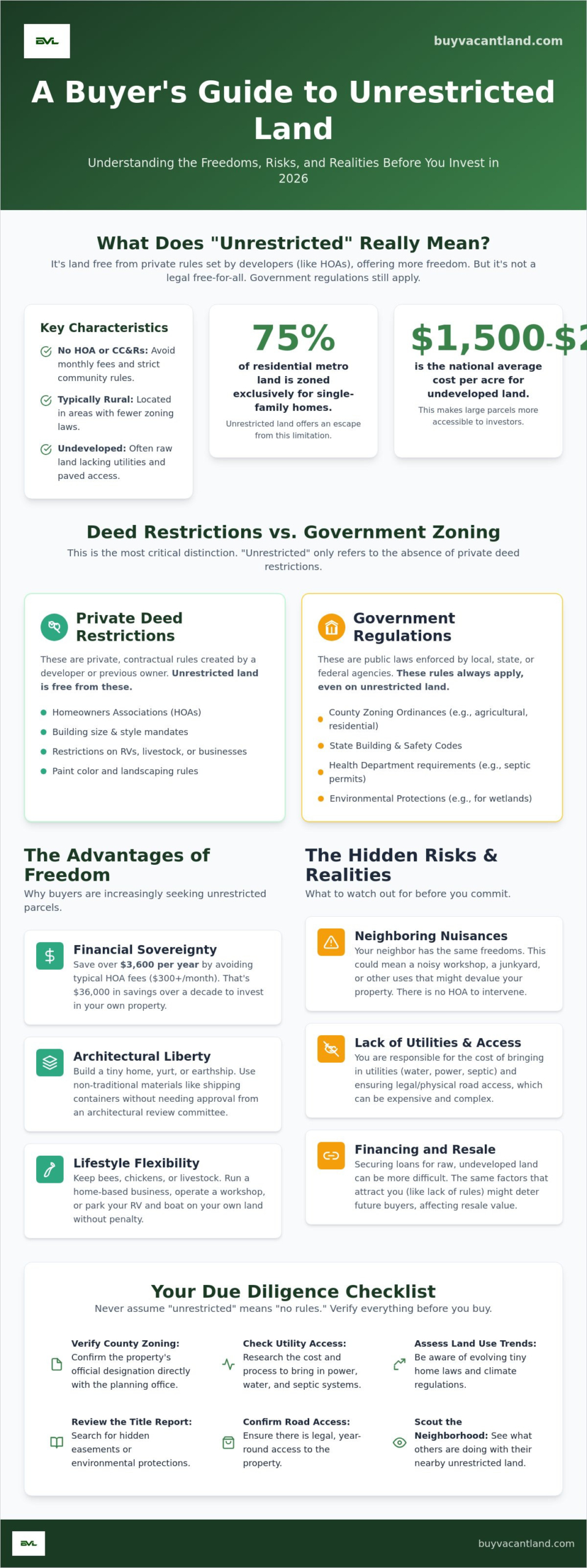
Does “unrestricted” really mean you can build anything you want, or are you walking into a regulatory trap? Most buyers assume these parcels offer total freedom. The reality is often more complex. To make a smart investment, you must understand the pros and cons of unrestricted land before committing your capital. While you might escape local zoning, state environmental laws and building codes still apply in 2026.
You likely feel the pressure to secure a deal before land prices climb higher. With the national average for undeveloped land currently between $1,500 and $2,500 per acre, the stakes are high. We understand the anxiety of potentially devaluing your investment because a neighbor builds something unexpected. This guide promises to clarify exactly what you can and cannot do with raw land. We will cover everything from deed restrictions to the 2026 financing landscape. You will get a clear checklist for your due diligence so you can buy with confidence.
Key Takeaways
- Identify the critical difference between private deed restrictions and government zoning to understand your true building rights.
- Evaluate the pros and cons of unrestricted land to determine if the freedom for alternative structures outweighs the risk of neighboring nuisances.
- Save money instantly by avoiding monthly HOA dues and special assessments common in restricted developments.
- Execute a precise due diligence plan by verifying county zoning and reviewing title reports for hidden environmental protections.
- Navigate 2026 land use trends to ensure your investment remains viable as tiny home laws and climate regulations evolve.
What is Unrestricted Land? Defining Total Property Freedom
Unrestricted land is property free from private contracts known as deed restrictions. It means no Homeowners Association (HOA) dictates your lifestyle. You won’t find Covenants, Conditions, and Restrictions (CC&Rs) telling you what color to paint your house or where to park your trailer. In 2026, these parcels are surging in popularity as buyers seek alternatives to traditional housing. The U.S. faces a shortage of 2.8 million housing units. This deficit drives investors toward raw land where they can build without the red tape of a developer’s master plan. For those looking to integrate these custom builds into a wider network of housing options, Bulvds offers a platform that connects diverse living experiences from short stays to long-term rentals. Understanding the pros and cons of unrestricted land starts with knowing exactly what you are buying.
Most unrestricted parcels share specific characteristics that define their value. You are usually looking at raw, undeveloped land in rural counties. These lots often lack utilities and paved access. National averages for this type of undeveloped vacant land currently hover between $1,500 and $2,500 per acre. Buyers choose these locations to escape the 75% of residential metro land zoned exclusively for single-family homes. You gain the right to innovate, but you also take on the burden of self-sufficiency.
Deed Restrictions vs. Zoning: The Critical Difference
The term “unrestricted” is often misunderstood. It specifically refers to the absence of a developer’s private rules. It does not mean the land exists outside the law. To understand your rights, you must grasp What is Unrestricted Land? in the context of government power. A property can be unrestricted by deeds but still have strict county zoning. CC&Rs are private agreements that “run with the land.” Zoning is a public regulation. If a parcel is unrestricted, it simply means no previous owner has legally barred specific activities like raising livestock or parking an RV.
Why ‘Unrestricted’ is Rarely 100% Rule-Free
Government “police power” applies to every square inch of soil in the country. Even on the most remote lot, you must respect state and federal mandates. Health departments require specific permits for septic systems to protect groundwater. Environmental laws protect wetlands and endangered species habitat. You cannot bypass these requirements just because your deed is clear. Unrestricted land is the absence of private contractual limits on land use. You still answer to the county and the state. Consider these common characteristics of unrestricted land:
- No HOA Fees: You keep your money instead of paying for shared amenities you might not use.
- Alternative Building: These lots are often the only places where tiny homes or yurts are permitted.
- Agricultural Freedom: You can typically keep bees, chickens, or larger livestock without a neighbor’s permission.
- Minimal Oversight: You skip the architectural review committees that plague suburban developments.
Success in this market requires a pragmatic approach. You must verify the pros and cons of unrestricted land by checking both the title report and the local planning office. Don’t assume “no restrictions” means “no rules.” Verify the facts before you deploy your capital.
The Major Advantages of Buying Unrestricted Land
Unrestricted land offers immediate financial relief and creative control. You bypass the rules that stifle innovation on most residential lots. For many buyers, the ability to build a tiny home or park an RV without a fine is the primary motivator. When you weigh the pros and cons of unrestricted land, the advantages often center on the total absence of a Homeowners Association. You stop paying for shared amenities you never use and start investing that capital into your own improvements. This type of property provides a blank slate for your vision.
Lower entry price points make these parcels accessible for first-time investors. National averages for raw rural land currently sit between $3,800 and $4,200 per acre. These figures allow you to secure significant acreage for the price of a small suburban lot. You gain the flexibility to use the land for agricultural purposes, livestock, or a home-based business. You can operate a workshop or a small farm without worrying about a neighbor’s complaint regarding commercial activity. This lack of oversight is the ultimate benefit for those seeking self-sufficiency.
Maximum Creative and Architectural Liberty
Traditional subdivisions enforce minimum square footage requirements. These rules often force you to build more house than you need or can afford. Unrestricted land removes these barriers. You can build with non-traditional materials like shipping containers, cob, or earthships. There is no architectural review committee to reject your design. You can also store your boat or trailer on your own property without incurring penalties. This freedom extends to your lifestyle choices. However, you must still understand The Legal Reality: Zoning and State Laws That Still Apply to ensure your project remains compliant with state-level environmental mandates. Freedom from private deeds does not mean freedom from state health codes.
Financial Sovereignty and Long-Term Savings
The cost of ownership drops significantly without monthly HOA dues. In many suburban areas, these fees exceed $300 per month. Avoiding this expense saves you $3,600 every year. Over a decade, you retain $36,000 that would have gone toward administrative overhead or special assessments. This financial freedom allows you to develop the land at your own pace. You can generate multiple income streams from your parcel. Options include leasing space for agricultural use, hosting campers, or providing outdoor storage. These revenue sources can offset your property taxes entirely.
Finding affordable entry points is the first step toward this sovereignty. You can browse current listings for cheap land for sale to see how far your budget goes in rural markets. These undeveloped parcels offer the lowest price per acre available today. If you are ready to secure your own slice of freedom, you can start searching vacant land listings to find a property that fits your specific goals. Balancing the pros and cons of unrestricted land requires a clear-eyed look at these benefits against the potential for neighboring nuisances.
The Risks and Potential Drawbacks of No Restrictions
Freedom is a gamble when you lack the protection of a governing body. While you escape HOA fees, you also lose the standards that preserve property values. Investing in these parcels requires a high tolerance for uncertainty. You must weigh the pros and cons of unrestricted land against your long-term financial goals. If the surrounding area shifts toward industrial use, your residential investment could plummet in value. There is no board to block a factory or a commercial warehouse from moving in next door.
Securing traditional bank financing for raw, unrestricted lots is a significant hurdle in 2026. Lenders view unimproved land as a high-risk asset. As of July 17, 2026, Country Bank requires a 40% down payment for raw land loans with interest rates starting at 8.25% and an APR of 8.739%. Eglin Federal Credit Union offers 10-year terms at a 9.00% APR. These strict requirements reflect the difficulty of borrowing for property that lacks immediate utility or collateral value. You will likely need substantial cash reserves to close the deal.
The ‘Bad Neighbor’ Problem
A lack of rules allows for aesthetic anarchy on neighboring parcels. If you have the right to build a yurt, your neighbor has the right to open a noisy auto-salvage yard or a commercial hog farm. You have no legal recourse to stop unsightly or loud businesses that operate within county law. This lack of neighborhood standards often leads to nuisance properties that deter future buyers. The freedom you enjoy is a double-edged sword that cuts both ways in a community context. Without a collective agreement, you are at the mercy of whoever buys the lot next to yours.
Infrastructure and Utility Hurdles
Communal infrastructure does not exist on most unrestricted land. You are responsible for every gallon of water and every foot of road. Bringing power to a remote parcel can cost tens of thousands of dollars depending on the distance to the nearest transformer. You also face the risk of landlocked property. You must verify recorded easements to ensure you have legal access to your own soil. A parcel without a clear right-of-way is a liability, not an asset. Private road maintenance becomes a personal burden. Without an association to collect dues, you must negotiate repair costs with neighbors who may refuse to pay. This situation often results in neglected access and damaged vehicles.
The Legal Reality: Zoning and State Laws That Still Apply
Don’t confuse “no deed restrictions” with “no laws.” This is the most common mistake buyers make when evaluating the pros and cons of unrestricted land. A deed might allow you to build a castle, but county zoning could limit you to a single-family cabin. Government power is the ultimate ceiling on your property rights. You must navigate these public regulations to avoid a total loss on your investment. While you escape the HOA, you never escape the county courthouse.
Government authorities enforce rules through zoning classifications like Agricultural, Residential, or Forest-Range. These designations dictate the density of development. For example, roughly 75% of residential land in U.S. metro areas is zoned exclusively for single-family homes. Even on unrestricted land, you cannot build a multi-family complex if the zoning code forbids it. You must also account for setbacks. These rules require you to build a specific distance from property lines, roads, and water sources. This reduces the “buildable” area of your lot significantly.
Understanding County-Level Zoning
Zoning is the primary tool local governments use to manage growth. You must contact the County Planning and Zoning department before you buy. Ask specifically about the “permitted uses” for the parcel. Some zones allow for mobile homes or tiny houses by right, while others require a special use permit. In 2026, many municipalities are incorporating climate-resilience into their land-use planning. This may include new restrictions on building in high-risk areas. Always verify the current zoning status to ensure your vision aligns with local law. You can search for unrestricted land listings that match your specific use requirements.
Health and Safety Regulations
Your freedom to live off-grid is still subject to state health codes. Most rural counties require a “perc” (percolation) test before you can install a septic system. If the soil does not drain properly, you cannot build a permanent residence. This is a non-negotiable health requirement. State-level fire safety codes also apply. You might be required to maintain a specific driveway width for emergency vehicle access. These rules exist to protect you and the community. “Off-grid” means self-sufficient, not unregulated. You must meet these standards to secure a certificate of occupancy.
Environmental protections and easements further restrict your land use. Federal laws protect wetlands and floodplains regardless of what your deed says. If your property contains a protected habitat, you cannot build there. Additionally, utility companies often hold easements for power lines or pipelines that cross your lot. These easements override your “unrestricted” status. They give the company the right to access your land and prevent you from building structures on that specific path. Balancing the pros and cons of unrestricted land requires a thorough title search to identify these hidden limits.
How to Perform Due Diligence on Unrestricted Property
Due diligence is your only defense against a bad investment. You have weighed the pros and cons of unrestricted land. Now you must verify the specific facts of the parcel. “Unrestricted” is a marketing term until you prove it with legal documents. Follow this five-step sequence to secure your asset and avoid hidden liabilities. Speed is important, but accuracy is vital.
- Step 1: Secure a Title Report. Order a current title report to identify deed restrictions. Look for buried CC&Rs or environmental easements that limit building.
- Step 2: Call the County Planning Department. Verify the zoning classification. Ask if your specific project, like a tiny home or RV park, is permitted.
- Step 3: Confirm Legal Access. A dirt path does not equal legal access. Verify recorded easements to ensure you aren’t buying a landlocked parcel.
- Step 4: Test the Soil and Utilities. Perform a perc test for septic suitability. Contact local providers to get a firm quote for bringing power to the lot.
- Step 5: Inspect the Perimeter. Look beyond the property lines. Use satellite imagery to identify nearby industrial sites or nuisance properties that could kill your resale value.
Navigating the Marketplace for Unrestricted Lots
Finding these rare parcels requires specialized tools. Use the search filters on our marketplace to target properties with “no HOA” or “unrestricted” in the description. Satellite imagery is your best friend during the scouting phase. Use it to spot neighboring junkyards or large commercial operations that a listing photo might hide. If bank financing feels out of reach due to the 8.25 percent interest rates for raw land, consider owner financed land as a streamlined alternative. This path often bypasses the strict 40 percent down payment requirements of traditional lenders.
Finalizing the Purchase with Confidence
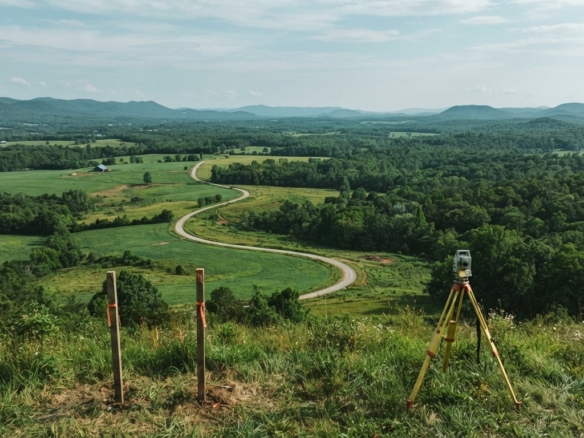
Never close on a parcel without a professional land survey. It’s the only way to know exactly where your boundaries sit. This prevents future legal battles with neighbors over fence lines or structures. If you are a first-time buyer, review our guide on how do you buy land to master the closing process. Understanding the pros and cons of unrestricted land gives you the upper hand in negotiations. You know the risks and you know the rewards. Use this checklist to move from browsing to owning. Your path to property freedom starts with a single, verified transaction. Browse current unrestricted listings today to find your perfect parcel.
Secure Your Property Freedom Today
You now have the tools to navigate the pros and cons of unrestricted land with total confidence. You know that true freedom requires a pragmatic balance between deed-level liberty and county-level regulation. By following a strict due diligence process, you can avoid the hidden hurdles of zoning and infrastructure costs. You are ready to stop paying monthly HOA fees and start building your own vision on your own schedule.
We offer a specialized marketplace for raw and off-grid land with national coverage. Our platform provides direct access to land owners and sellers across the country. You won’t find any hidden service fees for buyers here. This streamlined discovery process cuts through the traditional procedural hurdles that often delay your purchase. We focus on speed and transparency so you can secure your asset without unnecessary stress.
Find Your Perfect Unrestricted Lot on BuyVacantLand.com Today. Take the first step toward self-sufficiency and secure your slice of property freedom now. You have the knowledge to buy with absolute certainty.
Frequently Asked Questions
Can I live in an RV on unrestricted land?
You can usually live in an RV, but county health codes often override your deed freedom. While an unrestricted parcel has no HOA to fine you, the local government might require a permitted septic system for long-term stays. Some counties limit RV living to 30 or 60 days unless you are actively building a permanent home. Always verify these duration limits with the local planning department before you move in.
Does ‘unrestricted’ mean I don’t need a building permit?
You still need building permits for any permanent structure on unrestricted land. The term “unrestricted” only means you aren’t bound by private developer rules or HOA covenants. Public safety laws, fire codes, and state building requirements apply to every property in the country. Local inspectors must still approve your electrical, plumbing, and structural plans to ensure the building is safe for occupancy and meets legal standards.
Is it harder to get a loan for unrestricted land?
Financing is much more difficult for raw, unrestricted parcels than for developed lots. Most traditional lenders view these as high-risk assets and demand larger down payments. As of July 17, 2026, Country Bank requires a 40% down payment for raw land with interest rates near 8.25%. Because of these strict hurdles, many buyers choose owner financing or cash purchases to secure their land quickly without a bank.
How do I find out if a piece of land is truly unrestricted?
You find the truth by ordering a professional title report and contacting the county. The title report reveals any hidden deed restrictions or “covenants” from previous owners. After checking the deed, call the County Planning and Zoning department to confirm the current zoning classification. This two-step process is the only way to ensure the land is truly free from both private and public building limits.
Can I run a business from unrestricted property?
You can typically run a home-based business more easily on unrestricted property. Since there is no HOA to enforce commercial bans, you have the liberty to operate workshops, small farms, or storage services. For those building a business in the Savannah area, SavannahJobs.com is an excellent resource for recruiting local talent to help your enterprise thrive. However, you must still follow county zoning laws. Some zones allow small-scale agricultural sales but might block heavy industrial activity. Check the local “permitted uses” list to see what businesses the county allows on your lot.
What happens if my neighbor builds a nuisance on their unrestricted lot?
You have very little legal recourse if a neighbor builds something unsightly on their lot. This “aesthetic anarchy” is one of the most significant factors when weighing the pros and cons of unrestricted land. If your neighbor follows county health and building codes, they can operate loud businesses or store junk outdoors. You lose the neighborhood standards that an HOA provides, which can sometimes impact your long-term property appreciation.
Do I still have to pay property taxes on unrestricted land?
You must pay property taxes regardless of your land’s restricted or unrestricted status. These are mandatory government fees used to fund local services and infrastructure. As of April 1, 2026, New Jersey has the highest effective property tax rate at 2.23%. Hawaii offers the lowest rate at 0.28%. Your tax bill is based on the county’s assessed value of the land and any improvements you make to the property.
Is unrestricted land a good long-term investment?
Unrestricted land can be a strong long-term investment if you choose the right location. Its primary value lies in its flexibility for future buyers who want to build alternative homes or start small businesses. However, the lack of neighborhood rules makes it a higher-risk asset. You should focus on parcels with legal access and utility potential. These features ensure the land remains attractive to a wide range of future investors.



Join The Discussion