

Why are you paying a 5.7% commission to a traditional agent who treats your vacant land like a secondary thought? Holding raw property in 2026 is an expensive game of patience. Between rising property taxes and new federal reporting rules for all-cash transactions, your potential gains are constantly under threat. You likely feel the pressure of high holding costs and the frustration of trying to value an asset that most residential agents simply don’t understand. It’s time to stop waiting for passive appreciation and start taking control of your exit strategy.
This guide teaches you exactly how to sell land for profit by focusing on strategic value-adds and direct-to-buyer marketing. We’ll show you how to eliminate the friction of traditional real estate and execute a high-margin sale without the usual headaches. You’ll learn how to navigate 2026 capital gains tax rates, use seller financing to attract more buyers, and prepare your parcel for a fast, efficient closing. We’ve simplified the entire process into a clear plan that prioritizes your time and your bottom line. Get ready to turn your idle acreage into a liquid asset with total certainty.
Key Takeaways
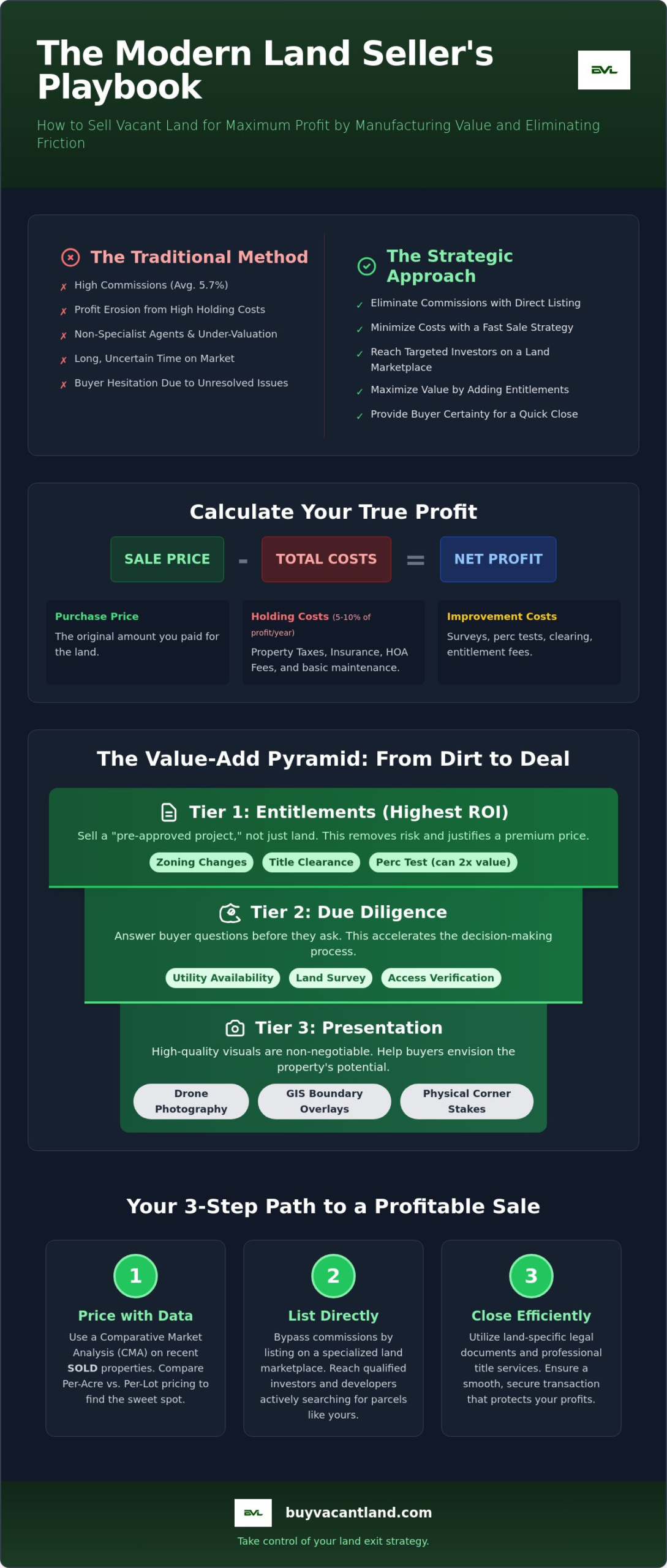
- Calculate your true profit by subtracting all holding costs and improvements from your final sale price.
- Discover how to sell land for profit by prioritizing property entitlements and title clearance over physical improvements.
- Select the right valuation model by comparing per-acre and per-lot pricing to maximize your property’s market worth.
- Eliminate expensive agent commissions by listing directly on a specialized land marketplace to reach targeted investors.
- Finalize your transaction efficiently using land-specific legal documents and professional title services to secure your gains.
The Fundamentals of Land Appreciation and Profitability
Profit in land investment is the result of deliberate math, not luck. It’s the net difference between your final sale price and the total sum of your purchase price, holding costs, and improvement expenses. If you want to master how to sell land for profit, you must treat every parcel as a financial instrument. Success requires tracking every dollar spent from the moment of acquisition to the final transfer of the deed.
The 2026 market offers two distinct paths for investors. “Buy and Hold” strategies work best in areas where supply is strictly capped by geography or zoning. “Buy and Flip” strategies are more aggressive. They rely on manufacturing value through entitlements or minor improvements. Both approaches require a firm grasp of Real estate appraisal to accurately benchmark your property against local comps. Watch for exit signals like a decrease in average days-on-market for nearby lots or a spike in commercial rezoning requests. These signals tell you the market is peaking and it’s time to liquidate.
Calculating Your True Holding Costs
Carrying costs are the silent killer of land investment profits. Every day you hold a property, your potential return diminishes. You must factor in property taxes, liability insurance premiums, and any necessary maintenance like weed abatement or fence repairs. A property that sits on the market for 12 months can easily lose 5 to 10 percent of its projected profit to these recurring expenses. Speed is your greatest ally in protecting your margins. Using a specialized listing platform to reach land-specific buyers reduces your time-on-market compared to traditional methods. The faster you move from listing to closing, the more capital you keep in your pocket. To offset these expenses while waiting for a buyer, owners of unique or scenic lots can generate interim revenue by listing their property on HolaPlace for private events.
Identifying Growth Corridors
Spotting the “path of progress” is the most reliable way to drive high-margin sales. You need to know where the local government is investing in infrastructure. New utility extensions, such as sewer lines or high-capacity electrical grids, often trigger immediate price surges for undeveloped land. Identify upcoming growth by monitoring municipal expansion plans and new highway exits. How to sell land for profit often comes down to timing your exit just as developers begin looking for their next project site. Position your lot in front of this expansion to capture maximum appreciation without ever lifting a shovel.
Strategic Value-Add: Increasing Market Worth Before the Sale
Manufacturing profit is more effective than waiting for it. Most owners leave money on the table because they sell “as-is” without removing buyer risk. If you want to know how to sell land for profit, start with entitlements. Changing a property’s “paper” status is often more lucrative than clearing the brush. A parcel with approved zoning for higher-density use is worth significantly more than raw acreage with undefined potential. You aren’t just selling dirt; you’re selling a pre-approved project.
Title issues kill deals. Resolve all liens, easements, or encumbrances before you list. A clean title report provides the certainty buyers need to move fast. You should also verify utility availability. Moving a property from “unimproved” to “utility-available” creates a massive value jump. Buyers pay a premium for properties where the hard work of permitting and infrastructure research is already done. For more guidance on this, check out these Proven Tips for Pricing, Preparing, and Closing. Once your land is prepped, you can list your vacant land for sale on a specialized marketplace to find the right investor quickly.
The ROI of Zoning and Perc Tests
Soil quality determines buildability. A successful perc test can double a lot’s value for residential buyers. It proves the land can support a septic system. Without it, your buyer faces an expensive gamble. Combine this with a rezoning effort to allow for more units or a change from agricultural to residential use. Providing a “ready-to-build” package eliminates the 6 to 12 month waiting period for the next owner. This convenience justifies a higher asking price and a faster closing.
Professional Photography and Boundary Marking
Visuals sell land. Drone photography is non-negotiable in 2026. Buyers want to see the topography, neighboring parcels, and access points from the air. Use GIS overlays to show exact property lines on your photos. This removes all guesswork. Physical markers matter too. Drive bright stakes into the property corners. It creates a psychological sense of ownership when a buyer walks the lot. High-quality visuals and clear boundaries prove you’re a professional seller who values the buyer’s time.
Pricing for Profit: Valuation Strategies for 2026
Accurate pricing is the difference between a closed deal and a stagnant listing. If you price too high, your property sits. If you price too low, you leave money on the table. Understanding how to sell land for profit requires a data-driven approach to valuation. You must perform a Comparative Market Analysis (CMA) that looks at sold prices, not just asking prices. Use marketplace data to find similar parcels sold within the last six months. Pay attention to the distinction between “Per-Acre” and “Per-Lot” pricing. Large agricultural tracts use per-acre rates, while residential lots in growth corridors are valued by their building potential. For more context on specific regional pricing, see our guide on how much is an acre of land.
Owner financing is a powerful lever for achieving a higher sale price. In 2026, land loan interest rates often range from 8% to 11%. By offering your own terms, you attract buyers who can’t secure traditional bank financing. This increased demand allows you to hold firm on a premium price. You aren’t just selling land; you’re providing the credit to buy it. This strategy often results in a higher total return than a cash sale, provided you vet your buyers carefully. For a broader look at the market, consult a guide to selling rural land to see how these strategies fit into a larger exit plan.
Appraisal Methods for Raw Land
Professional appraisals provide a formal valuation but come with a cost. The Sales Comparison Approach is the standard for most vacant land. It compares your lot to recent sales of similar size and utility. If the land is intended for commercial use, the Income Capitalization approach might be more appropriate. This method values the land based on its future income potential. Use marketplace data for initial pricing, but consider a professional appraiser if the parcel has unique zoning or high-value timber. This investment ensures you don’t undersell a complex asset.
Adjusting Price for Property Features
Every feature on your land has a dollar value. Road frontage and water access command significant premiums. Mature timber can also be a valuable secondary asset. Conversely, you must apply discounts for physical limitations. Steep terrain, protected wetlands, or restrictive utility easements reduce the buildable area and the final price. Create a pricing buffer for negotiations. Set your list price 5% to 10% above your “profit floor.” This gives you room to negotiate without cutting into your essential margins. Clear, documented adjustments build trust with buyers and justify your asking price during the closing process.
The Direct-to-Buyer Sales Process: Cutting Out Commissions
Stop wasting 6% to 10% of your equity on traditional real estate commissions. Most agents focus on residential homes with kitchens and bathrooms. They often treat vacant land as a secondary priority. When you list on the MLS, your property gets buried under thousands of single-family home listings. Learning how to sell land for profit means finding the specific stage where land buyers congregate. By selling direct, you eliminate the middleman and keep the full sale price in your pocket. This approach requires a proactive mindset and a platform built for undeveloped property.
Managing the sale yourself gives you total control over the narrative. You know the property’s potential better than any agent. You can speak directly to the value of the entitlements and improvements you’ve made. Vetting buyers becomes a simple process of requesting proof of funds before scheduling a site visit. This direct line of communication speeds up the transaction and removes the “telephone game” that often leads to misunderstandings and delayed closings. If you’re ready to bypass the traditional hurdles, you can list your land for sale on our specialized marketplace and connect with buyers immediately.
Listing on a Specialized Marketplace
Specialized platforms are designed to filter out “tire kickers.” These sites attract serious investors, developers, and off-grid enthusiasts who know exactly what they want. Your listing description must be punchy and benefit-driven. Don’t just list the acreage. Highlight the specific use cases, such as “perfect for a solar-ready homestead” or “pre-approved for a three-bedroom build.” Use high-intent keywords like “owner financing” or “off-grid” to catch the attention of specific buyer segments. Many investors are currently hunting for cheap land for sale to add to their 2026 portfolios. Positioning your property in this category ensures high visibility among active shoppers.
Marketing Your Land for Maximum Reach
Digital reach is your most powerful tool. Leverage social media groups dedicated to land homesteading and rural investment. These communities are filled with buyers who have already done their research and are ready to pull the trigger. Don’t ignore old-school methods either. A high-visibility sign on the property remains one of the most effective ways to capture local interest. Speed is your best friend in 2026. Respond to every lead within minutes, not days. Buyers move fast in a digital marketplace. A quick, professional response establishes trust and keeps the momentum moving toward a signed contract.
Closing the Deal and Securing Your Profit
Finalizing the sale is where your strategic preparation pays off. The Purchase and Sale Agreement (PSA) is your primary legal shield. It defines the price, the timeline, and the specific obligations of both parties. You don’t need a traditional agent to manage this paperwork. A competent title company or real estate attorney handles the heavy lifting of the closing process. They ensure the deed is recorded and the funds are distributed securely. This is how to sell land for profit without the friction of traditional brokerage hurdles. You maintain control of the transaction from the first signature to the final wire transfer.
Buyers will use the due diligence period to verify your claims. They’ll look at zoning, access, and soil quality. If you’ve followed the steps in previous sections, you’ve already mitigated these risks. In 2026, stay mindful of new Financial Crimes Enforcement Network (FinCEN) reporting rules. These rules require reporting for certain non-financed transactions involving entities like LLCs or trusts. Your title company will facilitate these disclosures to ensure full legal compliance. Their role as a neutral third party protects your equity and guarantees a clean title transfer for the buyer.
Streamlining Due Diligence
Speed is essential during the inspection phase. Prepare a “due diligence packet” before you even find a buyer. Include your most recent survey, tax bills, and any existing soil or perc test results. Providing this data upfront answers questions before they are asked and builds immediate trust. Set a firm timeline for inspections in the PSA. A 15 to 30 day window is standard for most vacant land deals. This prevents “deal creep” where a buyer stalls the closing while looking for better options. If a minor survey discrepancy appears, resolve it quickly with a signed affidavit or a small, calculated price adjustment to keep the deal on track.
The Final Handshake: Listing to Cash
Review your settlement statement line by line before the closing date. Verify that the numbers match your agreement exactly. You should see the full sale price minus prorated property taxes and standard closing fees. Since you sold direct, there will be no 5.7% commission draining your net return. Choose a wire transfer for your final payout to get the fastest access to your capital. Cashier’s checks are secure but often involve bank holding periods. Once the deed is recorded at the county office, the transaction is complete. Ready to exit your land position? List your vacant land on our national marketplace today.
Maximize Your Exit Potential
You now have the exact blueprint for a high-margin exit. Profit in 2026 isn’t just about waiting for the market to rise; it’s about manufacturing value through entitlements and choosing the right sales channel. By focusing on “paper” improvements and strategic pricing, you’ve mastered how to sell land for profit without the traditional real estate hurdles. You don’t need to sacrifice your equity to a middleman who doesn’t understand the unique value of undeveloped property. The path to a successful sale is direct, transparent, and focused on speed.
Take control of your transaction today. Avoid expensive commissions and connect directly with targeted investors who are ready to buy. Start your listing on BuyVacantLand.com and reach thousands of land buyers today. Our platform offers national exposure and a simple, direct-to-buyer process with zero hidden commissions. It’s the most efficient way to turn your acreage into liquid capital. Your land is a valuable asset. Stop paying holding costs and start realizing your gains with total certainty.
Frequently Asked Questions
Is it better to sell land for cash or offer owner financing?
Owner financing is often the superior strategy for maximizing your total return. In 2026, with land loan interest rates ranging from 8% to 11%, many buyers struggle to secure traditional bank financing. By acting as the lender, you can command a higher sale price and collect monthly interest. Cash sales are better if you need immediate liquidity, and working with a dedicated investor like The Local Cash Buyer can help you exit your real estate position quickly and efficiently.
How much does it cost to sell land without a real estate agent?
Selling land yourself eliminates the 5.7% national average commission. Your primary expenses include a listing fee on a specialized marketplace and standard closing costs like title insurance or attorney fees. You may also choose to pay for a professional survey or a perc test to increase buyer confidence. These upfront costs are significantly lower than the thousands of dollars lost to traditional agent commissions.
What is the fastest way to sell land for a profit in 2026?
The fastest way to move property is to list it on a specialized land marketplace with a “ready-to-build” packet. This packet should include a recent survey, a successful perc test, and confirmed utility access. Providing this data upfront removes the buyer’s risk and shortens the due diligence period. This is the most effective method for how to sell land for profit while minimizing your time on market.
Do I need a survey to sell my vacant land?
A survey isn’t always a legal requirement for listing, but it is a critical tool for closing. Most buyers and title companies will demand a clear definition of property boundaries and easements before the deed transfer. Investing in a survey upfront prevents last minute disputes and proves exactly what you are selling. It eliminates the guesswork that often causes buyers to walk away from a deal.
How is profit on land sales taxed?
Profit is taxed as capital gains based on how long you held the asset. In 2026, if you held the land for more than one year, you’ll pay long-term capital gains rates of 0%, 15%, or 20% depending on your taxable income. If you sell within one year, the profit is taxed as ordinary income at rates ranging from 10% to 37%. Always consult a tax professional to understand how state-level taxes and the 3.8% Net Investment Income Tax might apply.
What improvements add the most value to raw land?
Entitlements and “paper” improvements offer the highest return on investment. Securing a zoning change or obtaining a building permit can double the value of a parcel without moving a single shovel of dirt. Physical improvements like clearing brush or marking boundaries provide essential curb appeal. These steps are fundamental to how to sell land for profit because they transform raw acreage into a functional, low-risk asset for the next owner.
Can I sell land that has back taxes owed on it?
Yes, you can sell land with outstanding tax liens. The total amount of back taxes, including any interest or penalties, is typically deducted from your sale proceeds at closing. The title company handles the payment to the county to ensure the buyer receives a clear title. You don’t need to pay the taxes out of pocket before listing, provided there is enough equity in the sale to cover the debt.
How long does the average vacant land sale take to close?
A direct-to-buyer land sale typically closes within 30 to 60 days. This timeline depends on the buyer’s financing and the length of the due diligence period. Cash transactions move much faster because they bypass the lengthy bank appraisal and underwriting processes. Using a specialized marketplace ensures you reach buyers who understand land transactions, which prevents the delays common with traditional residential agents.




Join The Discussion