

Most traditional banks won’t touch raw land because it lacks the immediate collateral value of a finished home. If you’ve tried to secure a loan for a vacant lot, you already know the frustration of massive down payments and rigid commercial requirements. Understanding the pros and cons of owner financed land is the fastest way to bypass these hurdles without getting burned. It’s a pragmatic tool for buyers who want speed and sellers who want to move inventory without middleman fees.
We’ll give you a no-nonsense breakdown of bank-free land deals so you can master the mechanics of the 2026 market. This guide clarifies the legal risks, including the newest FinCEN reporting rules and interest rate trends that currently range from 6% to 12%. You’ll gain a clear framework to decide if a specific deal is fair or predatory. We’ll cover everything from equitable conversion to the “due-on-sale” clause. This information provides a faster, more certain path to land ownership while protecting your equity at every step.
Key Takeaways
- Understand how seller-carried notes eliminate the need for traditional bank underwriters and lengthy appraisal delays.
- Master the pros and cons of owner financed land to determine if a specific contract protects your equity or puts you at risk.
- Discover how sellers transform stagnant vacant parcels into reliable monthly income streams while expanding their pool of potential buyers.
- Identify the critical legal differences between a Land Contract and a Deed of Trust to ensure your path to ownership is secure.
- Learn how to efficiently navigate specialized marketplaces to filter for owner-financed terms and close your land deal faster.
Understanding Owner Financing in the Vacant Land Market
Traditional lenders view unimproved dirt as a high-risk asset. Since raw land doesn’t produce immediate rent or house a family, banks rarely offer standard mortgages for it. This gap in the market is why Seller financing has become the dominant method for moving acreage. In this arrangement, the person selling the land acts as the bank. You don’t deal with a corporate loan officer; you deal directly with the owner. It’s a pragmatic solution that keeps the market moving when traditional credit freezes up.
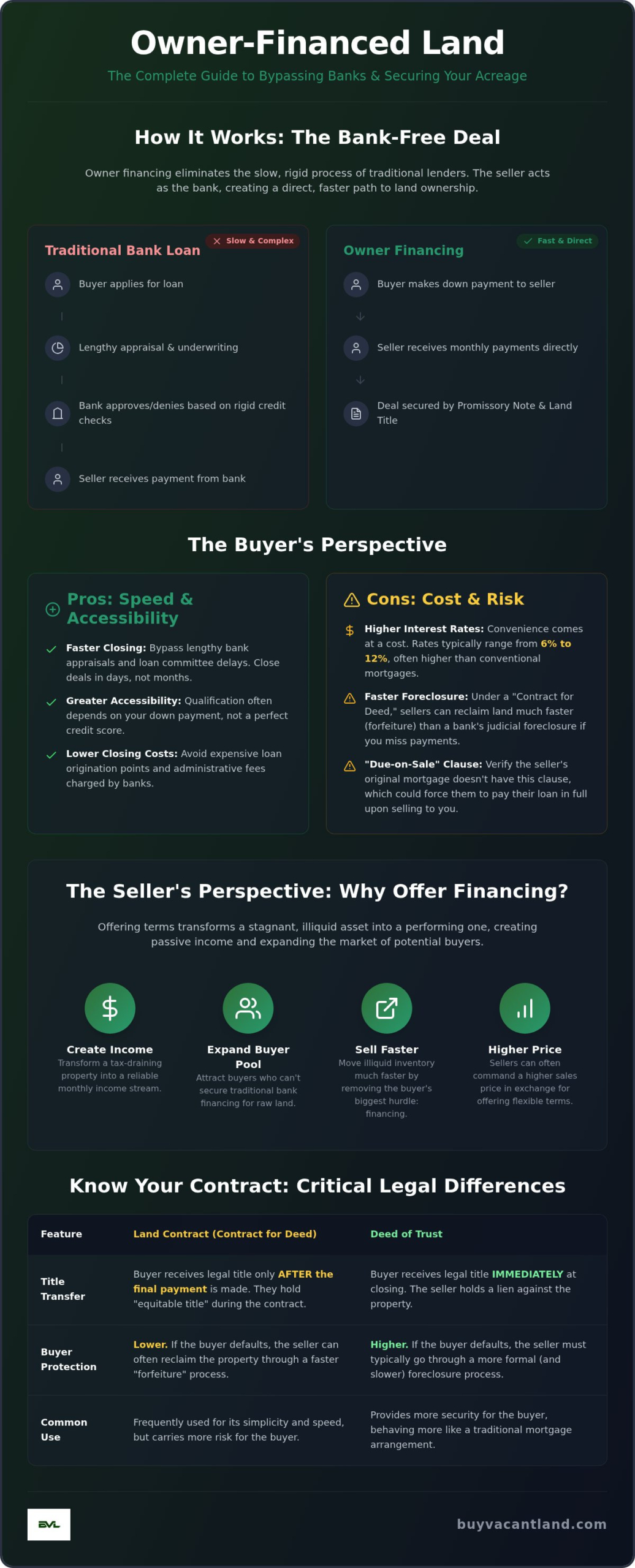
The process is straightforward. You provide a down payment and then pay monthly installments directly to the seller. The land itself serves as the collateral. If you stop paying, the seller takes the land back. This simplicity is one of the main factors when weighing the pros and cons of owner financed land. It removes the need for the massive down payments often required by commercial lenders and bypasses the rigid credit checks that stall traditional deals. You’re trading the complexity of a bank for a direct, person-to-person contract.
The Mechanics of a Bank-Free Land Deal
A bank-free deal relies on two main pillars: the promissory note and the security interest. The promissory note is the legal “I owe you” document. It outlines exactly how much you’re paying, the interest rate, and the payment schedule. Instead of a bank appraisal, the down payment serves as the seller’s protection. It proves you have skin in the game from day one. Throughout the payment term, the seller retains a security interest in the property. This means they have a legal claim to the dirt until you make that final payment. It’s a clean, efficient way to secure an asset without a middleman.
Common Terms: Amortization and Balloon Payments
Most land deals use an amortization schedule to calculate your monthly costs. This schedule breaks down how much of each payment goes toward the principal balance and how much covers interest. While a home mortgage might last 30 years, land deals are usually much shorter. Many sellers prefer a 5 or 10-year balloon payment to wrap up the transaction. A balloon payment is a large final sum due at the end of a shortened loan term. This structure keeps monthly payments affordable while ensuring the seller gets their full payout within a reasonable timeframe. It’s a critical element to understand when evaluating the pros and cons of owner financed land for your specific budget.
The Buyer’s Perspective: Pros and Cons of Seller-Carried Notes
Securing a loan for unimproved dirt is a hurdle most buyers can’t clear through a local bank. Traditional lenders rarely lend on off-grid or raw land because it lacks a structure to secure the debt. This reality makes the pros and cons of owner financed land a critical study for any serious land seeker. You’re effectively trading the rigid oversight of a bank for a flexible, direct agreement with the seller. This shift opens doors for buyers with non-traditional income or lower credit scores who still have the capital for a solid down payment.
Major Benefits: Speed and Accessibility
The elimination of the middleman results in unmatched speed. You don’t have to wait for a bank’s loan committee or a three-week appraisal window. Qualification usually hinges on the size of your down payment rather than a perfect credit history. Closing costs drop significantly because you skip loan origination points and administrative fees. If you want to master the broader details of how do you buy land, start by focusing on these high-speed, low-friction transactions. You can find these opportunities directly on a vacant land listing marketplace that specializes in seller terms.
Significant Risks: Costs and Foreclosure Speed
Convenience is expensive. Interest rates for owner-financed deals in 2026 generally range from 6% to 12%. This is often 2% to 6% above what you might pay for a primary residence mortgage. Understanding How Owner Financing Works is vital because the legal structure of your deal dictates your level of protection. In many “Contract for Deed” arrangements, the seller retains the legal title until the final payment. You only hold “equitable title” in the meantime. This distinction is dangerous. If you miss payments, the seller can often reclaim the land through a faster forfeiture process than a judicial foreclosure. Some state data shows default rates for land contracts reaching 35% to 50% within the first three years. Always verify that the seller’s original mortgage doesn’t have a “due-on-sale” clause that could trigger an immediate demand for full payment if they finance the sale to you.
The Seller’s Perspective: Why Offer Owner Financing for Raw Land?
Raw land is notoriously illiquid. It can sit on the market for years because most buyers don’t have tens of thousands in cash, and traditional banks won’t lend on unimproved dirt. By offering terms, you solve the buyer’s biggest problem. This strategy transforms a stagnant, tax-draining asset into a monthly stream of passive income. Sellers must weigh the pros and cons of owner financed land before committing to a long-term note, especially since you become the primary lender for the transaction.
Forbes explains owner financing as a way for sellers to secure a higher sales price in exchange for this flexibility. You’re providing a service that banks refuse to offer. In return, you can often demand a premium price and a solid interest rate. This approach bypasses the typical “cash only” barrier that keeps most land parcels from selling quickly. You get a down payment immediately and a steady check every month without the hassle of property management or rental repairs.
Advantages: Faster Sales and Interest Income
Offering terms makes your listing stand out on a vacant land marketplace. You aren’t just selling dirt; you’re selling an accessible financial path to ownership. This attracts a wider pool of buyers, from off-grid enthusiasts to small-scale developers who need to preserve their cash flow. Sellers also benefit from interest income that typically exceeds standard savings accounts. As of early 2026, many land notes carry rates between 6% and 12%. If you want to sell land quickly, providing a path to ownership without bank interference is your most effective tool.
Disadvantages: Management and Default Risks
Being the bank comes with administrative burdens. You must track monthly payments, manage the principal balance, and issue 1098-INT forms at year-end. New FinCEN regulations effective March 1, 2026, also require specific “Real Estate Reports” for certain seller-financed transfers to legal entities. The biggest drawback is the risk of default. If a buyer stops paying, you don’t get a lump sum to walk away with. You might face legal costs to regain possession through forfeiture or foreclosure. Your capital remains tied up in the land for years. This lack of immediate liquidity is the primary trade-off for the higher interest rates you collect.
Navigating the Legal Framework: Contracts and Deeds
The legal document you sign dictates who actually owns the dirt during your payment term. If you don’t understand the difference between holding a deed and holding a contract, you’re at risk. This legal distinction is the most overlooked part of the pros and cons of owner financed land. Every agreement must explicitly state the timeline for title transfer and the exact consequences of a late or missed payment. Clarity here prevents a simple administrative error from turning into a total loss of your equity.
Land Contracts vs. Deeds of Trust
In a Land Contract, also known as a “Contract for Deed,” the seller keeps the legal title in their name until you make the final payment. You only hold “equitable title,” which gives you the right to use the land but offers limited protection. If you default, the seller can often use a process called forfeiture. This allows them to reclaim the property quickly without a full court proceeding. It’s a high-risk structure for buyers because you’re essentially a tenant until the loan is satisfied.
A Deed of Trust combined with a Promissory Note is the gold standard for buyer protection. In this scenario, you receive the legal title at the closing table. A neutral third party, the trustee, holds a lien against the property as security for the seller. If you miss payments, the seller must follow formal foreclosure laws. This process is slower and provides you with more legal avenues to catch up on payments or protect your investment. It ensures the transaction mirrors a traditional bank loan’s safety levels.
Essential Clauses for a Safe Transaction
Protect your capital by insisting on specific protective clauses. First, ensure there’s a “No Prepayment Penalty” clause. You should have the right to pay off the balance early to save on interest costs without being penalized. Second, verify the “Due-on-Sale” status. If the seller has an underlying mortgage, their lender might have the right to demand full payment if the property is sold. You must confirm the land is owned “free and clear” or that the seller’s lender has approved the financing arrangement. Finally, always require a professional title search. This identifies hidden tax liens, old judgments, or utility easements that could make the land unusable. Before signing any legal paperwork, verify the property details on a professional marketplace to ensure the seller has the legal right to offer terms.
How to Find and Close Owner Financed Land Deals Today
Finding land with seller terms requires a different strategy than buying a suburban home. You won’t find these deals on standard residential listing sites. You need a specialized platform that caters specifically to raw and undeveloped parcels. This is where you can weigh the pros and cons of owner financed land by comparing actual terms side-by-side. Focus on listings that explicitly offer “seller terms” to save time and avoid dead-end negotiations with owners who only want a cash payout.
Searching the National Land Marketplace
Use BuyVacantLand.com to find listings where sellers are already open to financing. This marketplace removes the guesswork from your search. Look for keywords like “low down payment” or “no credit check” in listing descriptions. These markers indicate a seller who is ready to move the property quickly and bypass traditional credit hurdles. For specific search tips and advanced filtering techniques, refer to our guide on owner financed land.
Before you commit to a monthly payment, verify the zoning and property taxes. Call the county planning department directly. Ensure the land can actually be used for your intended purpose, whether that is an off-grid cabin or a small farm. Unpaid property taxes are a major risk in seller-financed deals. If the seller hasn’t paid the taxes, you could lose the land to a tax sale regardless of your payment history. This due diligence is the only way to ensure the pros of the deal outweigh the potential legal cons.
Finalizing the Deal Safely
Running the numbers is your most important task before closing. Ensure the monthly payment and the final balloon sum are sustainable for your long-term budget. Once the terms are agreed upon, hire a third-party title company or a real estate attorney to handle the closing process. They will ensure the title is clear and the documents are legally binding in your state. This step is non-negotiable for protecting your investment from hidden liens or ownership disputes.
Always record the contract or deed with the local county office immediately after signing. This provides public notice of your interest in the property and prevents the seller from selling the same lot to another party. Use a third-party payment servicer to track your installments. This creates a neutral, accurate record of every dollar paid toward your principal balance. Never hand over a down payment without a signed, notarized contract in your possession.
Secure Your Land Investment Today
Mastering the mechanics of bank-free deals allows you to move from searching to owning faster. You now understand the pros and cons of owner financed land, from the speed of closing to the legal risks of specific contract structures. Use this framework to vet every note and protect your equity. Successful land ownership in 2026 requires moving past traditional bank hurdles with a clear, pragmatic strategy. Don’t let rigid commercial lenders stall your progress when direct-to-seller options are readily available.
Our national marketplace connects you directly with sellers who offer flexible terms on every type of acreage. We focus exclusively on vacant land listings. This ensures you don’t waste time sifting through houses or rentals to find your off-grid retreat or industrial lot. You can Browse Owner Financed Land Listings on BuyVacantLand.com today to find a deal that fits your budget. This is the fastest, most reliable path to securing your property without the stress of traditional financing. Take control of your asset ownership and start your search now.
Frequently Asked Questions
Is owner financing safe for buyers with bad credit?
Yes, owner financing is a legitimate path for buyers with non-traditional credit profiles. Sellers usually prioritize the down payment and your ability to make monthly payments over a perfect credit score. You must review the interest rate and default clauses carefully to ensure the terms are fair. This method bypasses rigid bank standards but requires you to be certain about your long-term budget and ability to handle a final balloon payment.
Do I get the deed to the land immediately with owner financing?
The timing of the deed transfer depends on the legal structure of your specific deal. In a Deed of Trust, you typically receive the legal title at the closing table while a trustee holds a lien. In a Land Contract, the seller keeps the deed until you make the final payment. Understanding these pros and cons of owner financed land is vital for protecting your legal rights to the property.
What happens if I miss a payment on owner financed land?
Missing a payment can trigger a forfeiture or foreclosure process depending on your contract. In a Land Contract, the seller can often reclaim the land quickly and keep all your previous payments. A Deed of Trust offers more buyer protection but still leads to a formal foreclosure if you don’t cure the default. Always review the “grace period” and “late fee” clauses in your promissory note before you sign any paperwork.
Are interest rates higher for owner financed land than bank loans?
Yes, interest rates are generally 2% to 6% higher than conventional bank mortgage rates. Sellers charge this premium to offset the risk of lending without a traditional bank’s oversight. As of 2026, interest rates for raw land notes typically range from 6% to 12%. You’re paying for the convenience of a fast closing and the ability to skip the extensive documentation required by commercial lenders.
Can I build a house on land that is owner financed?
You can usually build if the contract allows it and you obtain the necessary county permits. Some sellers include clauses that require their written consent before you start major construction or land clearing. You must follow all local zoning laws and building codes regardless of the financing method. Be aware that building on land where you don’t yet hold the legal title adds significant risk to your total investment.
Do I need a lawyer for a seller-financed land deal?
Hiring a real estate lawyer or a title company is highly recommended to protect your interests. They verify that the title is clear and ensure the contract is recorded with the county. A professional review prevents you from signing predatory agreements or inheriting hidden liens. The small upfront cost of legal advice provides peace of mind and ensures your path to ownership is legally sound and enforceable.
Can I pay off an owner-financed land loan early?
Most owner-financed deals allow early payoff unless your contract includes a specific prepayment penalty. You should verify that your agreement includes a “No Prepayment Penalty” provision before closing. Paying off the balance early can save you thousands in interest costs over the life of the loan. Always request a written payoff statement from the seller and a recorded release of lien once you send the final lump sum.
Who pays property taxes on owner-financed land?
The buyer is typically responsible for property taxes once the contract is signed and they take possession. The agreement should state whether you pay the county directly or if the seller collects taxes as part of your monthly payment. Evaluating the pros and cons of owner financed land includes checking for existing tax liens before you buy. Failing to pay taxes can lead to a county tax sale and the loss of the property.




Join The Discussion